
Christ’s Messages to the Seven Churches and Their Relevance for Anglican Faith Today
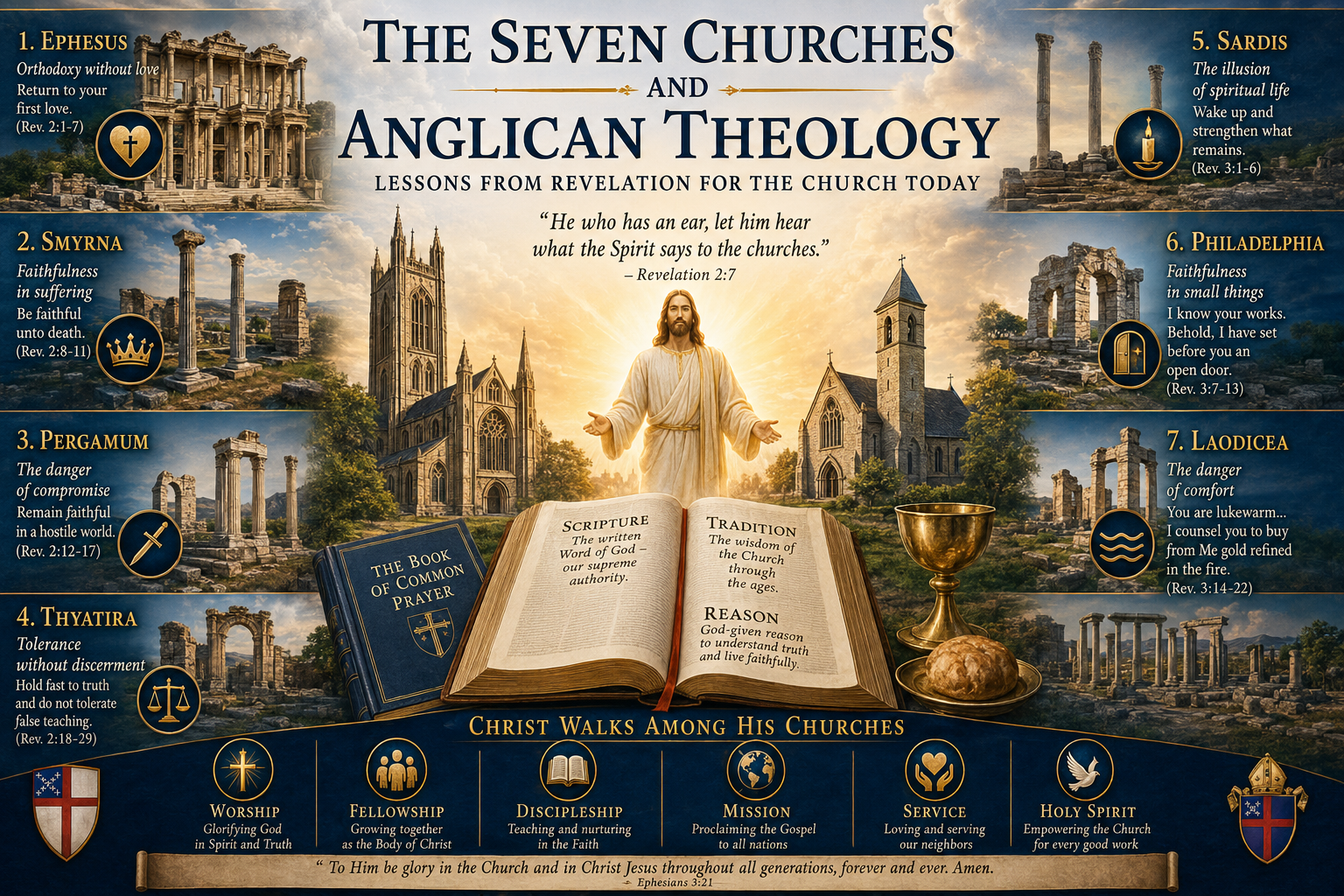
What the Churches of Revelation Teach Modern Anglicans About Faithfulness, Worship, and Mission
Introduction
The Book of Revelation contains seven remarkable messages from the risen Christ to seven churches located in the Roman province of Asia. Revelation chapters two and three recorded these messages, which were addressed to real Christian communities facing real challenges during the first century. Yet Christians throughout history have recognised that Christ’s words extend far beyond their original audience.
The seven churches—Ephesus, Smyrna, Pergamum, Thyatira, Sardis, Philadelphia, and Laodicea—represent enduring spiritual conditions that continue to appear throughout Christian history. They reveal both the strengths and weaknesses of the Church. They demonstrate how believers can remain faithful amid persecution, prosperity, false teaching, spiritual complacency, and cultural pressure.
For Anglicans, the messages to the seven churches carry particular significance. Anglican theology seeks to balance faithfulness to Scripture, continuity with Christian tradition, and engagement with the contemporary world. The seven churches provide a powerful lens through which modern Anglicans can evaluate their worship, doctrine, mission, and spiritual vitality.
This article explores how each of the seven churches offers lessons for Anglican theology and what Christ might say to the Anglican Communion today.
The Anglican Commitment to Listening to Scripture
Before examining the individual churches, it is important to recognise that Anglican theology begins with Scripture.
The Anglican tradition has historically affirmed that Holy Scripture contains all things necessary for salvation. The Thirty-Nine Articles place Scripture at the centre of Christian doctrine and practice. The Book of Common Prayer immerses believers in biblical language and biblical worship.
Because of this commitment, the messages to the seven churches are not merely historical curiosities. They are living words addressed to the Church in every generation.
Repeatedly Christ declares the following:
“He who has an ear, let him hear what the Spirit says to the churches.”
The challenge remains the same today.
Will the Church listen?
Ephesus: Orthodoxy Without Love
The church at Ephesus possessed many admirable qualities.
Christ commended their
Hard work
Perseverance
Discernment
Doctrinal vigilance
They rejected false teachers and remained committed to truth.
Yet Christ identified a serious problem.
“You have forsaken the love you had at first.”
Ephesus reminds Anglicans that correct doctrine alone is insufficient.
Anglicanism has long valued theological scholarship, careful biblical interpretation, and doctrinal precision. These are important gifts. Yet theology without love eventually becomes cold.
Churches may defend truth faithfully while gradually losing passion for Christ.
The lesson of Ephesus is clear:
Orthodoxy must always be accompanied by devotion.
The Church is called not merely to know about Christ but to love Him.
Smyrna: Faithfulness in Suffering
Unlike most of the seven churches, Smyrna received no rebuke.
Instead, Christ encouraged believers facing persecution.
They experienced:
Poverty
Opposition
Slander
Fear
Yet Christ reminded them:
“Be faithful unto death, and I will give you the crown of life.”
Throughout Anglican history many believers have suffered for their faith.
From the English Reformers to modern Christians facing persecution around the world, Smyrna reminds the Church that faithfulness often requires courage.
Many Anglican provinces today operate in regions where Christians face hostility and violence.
Smyrna teaches that success is not measured by comfort but by faithfulness.
Pergamum: The Danger of Compromise
Pergamum lived where Christ described it as:
“Where Satan’s throne is.”
The believers remained loyal to Christ despite intense cultural pressure.
Yet some tolerated false teaching and compromise.
Pergamum speaks directly to modern churches navigating secular culture.
Every generation faces pressure to conform.
The Anglican Communion frequently engages complex social, political, and ethical issues. Such engagement is necessary.
However, engagement must not become compromise.
The lesson of Pergamum is that the Church can remain present in culture without surrendering biblical conviction.
Faithfulness requires both wisdom and courage.
Thyatira: Tolerance Without Discernment
The church at Thyatira was known for the following:
Love
Faith
Service
Perseverance
Yet Christ rebuked them for tolerating destructive teaching.
Their problem was not lack of compassion.
Their problem was lack of discernment.
This issue remains a challenge for the modern Church.
Anglican theology values generosity, dialogue, and openness.
These are strengths.
Yet genuine love never requires abandoning truth.
Thyatira reminds Anglicans that compassion and discernment must work together.
The Church is called to welcome people while remaining faithful to God’s Word.
Sardis: The Illusion of Spiritual Life
Perhaps no message is more sobering than Christ’s words to Sardis.
“You have a reputation of being alive, but you are dead.”
Sardis possessed an impressive reputation.
Externally everything appeared successful.
Internally spiritual vitality was fading.
The warning applies to every Christian tradition.
Churches may possess:
Historic buildings
Rich traditions
Educational institutions
Public influence
Yet none of these guarantee spiritual life.
Anglicanism possesses a remarkable heritage.
The challenge is ensuring that heritage remains spiritually alive.
Sardis reminds believers that reputation can never substitute for renewal.
Philadelphia: Faithfulness in Small Things
Philadelphia received only encouragement.
Christ praised their faithfulness despite limited strength.
They were neither powerful nor influential.
Yet they remained obedient.
Many Anglican congregations resemble Philadelphia.
They may be:
Small
Rural
Aging
Overlooked
Yet God often works powerfully through faithful communities.
Philadelphia teaches that success in God’s kingdom is not measured by size but by obedience.
The Church is called to remain faithful regardless of worldly recognition.
Laodicea: The Danger of Comfort
Laodicea provides perhaps the most famous warning in Revelation.
The church was neither hot nor cold.
It was lukewarm.
Material prosperity had produced spiritual complacency.
Christ declared:
“You say, ‘I am rich; I have acquired wealth and do not need a thing.’”
Laodicea speaks powerfully to churches in affluent societies.
Modern Christians often face temptations not of persecution but of comfort.
The danger is subtle.
Material success can create spiritual self-sufficiency.
The message to Laodicea reminds Anglicans that true wealth is found in Christ rather than possessions, institutions, or influence.
The Seven Churches and Anglican Worship
One striking theme throughout Revelation is worship.
The churches constantly direct themselves toward the glory of God and the lordship of Christ.
This emphasis resonates deeply with Anglican tradition.
The Book of Common Prayer, the Eucharist, the liturgical year, and the daily offices all direct believers toward worship.
The seven churches remind Anglicans that worship must remain the following:
Christ-centered
Spirit-filled
Biblically grounded
Worship becomes empty when disconnected from obedience.
True worship transforms lives.
The Seven Churches and Anglican Mission
The churches of Revelation also reveal the church’s missionary calling.
Each congregation existed as a witness within its city.
The same remains true today.
The Anglican Communion serves across the following:
Africa
Asia
Europe
Oceania
North America
South America
The Church exists not merely for itself but for God’s mission in the world.
The seven churches remind believers that witness matters.
Christ continually evaluates His Church according to its faithfulness.
What Might Christ Say to Anglicanism Today:
No one can speak for Christ with certainty.
Yet the seven churches provide important questions.
Would Christ praise Anglican commitment to Scripture, worship, education, and mission?
Certainly.
Would Christ encourage Anglican believers suffering persecution around the world?
Without question.
Would Christ also challenge complacency, compromise, or declining spiritual vitality where they exist?
Perhaps.
The messages to the seven churches invite continual self-examination.
Every generation must ask:
Have we lost our first love?
Are we remaining faithful under pressure?
Are we compromising with culture?
Are we spiritually alive?
Are we lukewarm?
These questions remain as relevant today as they were in the first century.
Conclusion
The seven churches of Revelation offer timeless lessons for Anglican theology.
They remind the Church that faithfulness involves more than correct doctrine, beautiful worship, or historic tradition.
Faithfulness requires love, perseverance, courage, discernment, spiritual vitality, obedience, and wholehearted devotion to Christ.
The Anglican tradition possesses extraordinary gifts.
Its commitment to Scripture, worship, theology, and mission has enriched Christianity for centuries.
Yet the messages to the seven churches remind all Christians that Christ continually calls His Church to renewal.
The risen Lord still walks among His churches.
He still encourages.
He still corrects.
He still calls believers to faithfulness.
And He still declares:
“He who has an ear, let him hear what the Spirit says to the churches.”
For Anglicans and all Christians, that invitation remains as urgent today as it was nearly two thousand years ago.
Dr Daniel J. Grace
Faith • Civilization • Theology
Research • Journalism • Truth
🌐 danieljamesgrace.com
© 2026 Dr Daniel J. Grace. All Rights Reserved.
No part of this article may be reproduced, distributed, transmitted, or published in any form or by any means without prior written permission from the author, except for brief quotations used in academic citation, review, or research purposes.
Leave a Reply