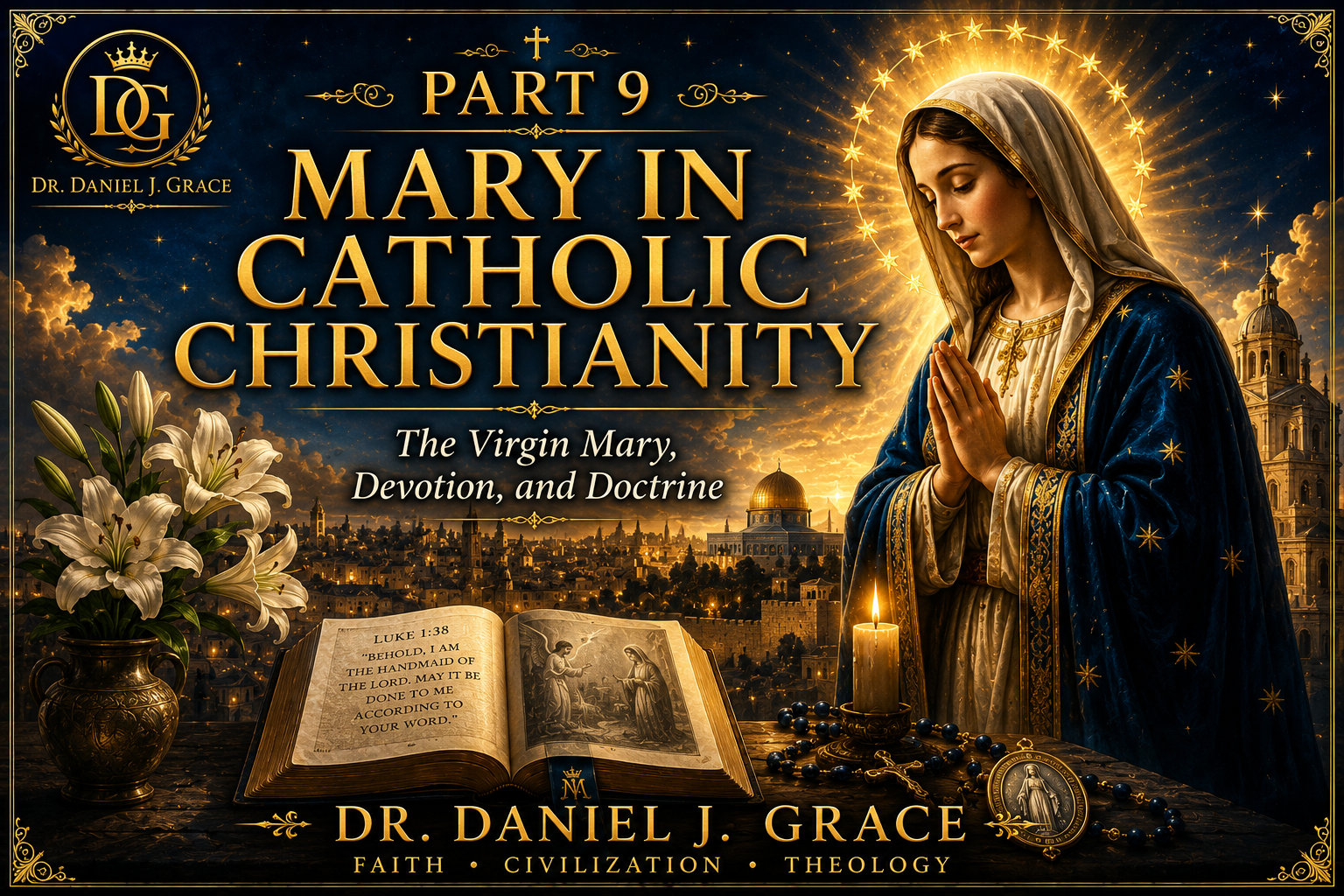
The Virgin Mary, Devotion, and Doctrine
Introduction
Few figures in Christian history have inspired as much devotion, admiration, theological reflection, and discussion as Mary, the mother of Jesus Christ. For Catholics, Mary occupies a unique place in salvation history. She is honoured as the Mother of God, the first disciple of Christ, a model of faith and obedience, and a spiritual mother to believers.
At the same time, Mary is often one of the most misunderstood aspects of Catholic Christianity. Some Christians wonder whether Catholics worship Mary. Others question the biblical basis for Marian doctrines and devotions. Throughout history, discussions about Mary have generated both profound devotion and significant controversy.
For Catholics, however, Mary’s importance is inseparable from Jesus Christ. Catholic teaching insists that every authentic Marian doctrine ultimately points toward Christ. Mary is not the centre of Christianity; Christ is. Yet, because God chose Mary to play a unique role in the Incarnation, Catholics believe she deserves a special place of honour in the life of the Church.
This chapter explores Mary’s role in Scripture, the development of Marian doctrine, the meaning of Catholic devotion, the major Marian teachings of the Church, and Mary’s continuing significance in Catholic spirituality today.
Mary in the Story of Salvation
Mary first appears in the Gospel accounts as a young Jewish woman living in Nazareth.
At first glance, she seems an unlikely candidate for a role that would change human history.
She was not wealthy.
She was not politically influential.
She did not belong to a powerful family.
Yet throughout Scripture, God frequently chooses humble individuals to accomplish extraordinary purposes.
Mary became one of the greatest examples of this divine pattern.
The Annunciation
One of the most important events in Mary’s life is the Annunciation.
According to the Gospel of Luke, the angel Gabriel appeared to Mary with a remarkable message.
She had been chosen by God to bear the Messiah.
Gabriel declared:
“Hail, full of grace, the Lord is with you.”
Mary was understandably troubled and confused.
She asked how such a thing could happen.
The angel explained that the Holy Spirit would come upon her.
The child she would bear would be called the Son of God.
Mary responded with one of the most significant acts of faith in human history:
“Let it be to me according to your word.”
This response reveals the heart of Mary’s character.
Faith.
Trust.
Obedience.
Humility.
Her willingness to accept God’s plan made her a central figure in salvation history.
Mary as the New Eve
Early Christian writers often compared Mary to Eve.
The comparison became one of the most important themes in Catholic theology.
According to the Book of Genesis, Eve participated in humanity’s fall through disobedience.
Mary, by contrast, cooperated with God’s plan through obedience.
Where Eve said no to God, Mary said yes.
Where Eve’s actions contributed to humanity’s fall, Mary’s obedience helped open the way for redemption through Christ.
This comparison does not place Mary on the same level as Christ.
Rather, it highlights her unique role within God’s plan of salvation.
Mary and the Incarnation
The doctrine of the Incarnation teaches that God became human in Jesus Christ.
Mary’s role in this mystery is essential.
Without Mary, there is no Bethlehem.
Without Bethlehem, there is no Incarnation.
Without the Incarnation, there is no Cross or Resurrection.
Catholic theology therefore regards Mary as intimately connected to the central events of Christian salvation.
Her importance derives entirely from her relationship to Christ.
The Visitation
Following the Annunciation, Mary visited her relative Elizabeth.
This event, known as the Visitation, reveals further aspects of Mary’s faith.
When Mary arrived, Elizabeth recognised God’s work within her.
Elizabeth declared:
“Blessed are you among women.”
Mary responded with a hymn known as the Magnificat.
The Magnificat remains one of the most beautiful prayers in Christian tradition.
It celebrates:
God’s mercy
God’s justice
God’s faithfulness
God’s concern for the humble
The prayer demonstrates Mary’s deep knowledge of Scripture and profound trust in God.
Mary at Bethlehem
The birth of Jesus at Bethlehem remains one of Christianity’s most beloved stories.
Mary gave birth under humble circumstances.
She laid the infant Jesus in a manger.
She witnessed the arrival of shepherds and later the visit of the Magi.
The events surrounding Christ’s birth reveal Mary’s willingness to embrace both uncertainty and trust.
Catholics often view Bethlehem as an example of Mary’s humility and dependence upon God.
Mary During Jesus’ Ministry
The Gospels mention Mary at several key moments during Jesus’ public ministry.
One significant event occurred at Cana.
The Wedding at Cana
The Wedding at Cana contains Mary’s final recorded words in Scripture.
When the wedding hosts ran out of wine, Mary brought the problem to Jesus.
She then instructed the servants:
“Do whatever he tells you.”
These words beautifully summarise Mary’s role in Catholic spirituality.
She directs attention toward Christ.
She encourages obedience to Him.
She points believers to Jesus rather than herself.
At Cana, Jesus performed His first recorded miracle.
The event highlights Mary’s faith and her confidence in Christ.
Mary at the Cross
One of the most powerful scenes in the New Testament occurs at Calvary.
As Jesus suffered on the Cross, Mary remained present.
Many disciples fled.
Mary stayed.
The Gospel of John records Jesus entrusting Mary to the beloved disciple.
Many Catholics see this moment as symbolically extending Mary’s spiritual motherhood to all believers.
Mary shared in Christ’s suffering as a mother witnessing the death of her son.
Her presence at the Cross remains a powerful symbol of faithfulness and perseverance.
Mary and the Early Church
After Christ’s resurrection and ascension, Mary appears among the believers gathered in prayer.
She was present during the days leading to Pentecost.
This final biblical appearance places Mary within the life of the early Church.
She is not portrayed as its leader.
Rather, she appears as a faithful disciple praying alongside other believers.
This image remains important within Catholic understanding.
Mary is both mother and disciple.
Mary as Mother of God
One of the most important Catholic teachings concerning Mary is the title ‘
Mother of God
This doctrine was formally affirmed at the Council of Ephesus in AD 431.
The title often causes confusion.
Catholics do not mean that Mary created God.
Nor do they suggest that Mary existed before God.
Instead, the title protects the truth about Jesus.
Jesus is both fully God and fully human.
Mary was birthing Jesus.
Therefore, the person she bore is God incarnate.
Calling Mary “Mother of God” emphasises Christ’s divine identity.
The doctrine is ultimately about Jesus rather than Mary alone.
The Perpetual Virginity of Mary
Catholic tradition teaches that Mary remained a virgin before, during, and after Christ’s birth.
This teaching became widespread in early Christianity.
Supporters view Mary’s lifelong virginity as a sign of her unique dedication to God’s mission.
Not all Christian traditions accept this doctrine.
Nevertheless, it remains an important element of Catholic teaching.
The Immaculate Conception
One of the most misunderstood Marian doctrines is the Immaculate Conception.
Many people mistakenly assume it refers to Jesus’ conception.
In reality, it concerns Mary.
The doctrine teaches that Mary was preserved from original sin from the first moment of her existence.
The Catholic Church formally defined this teaching in 1854.
Catholics believe this grace came entirely through Christ’s saving work.
Mary did not save herself.
She was redeemed by Christ in a unique way.
The doctrine emphasises God’s preparation of Mary for her role as the mother of Jesus.
The Assumption of Mary
Another important Marian doctrine is the Assumption.
The Church teaches that Mary was taken into heavenly glory at the end of her earthly life.
The doctrine was formally defined in 1950.
Unlike Christ’s Ascension, which occurred through His own divine power, the Assumption is understood as an act of God’s grace toward Mary.
The Assumption reflects Catholic hope in the resurrection and the ultimate destiny of God’s people.
Mary as Spiritual Mother
Catholics often refer to Mary as the spiritual mother of believers.
This idea emerges from her role within salvation history and her presence at the Cross.
The title does not replace Christ’s unique role as saviour.
Rather, it reflects Mary’s maternal concern for those who follow Jesus.
Many Catholics experience comfort in viewing Mary as a spiritual mother who encourages them in faith.
Marian Devotion
Catholic devotion to Mary takes many forms.
These include:
Prayer
Feasts
Pilgrimages
Hymns
Rosaries
Marian shrines
Such practices seek to honour Mary’s role in God’s plan.
Importantly, Catholic theology distinguishes between worship and veneration.
Worship and Veneration
A common misunderstanding is that Catholics worship Mary.
Official Catholic teaching rejects this idea.
Worship belongs to God alone.
Catholics distinguish between the following:
Worship (Latria)
Given only to God.
Veneration (Dulia)
Honour is given to saints.
Special Honor (Hyperdulia)
A unique form of honour is given to Mary because of her role in salvation history.
This distinction is essential for understanding Catholic devotion.
The Rosary
The Rosary is perhaps the best-known Marian devotion.
It combines prayer and meditation on events from the lives of Jesus and Mary.
The mysteries of the Rosary focus on the following:
Christ’s birth
Christ’s ministry
Christ’s suffering
Christ’s resurrection
The Rosary, therefore, remains deeply Christ-centred despite its Marian character.
Millions of Catholics pray the Rosary regularly.
Marian Apparitions
Throughout history, reports of Marian apparitions have emerged.
Examples include:
Lourdes
Fatima
Guadalupe
The Church investigates such claims carefully.
Even when approved, belief in apparitions is not required for Catholics.
Public revelation ended with Christ and the apostles.
Private revelations may encourage faith but do not add new doctrine.
Mary in Catholic Art
Mary has inspired countless works of art.
Paintings.
Sculptures.
Icons.
Cathedrals.
Music.
Literature.
Artists throughout history have portrayed Mary as:
Mother
Disciple
Queen
Intercessor
Marian imagery remains a major part of Christian artistic heritage.
Mary and Christian Unity
Mary remains an area of both agreement and disagreement among Christians.
Most Christians affirm the following:
Mary’s faith
Mary’s obedience
Mary’s role as the mother of Jesus
Differences emerge regarding doctrines such as:
Immaculate Conception
Assumption
Marian intercession
Modern ecumenical dialogue seeks greater understanding of these differences.
Protestant Perspectives
Many Protestants deeply respect Mary while rejecting certain Catholic teachings.
Most Protestants affirm the following:
The Virgin Birth
Mary’s faithfulness
Her importance in salvation history
However, many reject doctrines developed after the Reformation.
Despite disagreements, Mary remains a respected biblical figure throughout Christianity.
Orthodox Perspectives
Eastern Orthodox Christians hold Mary in very high honour.
They frequently refer to her as the following:
Theotokos — God-bearer.
Orthodox devotion often resembles Catholic devotion in many respects.
However, certain theological formulations differ.
Nevertheless, Mary occupies a prominent place within Orthodox spirituality.
Mary’s Relevance Today
Modern Christians can still learn much from Mary.
Her life demonstrates the following:
Faith
Humility
Courage
Obedience
Perseverance
In a culture that often values power and self-promotion, Mary’s example points toward trust in God.
Her words continue to challenge believers:
“Let it be to me according to your word.”
Lessons from Mary
Mary teaches Christians:
Trust God
Even when the future is uncertain.
Remain Humble
God often works through the humble.
Stay Faithful
Remain close to Christ during suffering.
Serve Others
Mary’s first response after the Annunciation was service to Elizabeth.
Point to Christ
Like Mary at Cana, believers should direct attention toward Jesus.
Conclusion
Mary occupies a unique place within Catholic Christianity because of her relationship to Jesus Christ.
She is honoured as the Mother of God, a model disciple, a witness of faith, and a spiritual mother to believers.
Catholic devotion to Mary seeks not to replace Christ but to lead believers closer to Him.
Throughout history Mary has inspired prayer, worship, art, theology, and spiritual reflection.
Her life continues to remind Christians that God’s greatest works often begin with simple faith and humble obedience.
In Part 10, we will explore The Saints and Christian Witness: Examples of Faith Throughout History, examining how holy men and women have shaped Catholic spirituality and Christian civilisation over the centuries.
Dr Daniel J. Grace
Faith • Civilization • Theology
Research • Journalism • Truth
© 2026 Dr Daniel J. Grace. All Rights Reserved.
No part of this article may be reproduced, distributed, transmitted, or published in any form or by any means without prior written permission from the author, except for brief quotations used in academic citation, review, or research purposes.
Leave a Reply