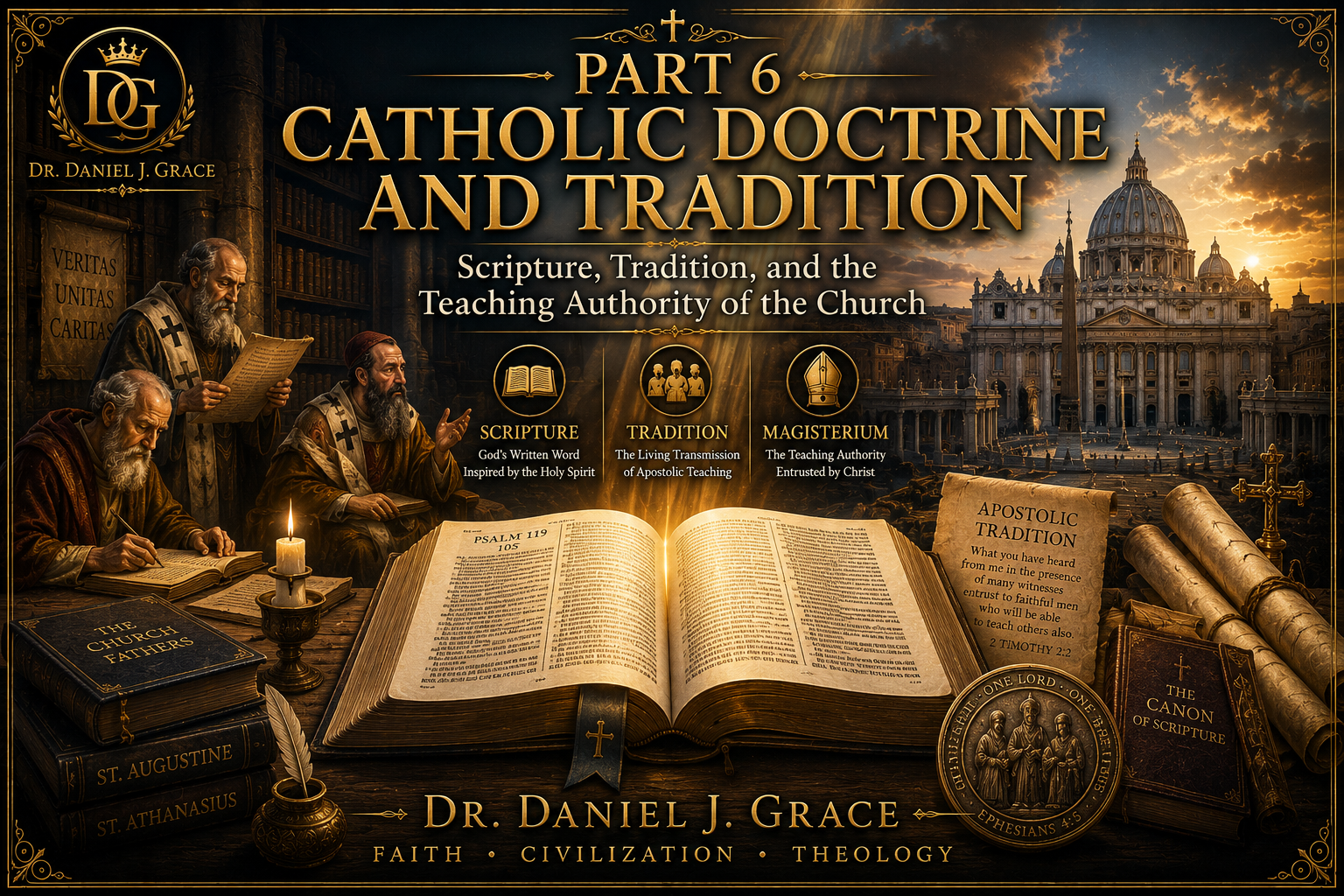
Scripture, Tradition, and the Teaching Authority of the Church
Introduction
One of the most important questions in Christianity concerns authority.
How do Christians know what to believe?
Where does Christian teaching come from?
How is truth preserved from one generation to another?
Catholic Christianity answers these questions through three closely connected realities:
Sacred Scripture
Sacred Tradition
The Teaching Authority of the Church (Magisterium)
Catholics do not see these as competing sources of authority. Rather, they believe these three work together under the guidance of the Holy Spirit to preserve and transmit the faith entrusted by Christ to the apostles.
This understanding distinguishes Catholic Christianity from many Protestant traditions, which often emphasise Scripture alone (Sola Scriptura). Catholics believe that God’s revelation comes through both Scripture and Apostolic Tradition, interpreted authentically within the life of the Church.
Understanding this relationship is essential for understanding Catholic doctrine, worship, the sacraments, and Church life.
What Is Doctrine?
The word ‘doctrine’ simply means ‘teaching’.
Christian doctrine refers to beliefs that the Church holds concerning God, salvation, Jesus Christ, the Holy Spirit, humanity, and the Christian life.
Not all doctrines have equal importance.
Some doctrines are foundational.
Examples include:
The Trinity
The divinity of Christ
The resurrection of Jesus
Salvation through Christ
Without these teachings, Christianity would cease to be what it is.
Other doctrines concern church practice, worship, discipline, or theological reflection.
The purpose of doctrine is not merely intellectual.
Doctrine exists to help believers know God more fully and live faithfully.
Divine Revelation
Catholics believe that all Christian truth begins with God’s revelation.
Human beings cannot fully discover God through reason alone.
God must reveal Himself.
The Bible presents revelation as God’s initiative.
God revealed Himself through:
Creation
The prophets
Israel’s history
Jesus Christ
According to Catholic teaching, Jesus Christ is the fullness of divine revelation.
Everything Christians need for salvation ultimately comes from Him.
The task of the Church is not to invent new revelation but to faithfully preserve and transmit what God has already revealed.
Sacred Scripture
The Bible occupies a central place in Catholic Christianity.
Catholics believe Scripture is inspired by God.
The Church teaches that human authors wrote under the guidance of the Holy Spirit.
As a result, Scripture communicates God’s truth faithfully.
The Bible contains:
Old Testament
The history, worship, wisdom, and prophetic writings of Israel.
New Testament
The life of Jesus, the apostles, and the early Church.
Together they form the written Word of God.
Catholics read Scripture in worship, personal devotion, theological study, and prayer.
The Bible remains the foundation of Christian faith.
The Formation of the Biblical Canon
An important historical question arises:
How did Christians know which books belong in the Bible?
The Bible did not fall from heaven as a complete volume.
The books were written over many centuries.
Various writings circulated among Christian communities.
The Church gradually recognised which books were genuinely apostolic and inspired.
Councils and church leaders helped identify the canon.
This process highlights an important Catholic argument:
The Church existed before the New Testament canon was formally established.
The Church helped to recognise and preserve the Scriptures.
For Catholics,this passage demonstratess the close relationship between Scripture and the Church.
What Is Sacred Tradition?
Many people misunderstand how Catholics use the word “Tradition”.
Tradition does not simply mean customs or habits.
‘Sacred Tradition’ refers to the apostolic faith that has been handed down through the Church.
Before the New Testament was completed, the apostles preached, taught, baptised, and established churches.
Much of this teaching was transmitted orally.
The Apostle Paul refers to traditions that believers received through preaching and instruction.
Catholics believe that this apostolic deposit of faith continues within the life of the Church.
Tradition preserves teachings received from the apostles and transmitted across generations.
Scripture and Tradition Together
Catholics do not place Tradition above Scripture.
Nor do they place Scripture above Tradition.
Instead, they view them as interconnected.
Scripture emerged from the life of the apostolic Church.
Tradition helped preserve and interpret Scripture.
Both originate from the same divine source.
The Second Vatican Council described Scripture and Tradition as forming one sacred deposit of faith.
This understanding remains central to Catholic theology.
Examples of Apostolic Tradition
Several aspects of Christian life developed through the combined witness of Scripture and Tradition.
Examples include:
The doctrine of the Trinity
The structure of bishops, priests, and deacons
The recognition of the biblical canon
Liturgical worship practices
Certain formulations of Christology
The foundations of these teachings are found in Scripture, but the Church has developed them more fully through its reflection on apostolic faith.
The Teaching Authority of the Church
The third element is the Magisterium.
The word comes from a Latin term that means “teaching office”.
The Magisterium refers to the authority entrusted to the bishops in communion with the pope.
Its purpose is to:
Teach the faith
Defend doctrine
Interpret Scripture
Preserve unity
Catholics believe this authority originates in Christ’s commission to the apostles.
The Church does not create truth.
Its role is to serve, preserve, and explain the truth already revealed by God.
The Role of the Pope
Within Catholic teaching, the pope serves as the visible sign of unity in the Church.
As Bishop of Rome and successor of Peter, he possesses special responsibilities.
These include:
Teaching
Encouraging unity
Preserving doctrine
Guiding the Church
The Pope does not stand above Scripture.
Nor does he possess unlimited authority.
His role is understood within the context of the Church’s broader teaching mission.
The Role of Bishops
Bishops are considered successors of the apostles.
Together they share responsibility for teaching and shepherding the Church.
Throughout history, bishops have done the following:
Preserved doctrine
Defended orthodoxy
Guided local churches
Participated in councils
The collective witness of bishops has played an important role in maintaining continuity within Catholic Christianity.
The Ecumenical Councils and Doctrine
The Ecumenical Councils demonstrate how Scripture, Tradition, and the Magisterium work together.
At Nicaea, Constantinople, Ephesus, and Chalcedon, bishops gathered to address theological controversies.
They examined Scripture.
They considered apostolic tradition.
They sought guidance from the Holy Spirit.
Their decisions helped define essential Christian doctrines.
Catholics view these councils as examples of the Church exercising its teaching authority.
The Development of Doctrine
One common misunderstanding concerns doctrinal development.
Catholics do not believe that doctrine changes into something entirely new.
Rather, they believe doctrine develops through more profound understanding.
An acorn becomes an oak tree.
The tree is larger and more developed, yet it remains the same living reality.
Similarly, the Church’s understanding of revealed truth grows over time.
This process is known as the development of doctrine.
The truth itself does not change.
Understanding becomes clearer.
The Trinity as an Example
The word “Trinity” does not appear in the Bible.
Yet the doctrine is deeply rooted in Scripture.
Early Christians reflected on biblical teachings concerning the following:the following:
The Father
The Son
The Holy Spirit
Through centuries of reflection and council discussions, the Church clarified the doctrine.
This illustrates how doctrine develops through Scripture, Tradition, and the teaching authority of the Church.
Faith and Reason
Catholic Christianity places profound value on reason.
Faith and reason are viewed as complementary rather than contradictory.
Catholics believe:
Truth cannot contradict truth.
Science and faith can coexist.
Reason helps clarify doctrine.
Theology involves careful intellectual reflection.
This perspective contributed to the development of universities, scholarship, and theological study throughout Christian history.
The Church Fathers
The writings of the Church Fathers hold profound importance within Catholic tradition.
Figures such as:
Ignatius of Antioch
Irenaeus
Athanasius
Augustine
Gregory the Great
John Chrysostom
helped explain and defend Christian doctrine.
Their writings provide valuable insight into how early Christians understood their faith.
Catholics frequently appeal to the Fathers as witnesses to apostolic Tradition.
The Importance of Creeds
Creeds serve as summaries of Christian belief.
The most famous include the following:
Apostles’ Creed
A concise statement of faith.
Nicene Creed
A more detailed doctrinal summary.
Creeds help preserve doctrinal unity and provide a common framework for Christian belief.
Catholics continue reciting these creeds in worship today.
Scripture in Catholic Worship
Catholic worship is deeply biblical.
Every Mass includes:
Old Testament readings
Psalms
New Testament readings
Gospel readings
Over time, Catholics hear large portions of Scripture proclaimed publicly.
The Eucharistic prayers also contain numerous biblical themes and references.
Contrary to common stereotypes, Catholic worship is saturated with Scripture.
The Protestant Reformation and Authority
The Protestant Reformation raised important questions concerning authority.
Many reformers emphasised the principle of Sola Scriptura.
They argued that Scripture alone should serve as the final authority.
Catholics responded that Scripture must be understood within the living Tradition of the Church.
This debate remains one of the most significant differences between Catholic and Protestant theology.
Despite disagreements, both traditions affirm the inspiration and importance of Scripture.
Vatican II and Revelation
The Second Vatican Council provided important teaching regarding revelation.
Its document, Dei Verbum, emphasised:
The importance of Scripture
The value of Tradition
The role of the Magisterium
The council encouraged Catholics to engage more deeply with the Bible while maintaining continuity with apostolic tradition.
This balanced approach remains influential today.
The Catechism of the Catholic Church
One important modern resource is the Catechism of the Catholic Church.
Published in 1992, it provides a comprehensive summary of Catholic doctrine.
The Catechism addresses the following:
Faith
Sacraments
Moral teaching
Prayer
It serves as a valuable guide for understanding Catholic belief.
Challenges in the Modern World
Modern society presents new questions.
Topics such as:
Technology
Bioethics
Artificial intelligence
Human dignity
Globalization
require thoughtful Christian responses.
The Church seeks to apply timeless principles to contemporary challenges.
This approach demonstrates the ongoing importance of doctrine and teaching authority.
Strengths of the Catholic Approach
Catholics identify several strengths in their understanding of authority.
Continuity
Connection with the apostolic Church.
Unity
Common doctrine across cultures and centuries.
Stability
Protection against constantly changing interpretations.
Historical Depth
Engagement with two thousand years of Christian reflection.
Balance
Integration of scripture, tradition, and reason.
Common Criticisms
Some Christians criticise the Catholic approach.
Common concerns include:
Fear of elevating Tradition above Scripture.
Concerns regarding centralised authority.
Questions about doctrinal development.
Catholics respond that Scripture, Tradition, and the Magisterium are intended to serve one another rather than compete.
These discussions remain important within ecumenical dialogue.
The Purpose of Doctrine
Ultimately, doctrine is not an end in itself.
The goal of doctrine is the following:
To know Christ.
To worship God faithfully.
To live holy lives.
To proclaim the Gospel.
To grow in love.
Correct doctrine serves discipleship.
Truth and holiness belong together.
The purpose of theology is transformation, not merely information.
Catholic Doctrine and Christian Unity
Despite differences among Christian traditions, many essential doctrines are shared.
Catholics, Orthodox Christians, Anglicans, and most Protestants affirm:
The Trinity
The divinity of Christ
The resurrection
Salvation through Christ
These shared beliefs provide a foundation for dialogue and cooperation.
Catholics continue praying for greater unity among Christians.
Lessons for Christians Today
Modern believers can learn several lessons.
Love Scripture
The Bible remains central.
Respect History
The Church’s past contains valuable wisdom.
Seek Truth
Faith involves both heart and mind.
Value Community
Christianity is lived within the Church.
Remain Faithful
The apostolic faith continues across generations.
Conclusion
Catholic doctrine rests upon a profound understanding of divine revelation.
Through Sacred Scripture, Sacred Tradition, and the teaching authority of the Church, Catholics believe that they have faithfully preserved and transmitted the apostolic faith throughout history.
These three realities work together to guide believers toward Christ, protect essential truths, and preserve Christian unity.
The goal is not merely correct information but faithful discipleship and deeper communion with God.
In the next chapter, we will explore The Seven Sacraments: Their Meaning and Role in Catholic Life, examining how Catholics encounter God’s grace through the sacramental life of the Church.
Dr Daniel J. Grace
Faith • Civilization • Theology
Research • Journalism • Truth
© 2026 Dr Daniel J. Grace. All Rights Reserved.
No part of this article may be reproduced, distributed, transmitted, or published in any form or by any means without prior written permission from the author, except for brief quotations used in academic citation, review, or research purposes.
Leave a Reply