
Peter’s Role in Scripture and Church History
Introduction
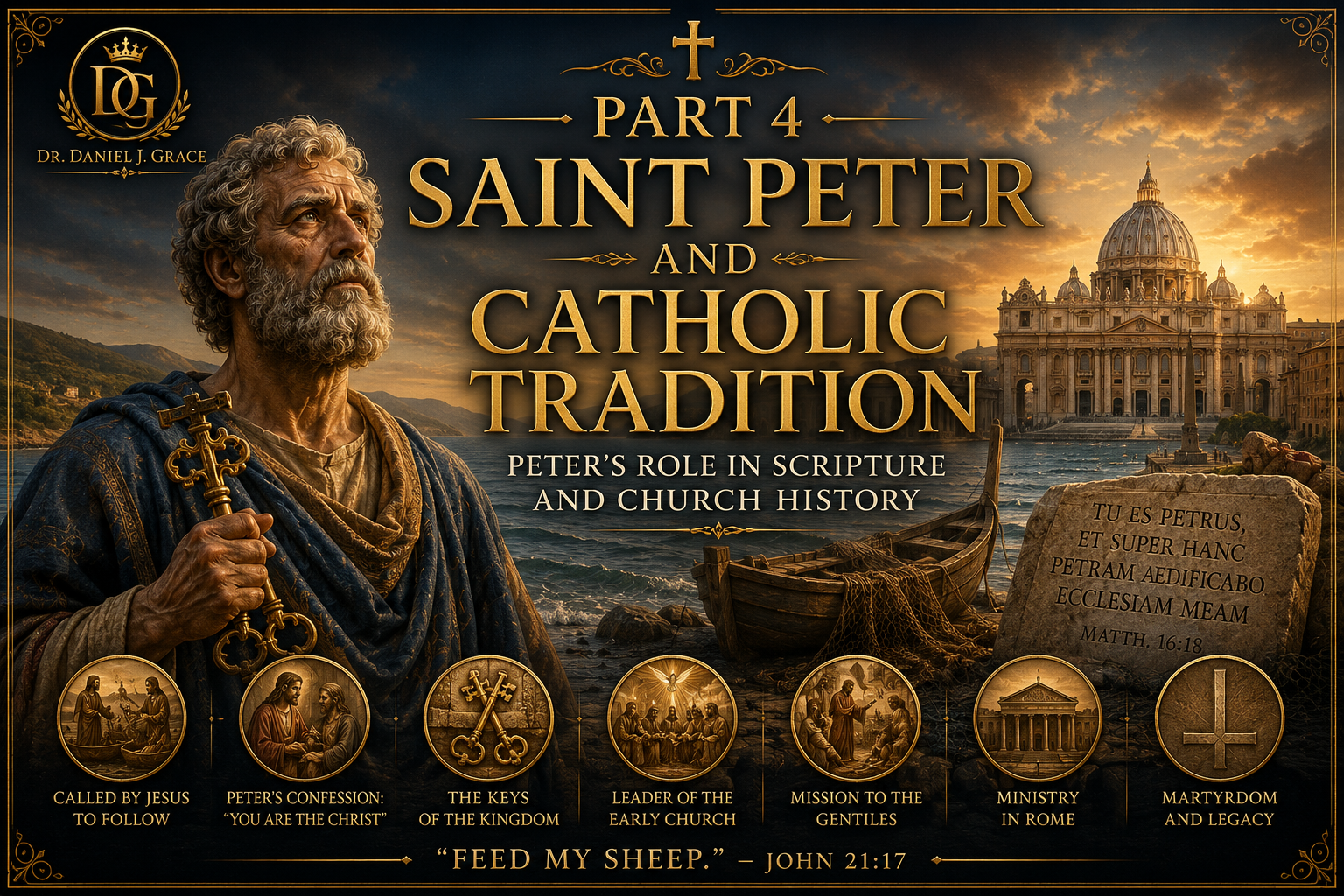
Among all the figures in Christian history outside of Jesus Christ Himself, few have exercised as much influence as Saint Peter. Fisherman, disciple, apostle, missionary, martyr, and ultimately a symbol of Christian leadership, Peter occupies a central place within Catholic Christianity.
For Catholics, Peter is more than simply one of the Twelve Apostles. He is considered the apostles’ leader, the first bishop of Rome, and the popes’ spiritual predecessor. His life provides the foundation for Catholic teaching concerning apostolic leadership, church unity, and the development of the papacy.
Yet Peter’s significance extends beyond Catholicism. Orthodox Christians honour him as one of the greatest apostles. Protestants admire his faith, courage, and witness. Throughout the Christian world, Peter remains one of the most respected figures in the history of the Church.
What makes Peter remarkable is not perfection but transformation. He was impulsive, sometimes fearful, occasionally mistaken, and often misunderstood. Yet through God’s grace, he became one of Christianity’s most influential leaders.
His story is a story of God’s ability to use imperfect people for extraordinary purposes.
Peter Before Meeting Jesus
Peter was originally known as Simon.
He was born into a Jewish family in Galilee and worked as a fisherman.
Fishing was demanding work that required physical strength, patience, endurance, and practical skill.
Simon worked alongside his brother Andrew and was likely involved in a family fishing business.
The Sea of Galilee was the centre of Simon’s world.
Nothing suggests that Simon expected to become one of the most influential religious figures in history.
He was an ordinary man, leading an ordinary life.
Yet God often chooses ordinary people to accomplish extraordinary purposes.
The Call of Peter
According to the Gospels, Simon’s life changed dramatically when he encountered Jesus.
One day Jesus approached Simon and Andrew while they were fishing.
Jesus spoke simple but life-changing words:
“Follow me, and I will make you fishers of men.”
The invitation required faith.
Leaving fishing meant leaving security, income, and familiarity.
Yet Simon responded immediately.
This moment marked the beginning of a journey that would transform both Peter and the future of Christianity.
Catholic tradition often emphasises this event as an example of discipleship.
Peter’s willingness to leave everything behind demonstrates the radical commitment required of those who follow Christ.
The Meaning of Peter’s New Name
One of the most significant moments in Simon’s life occurred when Jesus gave him a new name.
The name Peter comes from the Greek word Petros, which means “rock”.
In biblical tradition, name changes often signify divine purpose.
Abram became Abraham.
Jacob became Israel.
Simon became Peter.
The new name indicated a future role in God’s plan.
Catholics regard this name change as highly significant because it points toward Peter’s future leadership within the Church.
The symbolism of the rock would later become central to Catholic understanding of Peter’s ministry.
Peter Among the Twelve Apostles
The Gospels consistently portray Peter as occupying a prominent position among the apostles.
His name appears first in apostolic lists.
He often speaks on behalf of the group.
He participates in key events.
He asks questions others hesitate to ask.
His personality emerges vividly throughout the Gospel narratives.
Peter is bold.
Peter is passionate.
Peter is impulsive.
Peter is deeply devoted to Jesus.
These characteristics made him both effective and vulnerable.
Scripture openly displays his strengths and weaknesses.
Unlike legendary heroes whose flaws are hidden, Peter’s failures are recorded alongside his successes.
This honesty strengthens the credibility of the Gospel accounts.
Walking on Water
One of the most famous stories involving Peter occurs during a storm on the Sea of Galilee.
Seeing Jesus walking upon the water, Peter boldly asks permission to come to Him.
Jesus invites him.
Peter steps out of the boat.
For a brief moment, he walks upon the water.
Then fear overtakes him.
He begins to sink.
Jesus reaches out and saves him.
This event illustrates much about Peter’s character.
He possessed remarkable courage.
Yet he also struggled with doubt.
Many Christians see themselves in Peter.
They desire faith yet sometimes become overwhelmed by fear.
Peter’s experience reminds believers that Christ remains faithful even when human faith falters.
Peter’s Confession of Faith
One of the most important events in Peter’s life occurred at Caesarea Philippi.
Jesus asked His disciples,
“Who do people say that I am?”
Various answers were offered.
Then Jesus asked:
“Who do you say that I am?”
Peter responded:
“You are the Christ, the Son of the living God.”
This declaration represents one of the clearest statements of faith in the New Testament.
Jesus praised Peter and declared that this insight came from God.
For Catholics, this moment carries profound significance because Jesus immediately follows it with his famous words regarding Peter and the Church.
The Rock and the Keys
Following Peter’s confession, Jesus declared:
“You are Peter, and upon this rock I will build my Church.”
Jesus also spoke of giving Peter the keys of the kingdom.
These verses have been discussed extensively throughout Christian history.
Catholics interpret them as evidence that Peter received a unique leadership role among the apostles.
The imagery of keys suggests authority and responsibility.
The imagery of the rock suggests stability and foundation.
These passages became central to later Catholic understanding of Petrine leadership and the papacy.
Other Christian traditions interpret these verses differently, but all acknowledge their importance.
Peter’s Human Weakness
One reason Peter remains relatable is that Scripture does not hide his failures.
Shortly after receiving praise from Jesus, Peter attempted to discourage Jesus from speaking about His coming suffering.
Jesus strongly corrected him.
Peter often misunderstood Christ’s mission.
His expectations reflected common hopes for a political Messiah rather than a suffering Saviour.
His mistakes remind readers that spiritual leadership does not require perfection.
Even exceptional leaders require growth, correction, and grace.
The Transfiguration
Peter was among the three disciples chosen to witness the Transfiguration.
Alongside James and John, he saw Jesus revealed in glory.
Moses and Elijah appeared.
A heavenly voice declared:
“This is my beloved Son.”
The event profoundly affected Peter.
Years later he would reference it in his writings as evidence of Christ’s divine majesty.
The Transfiguration reinforced Peter’s conviction regarding Jesus’ identity.
Peter at the Last Supper
Peter played a significant role during the final days before Jesus’ crucifixion.
At the Last Supper he demonstrated both loyalty and overconfidence.
When Jesus predicted that the disciples would fall away, Peter insisted that he would remain faithful.
He boldly declared:
“Even if all fall away, I never will.”
Yet Jesus predicted that Peter would deny Him three times before morning.
Peter could not imagine such failure.
Nevertheless, the prediction would soon come true.
Peter’s Denial
Peter’s denial remains one of the most heartbreaking episodes in the New Testament.
After Jesus was arrested, Peter followed him at a distance.
As suspicion grew, people began to recognise him as one of Jesus’ followers.
Three times Peter denied knowing Christ.
Then the rooster crowed.
Peter remembered Jesus’ words.
Overwhelmed with grief, he wept bitterly.
The story demonstrates human weakness in its most painful form.
Yet it also prepares readers for one of Scripture’s greatest stories of restoration.
Peter’s Restoration
Following the resurrection, Jesus appeared to His disciples.
One particularly significant encounter occurred beside the Sea of Galilee.
Three times Jesus asked Peter the following:
“Do you love me?”
Three times Peter affirmed his love.
Three times Jesus commissioned him:
“Feed my sheep.”
Many Christians view this conversation as Peter’s restoration after his three denials.
For Catholics, the passage also highlights Peter’s pastoral responsibility within the Church.
Jesus not only forgave Peter but entrusted him with leadership.
The restoration demonstrates grace, forgiveness, and renewed calling.
Peter at Pentecost
The fearful disciple who denied Jesus became a courageous witness after Pentecost.
Filled with the Holy Spirit, Peter publicly proclaimed the Gospel.
Thousands responded.
The Church began to grow rapidly.
Peter emerged as a leading figure in the early Christian movement.
His transformation was remarkable.
The man who once feared a servant girl now boldly preached before crowds.
The difference was not human determination alone.
It was the work of God’s Spirit.
Peter in the Book of Acts
The early chapters of Acts place Peter at the centre of events.
He performs miracles.
He preaches sermons.
He confronts opposition.
He helps guide the Church through difficult decisions.
Peter’s leadership is evident throughout these narratives.
He is not portrayed as a dictator but as a servant leader working alongside the other apostles.
His influence is substantial yet exercised within the context of a wider apostolic community.
Peter and the Gentiles
One of Peter’s most important contributions involved the inclusion of Gentiles.
Early Christians initially struggled with questions regarding non-Jewish converts.
Through a vision from God and his encounter with Cornelius, Peter came to understand that the Gospel was intended for all nations.
This realisation transformed the Christian mission.
The Church would no longer be limited to one ethnic group.
Peter’s experience helped shape Christianity’s universal identity.
Catholics often view this event as an example of God’s guidance within the life of the Church.
Peter and Paul
The relationship between Peter and Paul remains fascinating.
Both men were influential leaders.
Both played major roles in Christian expansion.
Yet they possessed different personalities and ministries.
At times they disagreed.
Paul records a confrontation with Peter regarding conduct toward Gentile believers.
The disagreement demonstrates that early Christian leaders could experience conflict.
Yet it also shows their shared commitment to truth.
Despite differences, Peter and Paul ultimately served the same Gospel.
Both are honoured as foundational figures in the Catholic tradition.
Peter’s Journey to Rome
Ancient Christian tradition consistently associates Peter with Rome.
Although the New Testament does not describe every detail, early Christian writers affirm Peter’s ministry in the imperial capital.
Rome presented both opportunity and danger.
It was the centre of imperial power.
It was also a place where Christians increasingly faced persecution.
Peter’s decision to minister there reflected courage and commitment.
His presence helped establish Rome’s importance within Christianity.
The Martyrdom of Peter
According to ancient tradition, Peter was martyred during the persecution under Emperor Nero around AD 64–67.
Christian tradition holds that Peter was crucified.
One famous tradition states that Peter requested crucifixion upside down because he felt unworthy to die in the same manner as Jesus.
Whether every detail can be historically verified, there is strong evidence that Peter died as a martyr in Rome.
His death profoundly influenced Christian memory.
Peter’s witness became a symbol of faithfulness unto death.
Peter’s Tomb
For centuries Christians have venerated the traditional site of Peter’s burial.
Saint Peter’s Basilica in Vatican City stands above this location.
Archaeological investigations conducted during the twentieth century uncovered evidence consistent with ancient traditions regarding Peter’s tomb.
Scholars continue to discuss various details, but the discoveries have bolstered confidence in the long-held belief that Peter was buried in Rome.
The site remains one of Christianity’s most important pilgrimage destinations.
Peter in the Early Church Fathers
The earliest Christian writers frequently referenced Peter.
Clement of Rome.
Ignatius of Antioch.
Irenaeus of Lyons.
Tertullian.
Origen.
Augustine.
Many Church Fathers spoke of Peter’s faith, ministry, and martyrdom.
Their writings reveal how highly early Christians regarded Peter.
They also provide important evidence regarding the development of traditions associated with Peter and Rome.
Peter and Apostolic Succession
Catholic theology connects Peter closely with the concept of apostolic succession.
The Church teaches that apostolic ministry continues through bishops.
Just as the apostles appointed successors, bishops continue their mission throughout history.
The Bishop of Rome is regarded as Peter’s successor.
This succession provides continuity between the apostolic era and the modern Church.
For Catholics, this continuity represents an important safeguard for unity and doctrine.
Peter in Catholic Theology
Within Catholic theology, Peter symbolises a number of important realities.
Unity
Peter serves as a visible sign of Christian unity.
Leadership
Peter represents pastoral responsibility.
Mission
Peter demonstrates a commitment to evangelisation.
Faith
Peter’s confession remains foundational.
Grace
Peter’s restoration illustrates God’s forgiveness.
These themes continue to shape Catholic understanding of the Church.
Orthodox and Protestant Perspectives
Other Christian traditions honour Peter, but they differ regarding certain conclusions.
Orthodox Christians recognise Peter’s importance and often refer to him as the first among the apostles.
However, they do not accept all Catholic claims concerning papal authority.
Protestants likewise honour Peter as a major apostolic figure, but they frequently interpret passages concerning him differently.
Despite disagreements, Peter remains respected across Christian traditions.
His life continues to inspire believers worldwide.
Peter as a Model of Leadership
Peter offers important lessons regarding leadership.
He was courageous but humble.
He made mistakes but learned from them.
He experienced failure but found restoration.
He possessed authority but served others.
These qualities remain relevant for Christian leaders today.
Peter’s example reminds believers that leadership involves both responsibility and dependence upon God’s grace.
Lessons for Modern Christians
Peter’s life teaches numerous lessons.
Faith requires action.
Failure does not define us.
God’s grace can restore broken lives.
Courage grows through reliance on God.
Leadership is service.
Unity matters.
The Gospel is for all people.
These lessons explain why Peter continues to speak powerfully to modern Christians.
Conclusion
Saint Peter occupies a unique place in Christian history.
From humble fisherman to apostle, from failure to restoration, from disciple to martyr, his life demonstrates the transforming power of God’s grace.
For Catholics, Peter’s significance extends beyond personal discipleship. He represents continuity, leadership, and unity within the Church. His connection to Rome and his role among the apostles form the historical and theological foundation for the development of the papacy.
Yet Peter’s greatest legacy is not institutional.
It is spiritual.
His story serves as a reminder to Christians that God enjoys using flawed individuals to achieve remarkable goals.
The fisherman from Galilee became a pillar of the church—not because he was flawless, but because he trusted Christ.
In the next chapter, we will explore the ecumenical councils: Nicaea, Constantinople, Ephesus, and Chalcedon and examine how the early Church defined the doctrines that continue to shape Christian belief today.
Dr Daniel J. Grace
Faith • Civilization • Theology
Research • Journalism • Truth
© 2026 Dr Daniel J. Grace. All Rights Reserved.
No part of this article may be reproduced, distributed, transmitted, or published in any form or by any means without prior written permission from the author, except for brief quotations used in academic citation, review, or research purposes.
Leave a Reply