
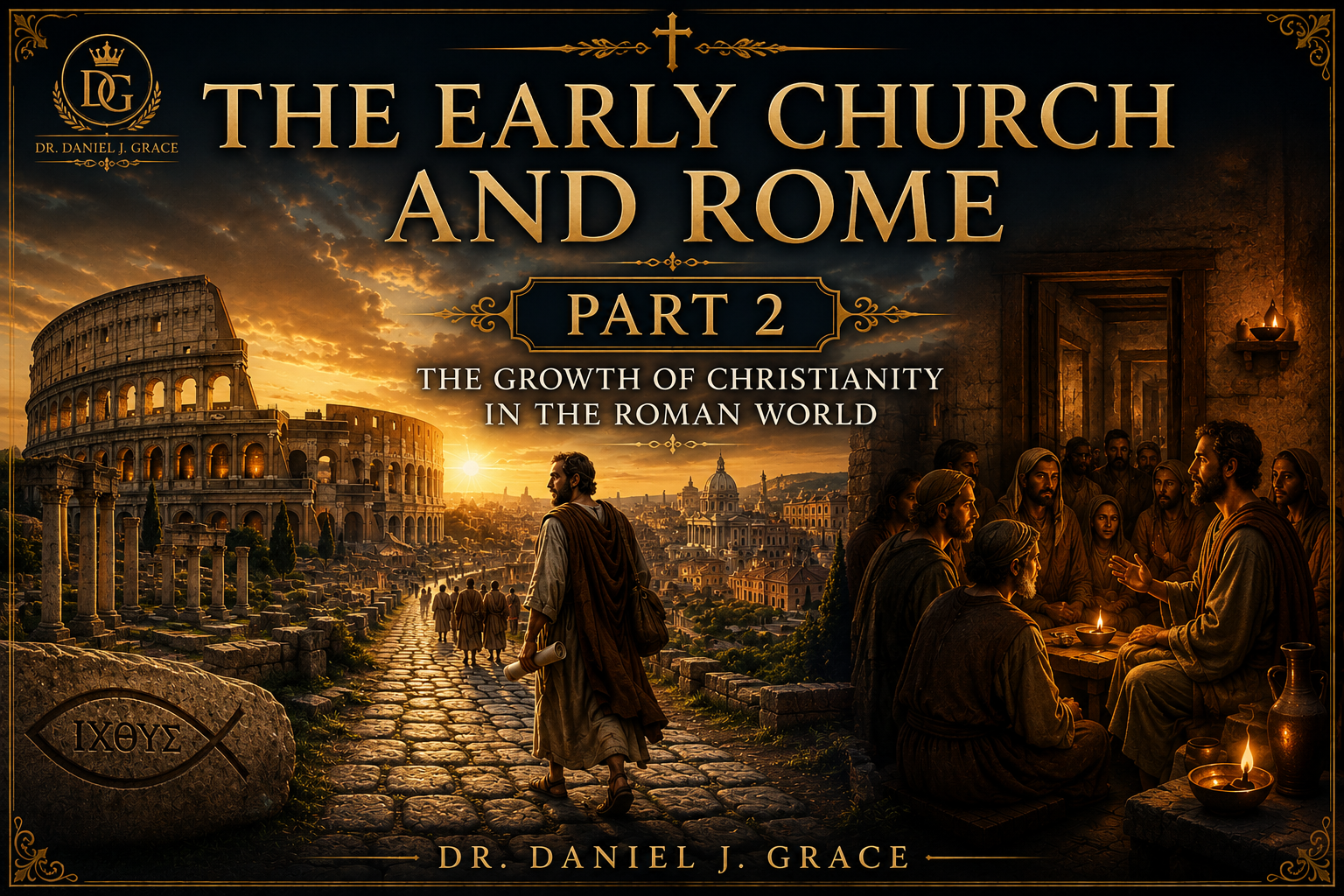
The Growth of Christianity in the Roman World
Introduction
To understand the story of Catholic Christianity, we must first understand the world in which it was born. The first Christians lived under the rule of the Roman Empire, one of the most powerful political systems in human history. Its roads connected nations, its laws governed millions, and its cities became centres of commerce, culture, and religion.
Into this world came Jesus Christ and the message of the Gospel.
What began as a small movement among Jewish believers in first-century Judea eventually spread throughout the Roman Empire and beyond. Within three centuries, Christianity had grown from a persecuted minority into a faith that transformed the ancient world.
The Early Church was not yet divided into Catholic, Orthodox, Protestant, or other traditions. Christians shared a common faith centred on Jesus Christ, the apostles, Scripture, prayer, and worship. The foundations laid during these centuries would profoundly influence the development of Catholic Christianity and the wider Christian family.
This chapter explores how Christianity spread through the Roman world, the challenges it faced, the people who shaped its growth, and the reasons why the city of Rome became so important in Christian history.
The Roman Empire in the First Century
When Jesus was born, the Roman Empire dominated the Mediterranean world. Stretching from Britain to the Middle East and from North Africa to central Europe, Rome controlled vast territories and countless peoples.
Several features of the Roman Empire unexpectedly helped Christianity spread.
Roman Roads
The Romans built thousands of kilometres of roads that connected major cities and provinces.
These roads allowed merchants, soldiers, government officials, and travellers to move efficiently across the empire.
The Apostle Paul and other Christian missionaries frequently travelled these routes while establishing churches and spreading the Gospel.
Without Rome’s transportation network, Christianity would likely have spread much more slowly.
Common Languages
The Roman world shared two major languages.
Greek was widely spoken throughout the Eastern Empire.
Latin dominated the western empire.
Because many people understood Greek, Christian missionaries could communicate with diverse populations.
The New Testament itself was written primarily in Greek, enabling Christian teachings to reach a broad audience.
Relative Peace
Historians often refer to this period as the Pax Romana (”Roman Peace”).
Although not free from conflict, this era provided greater stability than many previous centuries.
The relative peace allowed travel, trade, and communication across large regions, creating favourable conditions for missionary work.
Judaism and the Birth of Christianity
Christianity emerged from a Jewish context.
Jesus, His disciples, and the earliest believers were Jews who worshipped the God of Israel and accepted the authority of the Hebrew Scriptures.
The first Christians did not initially see themselves as followers of a new religion.
Rather, they believed that Jesus was the promised Messiah foretold by the prophets.
After Jesus’ resurrection, His followers proclaimed that God had fulfilled His promises through Christ.
The earliest Christian community formed in Jerusalem under the leadership of the apostles.
The Book of Acts describes how believers devoted themselves to the following:
The apostles’ teaching
Fellowship
Prayer
The breaking of bread
Caring for those in need
These practices became essential features of Christian life.
Pentecost and the Beginning of the Church
Many Christians regard the Day of Pentecost as the birth of the Church.
According to Acts chapter 2, the Holy Spirit descended upon the disciples gathered in Jerusalem.
Filled with courage and conviction, they began proclaiming the Gospel.
Peter preached a sermon explaining that Jesus was the promised Messiah and that His resurrection fulfilled God’s plan.
Thousands responded in faith and were baptised.
This event marked the beginning of the Church’s public mission.
Pentecost also demonstrated an important theme that would characterise Catholic Christianity: the universal nature of the Gospel.
People from many nations heard the message in their own languages.
From the beginning, Christianity was intended for all peoples.
The Apostles and Missionary Expansion
The apostles played a crucial role in spreading Christianity throughout the Roman world.
Peter
Peter emerged as a leading figure among the apostles.
The New Testament frequently presents him as a spokesman for the disciples.
He preached at Pentecost, performed miracles, and helped guide the early Christian community.
Catholic tradition later associated Peter closely with Rome and regarded him as the first bishop of Rome.
His role would become highly significant in the development of the papacy.
Paul
No individual contributed more to early missionary expansion than Paul.
Originally a persecutor of Christians, Paul experienced a dramatic conversion and became one of Christianity’s most influential leaders.
He travelled extensively throughout Asia Minor, Greece, and eventually Rome.
Paul established churches, trained leaders, wrote letters, and defended Christian teaching.
Many of his letters became part of the New Testament.
His missionary efforts helped transform Christianity from a primarily Jewish movement into a global faith.
The First Christian Communities
As missionaries travelled, Christian communities emerged in major cities throughout the empire.
Important centres included:
Jerusalem
Antioch
Ephesus
Corinth
Philippi
Alexandria
Rome
These churches varied in size and culture but shared common beliefs.
Christians gathered for worship, prayer, teaching, and fellowship.
Many met in private homes rather than dedicated church buildings.
House churches became the primary setting for Christian life during the first centuries.
These communities were often small but deeply committed.
Believers supported one another financially, spiritually, and emotionally.
Their love and unity attracted attention from outsiders.
Persecution and Suffering
Contrary to popular assumptions, Christianity did not spread because it enjoyed political support.
For much of its early history, Christians faced suspicion, hostility, and persecution.
Why Were Christians Persecuted?
Several factors contributed to opposition.
First, Christians refused to worship Roman gods.
Second, they rejected emperor worship.
Third, their exclusive devotion to Christ was often misunderstood.
Many Romans viewed Christians as strange, disloyal, or even dangerous.
False rumours circulated about Christian practices.
As a result, believers sometimes became targets during times of political instability.
Nero
One of the earliest major persecutions occurred under Emperor Nero.
After a devastating fire in Rome in AD 64, Nero blamed Christians.
Many believers were arrested, tortured, and executed.
According to Christian tradition, both Peter and Paul were martyred during this period.
Later Persecutions
Persecutions occurred intermittently under various emperors.
Some were local and limited.
Others were empire-wide.
The most severe persecution occurred under Emperor Diocletian in the early fourth century.
Churches were destroyed.
Scriptures were confiscated.
Christians were imprisoned and executed.
Despite these hardships, Christianity continued to grow.
The Witness of the Martyrs
The courage of Christian martyrs profoundly influenced the spread of Christianity.
Martyrs were believers who chose faithfulness to Christ even at the cost of death.
Many faced imprisonment, torture, and execution.
Rather than abandoning their faith, they remained steadfast.
Their example inspired other believers and impressed many observers.
One early Christian writer famously declared:
“The blood of the martyrs is the seed of the Church.”
The witness of the martyrs became an important part of Christian identity and spirituality.
Their stories continue to be remembered within Catholic Christianity today.
The Growth of Church Leadership
As Christianity expanded, churches developed structures of leadership.
Three primary offices emerged:
Bishops
Bishops provided oversight and guidance.
They protected doctrine, maintained unity, and supervised local churches.
Priests
Priests assisted bishops in ministry and worship.
They cared for congregations and administered sacraments.
Deacons
Deacons focused on service, charity, and practical ministry.
This threefold pattern of leadership became firmly established during the early centuries and remains central to Catholic Christianity.
The Importance of Rome
Among all early Christian centres, Rome gradually gained unique significance.
Several reasons explain this development.
Political Importance
Rome was the capital of the empire.
Events occurring in Rome often influenced the entire Mediterranean world.
Apostolic Connections
Christian tradition associated Rome with both Peter and Paul.
The presence of these two great apostles gave the Roman Church considerable prestige.
Influence and Stability
The Roman Church often provided leadership during times of doctrinal controversy and crisis.
Other churches frequently sought its counsel.
As Christianity expanded, the influence of the Bishop of Rome increased.
This process occurred gradually over several centuries rather than appearing suddenly.
Defending the Faith
The early Church faced challenges not only from persecution but also from false teachings.
Various groups promoted ideas inconsistent with apostolic teaching.
Christian leaders responded by explaining and defending the faith.
Writers such as:
Ignatius of Antioch
Justin Martyr
Irenaeus of Lyons
Tertullian
Athanasius
helped preserve orthodox Christian doctrine.
Their writings remain valuable sources for understanding early Christianity.
Many of these figures are honoured as saints in Catholic tradition.
Worship in the Early Church
Early Christian worship contained elements that remain familiar today.
Believers gathered for:
Scripture readings
Prayer
Preaching
Hymns
The Eucharist
The Eucharist occupied a central place in worship.
Christians believed they were obeying Christ’s command to remember Him through the breaking of bread.
Even during persecution, believers continued gathering for worship.
Many risked imprisonment or death in order to participate.
This commitment demonstrated the importance of communal worship within early Christianity.
Constantine and a New Era
A major turning point occurred during the reign of Emperor Constantine.
In AD 313, Constantine issued the Edict of Milan, granting legal recognition to Christianity.
For the first time, Christians could worship openly without fear of persecution.
This dramatic change transformed the Church’s position within society.
Churches were built.
Christian leaders gained greater freedom.
Theological discussions could occur publicly.
Although debates continue regarding Constantine’s legacy, his reign marked the beginning of a new chapter in Christian history.
The Council of Nicaea
One of the most important events in early Christianity was the Council of Nicaea in AD 325.
Church leaders gathered to address theological disputes concerning the nature of Christ.
The council affirmed that Jesus Christ is fully divine and of the same essence as the Father.
The Nicene Creed emerged from this gathering.
Today, Catholics, Orthodox Christians, Anglicans, Lutherans, and many Protestants continue to affirm the creed.
The council demonstrated the Church’s commitment to preserving doctrinal unity.
Christianity Becomes a Global Faith
By the fourth century, Christianity had spread throughout the empire and beyond.
Believers could be found in:
Europe
North Africa
The Middle East
Parts of Asia
Missionaries continued carrying the Gospel into new regions.
The Church increasingly reflected the universal vision implied by the word “Catholic”.
Christianity was no longer a small movement in Judea.
It had become a worldwide faith.
Lessons from the Early Church
The history of the Early Church offers important lessons.
Faithfulness
Early Christians remained committed despite persecution.
Mission
The Church actively shared the Gospel with others.
Community
Believers supported one another through fellowship and service.
Unity
The Church sought to preserve apostolic teaching and doctrinal truth.
Hope
Christians believed that God’s purposes would prevail despite opposition.
These themes continue to influence Catholic Christianity today.
Conclusion
The growth of Christianity within the Roman world is one of history’s most remarkable stories.
Beginning with a small group of disciples in Jerusalem, the Gospel spread across the empire through missionary work, faithful witness, sacrificial service, and the power of conviction.
The apostles established churches, martyrs inspired believers, bishops preserved unity, and Christian communities transformed lives.
Rome gradually emerged as a centre of Christian influence, setting the stage for the later development of the papacy and Catholic identity.
The foundations laid during these early centuries shaped the future of Christianity and continue to influence believers around the world today.
In the next chapter, we will examine how the Bishop of Rome gradually became known as the Pope and how the papacy developed throughout Christian history.
Dr Daniel J. Grace
Faith • Civilization • Theology
Research • Journalism • Truth
© 2026 Dr Daniel J. Grace. All Rights Reserved.
No part of this article may be reproduced, distributed, transmitted, or published in any form or by any means without prior written permission from the author, except for brief quotations used in academic citation, review, or research purposes.
Leave a Reply