Global Growth, Challenges, and Opportunities
Introduction
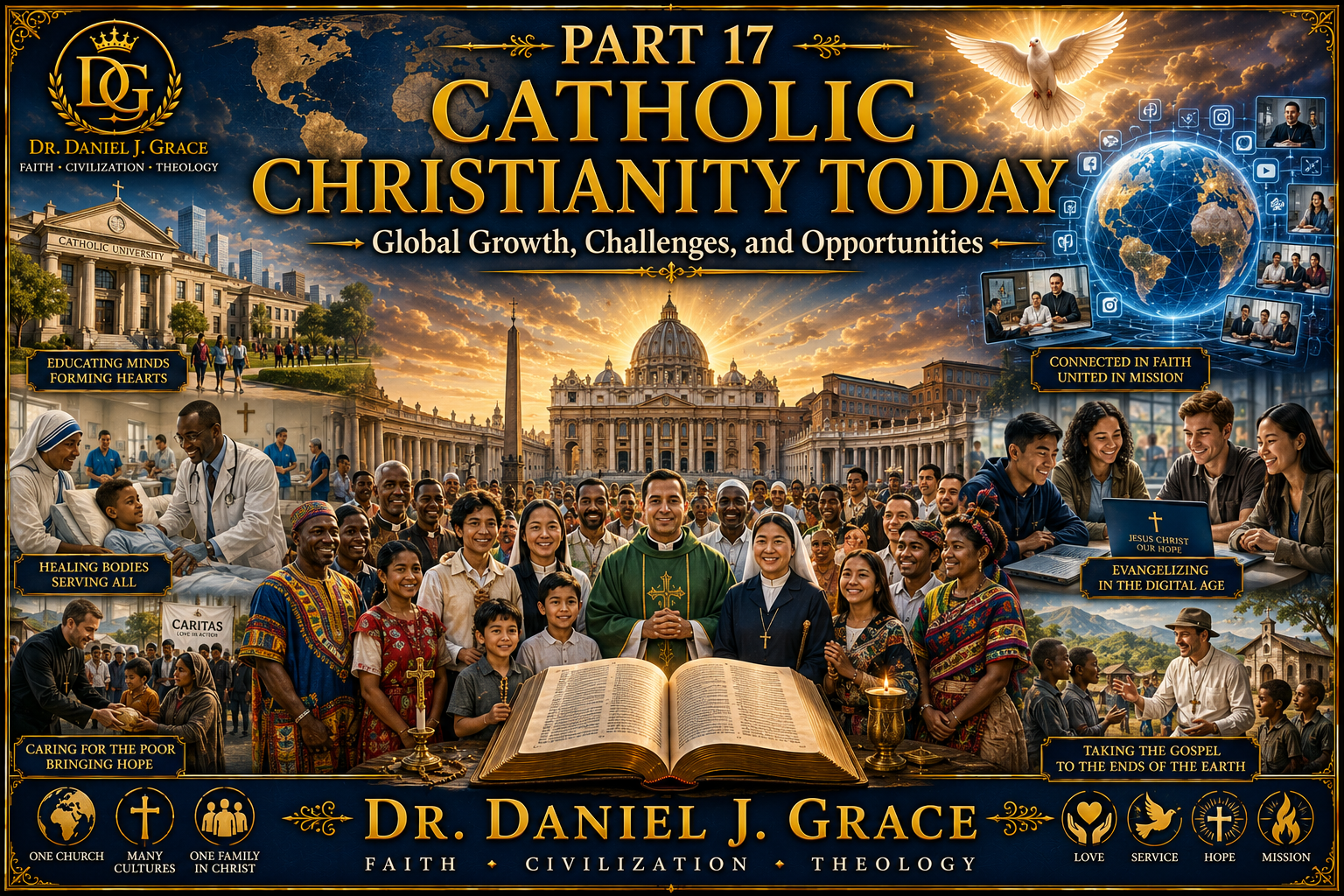
Catholic Christianity enters the twenty-first century as one of the largest and most influential religious traditions in human history. With more than one billion members spread across every inhabited continent, the Catholic Church remains a truly global community.
From the magnificent cathedrals of Europe to small mission chapels in Africa, from crowded cities in Asia to remote villages in Oceania, Catholicism continues to shape the spiritual lives of millions.
Yet modern Catholicism faces significant challenges.
Rapid technological change, secularisation, globalisation, shifting cultural values, declining religious participation in some regions, and increasing religious diversity all raise new questions.
At the same time, extraordinary opportunities exist.
The Church continues expanding in many parts of Africa and Asia. New movements of evangelisation are emerging. Digital communication creates unprecedented possibilities for education and outreach. Lay leadership is growing. Catholic social teaching continues influencing discussions about justice, poverty, human rights, and environmental stewardship.
Modern Catholicism is therefore a story of both continuity and change.
The Church remains rooted in ancient traditions while seeking to proclaim the Gospel within an increasingly interconnected world.
This chapter explores Catholic Christianity today, examining its global presence, strengths, challenges, opportunities, and future direction.
A Truly Global Church
One of the most remarkable developments in modern Catholicism is its global character.
For centuries, many people associated Catholicism primarily with Europe.
Today that perception is incomplete.
The Catholic Church exists on every continent.
Its members come from:
Africa
Asia
Europe
North America
South America
Oceania
This diversity has transformed the Church.
The Demographic Shift
For much of Christian history, Europe was the centre of Catholic influence.
However, demographic patterns have changed dramatically.
The fastest growth now occurs in:
Africa
Asia
Parts of Latin America
Meanwhile, many European countries experience declining church attendance.
This shift is reshaping global Catholicism.
Catholicism in Africa
Africa represents one of the most dynamic regions of contemporary Christianity.
Catholic populations have grown rapidly.
Many African dioceses report:
Growing congregations
Increasing vocations
Expanding ministries
African Catholics bring energy, vitality, and strong community engagement.
Why Catholicism Grows in Africa
Several factors contribute to growth.
Strong Family Structures
Faith is often transmitted through family relationships.
Community Life
Churches often serve as community centres.
Youthful Population
Many African nations have large younger populations.
Active Evangelization
Mission and outreach remain priorities.
The result has been remarkable expansion.
Catholicism in Asia
Asia contains some of the world’s oldest Christian communities.
At the same time, Christians remain minorities in many countries.
Catholicism continues to grow in the following places:
South Korea
India
Vietnam
Philippines
The Church increasingly engages with diverse religious traditions.
The Philippines
The Philippines remains one of the largest Catholic nations in the world.
The Catholic faith deeply influences the following:
Culture
Education
Family life
Public celebrations
Filipino Catholics contribute significantly to global Catholicism.
India
India contains ancient Christian communities associated with Saint Thomas.
Modern Catholicism continues growing while existing alongside Hinduism, Islam, Sikhism, Buddhism, and other traditions.
This environment encourages dialogue and mutual understanding.
Catholicism in Latin America
Latin America remains home to one of the world’s largest Catholic populations.
Countries such as:
Brazil
Mexico
Colombia
Argentina
Peru
contain millions of Catholics.
The region has profoundly influenced global Catholic life.
Pope Francis
The election of Pope Francis in 2013 marked a historic moment.
For the first time, a pope came from Latin America.
His election highlighted Catholicism’s increasingly global character.
Francis brought attention to the following:
Mercy
Poverty
Mission
Social justice
His leadership continues shaping contemporary Catholicism.
Catholicism in North America
The Catholic Church remains a major religious presence in North America.
Catholic institutions include the following:
Schools
Universities
Hospitals
Charitable organizations
Immigration has contributed significantly to Catholic growth and diversity.
Catholicism in Europe
Europe remains historically important.
Many of Christianity’s great
Cathedrals
Universities
Monasteries
Pilgrimage sites
are located there.
However, secularisation presents challenges.
Church attendance has declined in many countries.
The Church continues to seek new approaches to evangelisation.
Catholicism in Oceania
Australia, New Zealand, and Pacific nations possess vibrant Catholic communities.
Catholic schools and social services play important roles.
The Church continues adapting to changing social realities.
The Mission of the Church Today
Modern Catholicism remains committed to its fundamental mission:
To proclaim Jesus Christ and serve humanity.
This mission includes:
Worship
Evangelization
Education
Charity
Social action
These dimensions remain interconnected.
Evangelization in the Modern World
The Church often speaks of a “New Evangelisation”.
This concept emphasises reaching out to people who may have become distant from the faith.
The goal is not simply institutional growth.
The goal is a renewed encounter with Christ.
Digital Evangelization
Technology has transformed communication.
Catholics increasingly use the following:
Websites
Podcasts
Social media
YouTube
Online education
Digital ministry creates opportunities unimaginable in previous generations.
Opportunities of the Digital Age
Technology allows the Church to:
Reach global audiences
Share educational resources
Provide spiritual support
Connect communities
Many ministries now operate across national boundaries.
Challenges of the Digital Age
Technology also creates difficulties.
Examples include:
Misinformation
Isolation
Distraction
Polarization
The Church encourages responsible and ethical use of technology.
Catholic Education
Education remains one of Catholicism’s greatest strengths.
Catholic schools and universities serve millions worldwide.
These institutions aim to combine the following:
Academic excellence
Moral formation
Spiritual development
Education continues to be a major form of mission.
Catholic Universities
Catholic universities contribute significantly to:
Theology
Science
Medicine
Law
Humanities
They demonstrate that faith and intellectual inquiry can coexist.
Healthcare Ministry
Catholic healthcare remains among the largest healthcare networks in the world.
Hospitals and clinics serve millions regardless of religious background.
Healthcare ministry reflects Christ’s concern for the sick and vulnerable.
Charity and Social Service
Catholic organisations provide assistance in the following areas:
Disaster relief
Refugee support
Poverty reduction
Education
Healthcare
These ministries represent practical expressions of Christian love.
Catholic Social Teaching
Catholic social teaching continues influencing discussions concerning the following:
Human dignity
Economic justice
Peace
Human rights
Environmental stewardship
Its principles remain relevant.
Human Dignity
The foundation of Catholic social teaching is human dignity.
Every person possesses value because they are created in the image of God.
This principle influences many Catholic positions on social issues.
Care for the Poor
Catholic tradition consistently emphasises concern for the poor.
The Church teaches that societies should protect vulnerable people.
This concern remains central to Catholic mission.
Environmental Stewardship
Environmental issues have become increasingly important.
Pope Francis highlighted these concerns in Laudato Si’.
Catholics are encouraged to care responsibly for creation.
Religious Freedom
The Church strongly supports religious freedom.
People should be free to:
Practise faith
Change beliefs
Worship without coercion
Religious liberty remains an important concern globally.
Ecumenical Relations
Relations with other Christians have improved significantly.
Catholics increasingly cooperate with the following:
Orthodox Christians
Protestants
Evangelicals
Shared concerns often create opportunities for collaboration.
Interfaith Dialogue
The Church also engages in dialogue with other religions.
Relationships with:
Judaism
Islam
Hinduism
Buddhism
have become increasingly important.
Dialogue seeks understanding while respecting differences.
The Role of the Laity
One major development in modern Catholicism is the growing role of laypeople.
Lay Catholics contribute through the following:
Education
Leadership
Evangelization
Social ministry
The Church increasingly recognises the importance of women.
Women in the Church
Women play essential roles throughout Catholic life.
They serve as:
Educators
Theologians
Missionaries
Religious sisters
Lay leaders
Their contributions continue shaping modern Catholicism.
Youth and the Future
Young people represent both a challenge and an opportunity.
Many young adults question religious institutions.
At the same time, many seek meaning, purpose, and community.
The Church continues exploring ways to engage younger generations.
Vocations
The Church depends upon vocations to the following:
Priesthood
Religious life
Missionary service
Some regions experience declining numbers.
Others report significant growth.
Vocation development remains a major priority.
Secularization
One of the greatest challenges facing modern Catholicism is secularisation.
Many societies increasingly view religion as irrelevant.
This trend affects:
Worship attendance
Religious education
Institutional participation
The Church seeks creative responses.
Consumer Culture
Modern consumer culture often emphasises the following points:
Individualism
Material success
Immediate gratification
These values can conflict with Christian teachings about sacrifice, service, and community.
Moral and Ethical Questions
Contemporary society presents complex ethical questions involving:
Biotechnology
Artificial intelligence
Genetics
Medical ethics
The Church continues developing responses grounded in human dignity.
Migration and Globalization
Migration has transformed Catholic communities.
Parishes increasingly serve people from diverse cultural backgrounds.
Globalisation brings both opportunities and challenges.
Cultural Diversity
Modern Catholicism includes extraordinary diversity.
Catholics worship in hundreds of languages.
Different cultures enrich the universal Church.
This diversity is one of Catholicism’s greatest strengths.
Synodality
Recent Catholic discussions have emphasised synodality.
This concept involves listening, participation, and shared discernment.
The goal is deeper collaboration within the Church.
Pope Francis and Contemporary Priorities
Pope Francis frequently emphasises:
Mercy
Evangelization
Care for the poor
Environmental stewardship
Dialogue
These priorities continue influencing Catholic life worldwide.
Strengths of Modern Catholicism
Catholic Christianity possesses significant strengths.
Global Presence
The Church exists worldwide.
Historical Continuity
Catholicism maintains deep historical roots.
Educational Institutions
Schools and universities remain influential.
Social Ministry
Catholic charities serve millions.
Rich Spiritual Traditions
The Church offers centuries of spiritual wisdom.
Challenges Facing the Future
Several challenges remain.
Secularization
Declining participation in some regions.
Cultural Polarization
Political divisions affect communities.
Ethical Complexity
New technologies raise difficult questions.
Leadership Development
Future leaders must be prepared effectively.
Reasons for Hope
Despite challenges, many reasons for hope exist.
Growth in Africa and Asia
The Church continues expanding.
Digital Outreach
New opportunities for evangelisation are emerging.
Strong Lay Leadership
Lay involvement continues increasing.
Youth Movements
Many young Catholics remain committed.
Global Mission
The Gospel continues reaching new audiences.
What Makes Catholicism Unique Today?
Several characteristics continue distinguishing Catholic Christianity.
Universality
The Church spans cultures and nations.
Sacramental Life
Worship remains central.
Historical Continuity
Catholics value connection to apostolic origins.
Intellectual Tradition
Faith and reason remain partners.
Social Concern
Service to humanity remains essential.
The Future of Catholic Christianity
Predicting the future is difficult.
Yet several trends seem likely.
The Church will become increasingly the following:
Global
Diverse
Digitally connected
Africa and Asia will likely play growing roles.
Lay leadership will continue expanding.
Mission will remain central.
Lessons for Modern Believers
Modern Catholics can learn several lessons.
Remain Rooted in Faith
Ancient truths remain relevant.
Engage the World
Christians should not retreat from society.
Serve Others
Faith expresses itself through love.
Embrace Diversity
The Church belongs to all nations.
Maintain Hope
Challenges do not eliminate God’s faithfulness.
Conclusion
Catholic Christianity today stands at a fascinating moment in history.
The Church faces significant challenges, including secularisation, cultural change, and ethical complexities.
Yet it also possesses extraordinary opportunities.
Its global presence, educational institutions, charitable ministries, spiritual traditions, and missionary vision continue influencing millions.
Modern Catholicism remains rooted in ancient faith while seeking to proclaim the Gospel within a rapidly changing world.
Its future will depend not merely on institutions or programmes but on believers who live faithfully, serve compassionately, and witness courageously to Jesus Christ.
In Part 18 — Strengths, Contributions, and Ongoing Debates: A Balanced Assessment of Catholic Christianity in the Modern World, we will conclude this series by examining Catholicism’s enduring contributions, its challenges, and its continuing role within the wider Christian family and global society.
Dr Daniel J. Grace
Faith • Civilization • Theology
Research • Journalism • Truth
© 2026 Dr Daniel J. Grace. All Rights Reserved.
No part of this article may be reproduced, distributed, transmitted, or published in any form or by any means without prior written permission from the author, except for brief quotations used in academic citation, review, or research purposes.
Leave a Reply