Major Developments in Modern Catholicism
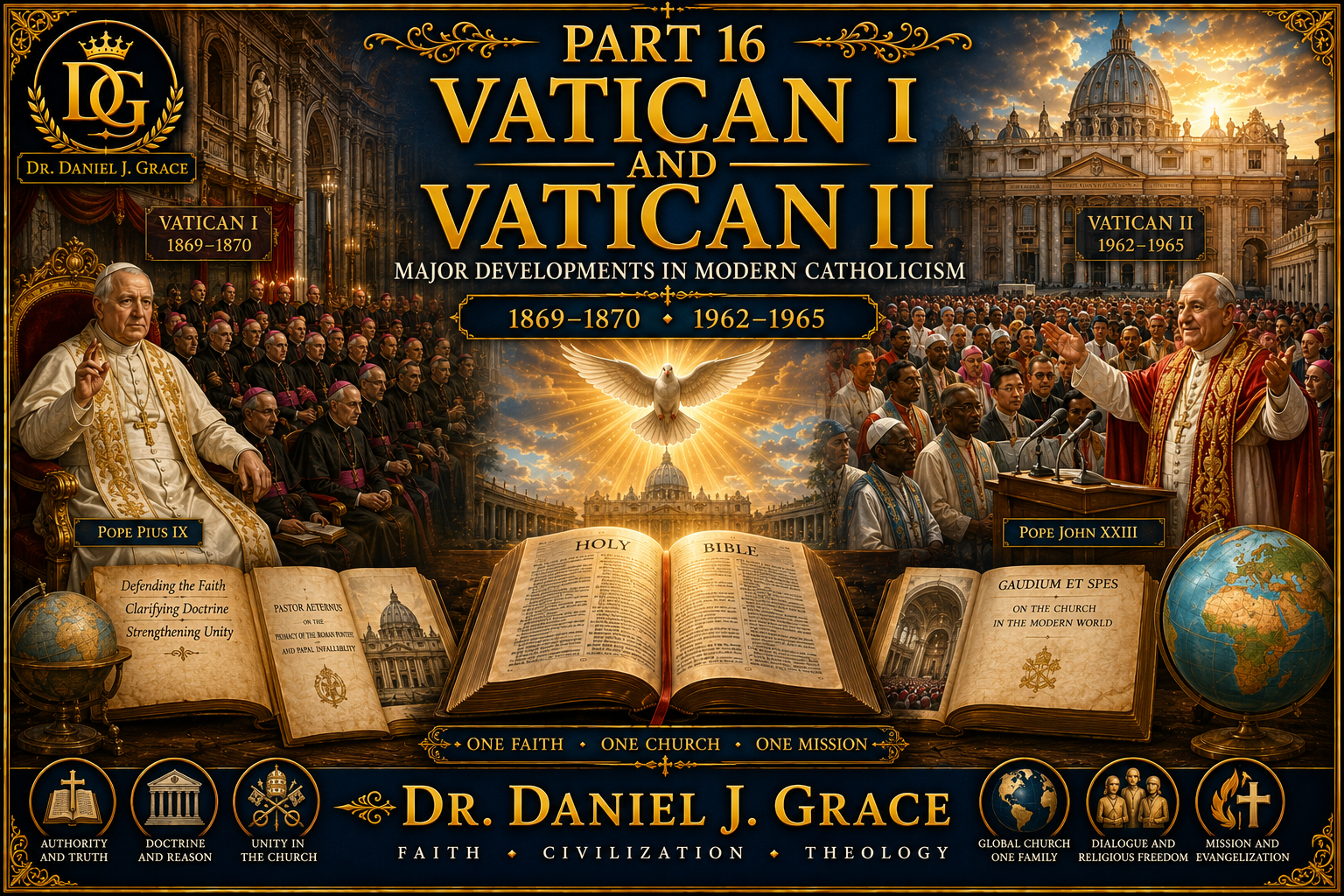
Introduction
The nineteenth and twentieth centuries brought some of the most dramatic changes in human history. Revolutions reshaped nations. Scientific discoveries transformed knowledge. Industrialisation altered society. Global wars devastated continents. New technologies changed communication, transportation, and culture.
The Catholic Church faced unprecedented challenges.
How should Christianity respond to modern science?
What should the Church say about democracy, human rights, religious freedom, and globalisation?
How could ancient truths be communicated to a rapidly changing world?
These questions became increasingly urgent as modernity transformed society.
Two major councils helped shape the Catholic response:
The First Vatican Council (1869–1870)
The Second Vatican Council (1962–1965)
Together, these councils profoundly influenced modern Catholicism.
While Vatican I focused on authority and doctrine during a period of political uncertainty, Vatican II emphasised renewal, engagement with the modern world, and the Church’s universal mission.
Understanding these councils is essential for understanding contemporary Catholicism.
The World Before Vatican I
The nineteenth century was a period of immense change.
Traditional political systems were being challenged.
Nationalism was rising.
Industrialisation was transforming economies.
Scientific discoveries raised new questions.
The Church often found itself confronting movements that appeared hostile to religion.
The French Revolution
The French Revolution profoundly affected Catholic Europe.
Church property was confiscated.
Religious institutions were disrupted.
Many clergy faced persecution.
The revolution demonstrated that Christianity could no longer assume a privileged position within society.
The Rise of Secularism
Secularism increasingly influenced politics and culture.
Many intellectuals believed religion would gradually disappear.
Some viewed faith as incompatible with reason and scientific progress.
The Church recognised the need to respond to this challenge.
Pope Pius IX
One of the most important figures of the nineteenth century was Pope Pius IX.
His pontificate lasted from 1846 to 1878, making it one of the longest in history.
During his leadership, the Church faced enormous political and cultural challenges.
The Loss of the Papal States
For centuries, popes had governed territories known as the Papal States.
During the movement for Italian unification, the new Kingdom of Italy absorbed these territories.
The Pope lost direct political control over much of central Italy.
This event significantly changed the role of the papacy.
Why Vatican I Was Convened
Pius IX believed the Church needed a council.
The goals included:
Clarifying doctrine
Strengthening unity
Addressing modern challenges
Defending the faith
The First Vatican Council opened in 1869.
The First Vatican Council
Vatican I was the twentieth ecumenical council of the Catholic Church.
Hundreds of bishops from around the world attended.
The council sought to provide clear teaching amid growing uncertainty.
Faith and Reason
One of Vatican I’s most important teachings concerned faith and reason.
The council rejected the idea that faith and reason are enemies.
Instead, it taught that both originate from God.
Truth cannot contradict truth.
Scientific discovery and authentic faith ultimately belong together.
Revelation
The council emphasised that God reveals Himself through:
Creation
Human reason
Divine revelation
While reason can know certain truths about God, revelation provides knowledge that human beings could not discover by themselves.
Rationalism and Materialism
The council responded to the following intellectual movements:
Rationalism
Materialism
Skepticism
These philosophies often dismissed supernatural belief.
Vatican I defended the legitimacy of Christian faith.
Papal Infallibility
The most famous teaching of Vatican I concerns papal infallibility.
This doctrine is often misunderstood.
It does not mean that the Pope is perfect.
It does not mean that every statement made by a pope is infallible.
The teaching is much narrower.
What Papal Infallibility Means
The council taught that when the Pope formally defines a doctrine concerning faith or morals for the entire church, he is preserved from error by the Holy Spirit.
This protection exists for the benefit of the Church.
The doctrine applies only under very specific circumstances.
Misunderstandings About Infallibility
Many people mistakenly believe Catholics think the Pope is infallible.
The Church has never taught this doctrine.
Popes remain human beings.
They can make poor decisions.
They can commit sins.
Infallibility applies only to specific doctrinal definitions.
The Council Ends Early
Vatican I did not complete all of its planned work.
In 1870, political events interrupted the council.
The Franco-Prussian War erupted.
Rome was occupied.
The council was suspended and never formally reconvened.
Catholicism After Vatican I
Following Vatican I, the Church entered a period of significant change.
Catholics increasingly faced modern challenges involving the following:
Science
Politics
Industrialization
Secularization
The Church continued responding to these developments.
Pope Leo XIII
Pope Leo XIII became one of the most influential modern popes.
He encouraged engagement with contemporary issues.
His writings helped shape modern Catholic social teaching.
Rerum Novarum
In 1891, Leo XIII issued Rerum Novarum.
This document addressed social and economic issues.
It discussed:
Workers’ rights
Human dignity
Private property
Social justice
Many consider it the foundation of modern Catholic social teaching.
Catholic Social Teaching
Catholic social teaching developed significantly during the modern period.
Key themes include:
Human dignity
Solidarity
Justice
Care for the poor
The common good
These principles continue influencing Catholic thought today.
The Twentieth Century
The twentieth century brought extraordinary challenges.
Two world wars devastated humanity.
Totalitarian regimes emerged.
Technological advances transformed society.
The Church increasingly recognised the need for renewal.
Pope John XXIII
One of the most beloved modern popes was Pope John XXIII.
Elected in 1958, many expected a short and uneventful pontificate.
Instead, he surprised the world.
He announced a new ecumenical council.
Why Vatican II Was Called
John XXIII believed the Church needed renewal.
He often used the Italian word.
Aggiornamento
Meaning:
“Bringing it up to date.”
The goal was not to change essential doctrine.
Rather, it was to communicate timeless truths more effectively in the modern world.
The Second Vatican Council
The Second Vatican Council opened in 1962.
It became one of the most significant events in modern Catholic history.
Thousands of bishops from every continent attended.
The global nature of the Church became highly visible.
A Truly Global Church
Unlike earlier councils dominated by Europe, Vatican II included strong participation from:
Africa
Asia
Latin America
Oceania
The council reflected Catholicism’s increasingly global character.
The Spirit of Vatican II
The council sought:
Renewal
Evangelization
Dialogue
Mission
Unity
Its tone differed significantly from earlier defensive approaches.
The Church aimed to engage rather than retreat from the modern world.
The Church as the People of God
One of the most important ideas of Vatican II was the Church as the “People of God.”
The council emphasised that all believers share in the Church’s mission.
This perspective highlighted the importance of lay Catholics.
The Universal Call to Holiness
Vatican II taught that holiness is not limited to priests and religious.
Every Christian is called to holiness.
Whether
Teacher
Parent
Farmer
Student
Worker
All believers are called to follow Christ faithfully.
Liturgy and Worship
One of the most visible changes involved worship.
The Constitution on the Sacred Liturgy encouraged greater participation by the faithful.
Several reforms followed.
Vernacular Languages
Previously, the Mass was generally celebrated in Latin.
After Vatican II, local languages became widely used.
This allowed many Catholics to participate more actively.
Active Participation
The council emphasised that worshippers should engage actively in the liturgy.
The Mass was not merely something observed.
It was something in which the entire community participated.
Scripture in Catholic Life
Vatican II encouraged greater engagement with Scripture.
Catholics were urged to:
Read the Bible
Study Scripture
Incorporate biblical reflection into daily life
Bible study expanded significantly after the council.
The Church and the Modern World
One of Vatican II’s most important documents was Gaudium et Spes.
This document addressed contemporary society.
Topics included:
Human dignity
Family life
Culture
Economics
Politics
Peace
The Church expressed a desire to engage constructively with the modern world.
Religious Freedom
The council affirmed religious freedom.
People should not be coerced into religious belief.
Faith requires genuine freedom.
This teaching represented a significant development in Catholic thought.
Ecumenism
Vatican II encouraged improved relations with other Christians.
The council recognised that many elements of Christian truth exist outside the visible Catholic structures.
Efforts toward Christian unity increased significantly.
Relations with Protestants
The council promoted dialogue with Protestant communities.
Rather than focusing solely on differences, the council also highlighted shared beliefs.
Ecumenical conversations expanded worldwide.
Relations with the Orthodox Church
Vatican II also encouraged closer relationships with Eastern Orthodox Christians.
Shared traditions and common heritage received renewed attention.
Interfaith Dialogue
The council addressed relationships with non-Christian religions.
A landmark document called Nostra Aetate transformed Catholic attitudes toward dialogue.
Judaism
Vatican II strongly affirmed the Jewish roots of Christianity.
The council rejected antisemitism.
Relations between Catholics and Jews improved dramatically following the council.
Islam
The council also expressed respect for Muslims.
Shared belief in one God provided a basis for dialogue and cooperation.
Mission After Vatican II
The council renewed emphasis on the mission.
Evangelisation remained central to Catholic identity.
At the same time, the mission increasingly involved the following:
Dialogue
Service
Respect for cultures
The Role of the Laity
One major theme of Vatican II involved the laity.
Lay Catholics were encouraged to take active roles in the following:
Evangelization
Education
Social action
Parish life
This development transformed Catholic communities worldwide.
Challenges Following Vatican II
The implementation of Vatican II was not always smooth.
Some welcomed reforms enthusiastically.
Others feared that important traditions were being lost.
Debates emerged concerning interpretation.
Different Interpretations
Some viewed Vatican II as a dramatic break from the past.
Others saw it as renewal within continuity.
Popes have generally emphasised this continuity.
The council sought renewal while remaining faithful to Catholic tradition.
Pope Paul VI
Following the death of John XXIII, Pope Paul VI guided Vatican II to completion.
He played a crucial role in implementing the council’s reforms.
Pope John Paul II
John Paul II became one of the most influential interpreters of Vatican II.
He promoted:
Evangelization
Human dignity
Ecumenism
Global mission
His leadership helped shape post-conciliar Catholicism.
Pope Benedict XVI
Benedict XVI emphasised the continuity of Vatican II with earlier Church teaching.
He argued that authentic reform must remain rooted in tradition.
Pope Francis
Pope Francis continues drawing upon Vatican II themes.
His papacy emphasises:
Mercy
Mission
Dialogue
Care for the poor
Many of his priorities reflect the council’s vision.
Vatican II’s Lasting Impact
The council transformed Catholic life in many ways.
You can see its influence in:
Worship
Education
Ecumenism
Scripture study
Mission
Social engagement
Many events have shaped modern Catholicism profoundly.
Strengths of Vatican I and Vatican II
Together, the councils contributed important developments.
Vatican I
Clarified authority
Defended faith and reason
Strengthened unity
Vatican II
Encouraged renewal
Promoted dialogue
Expanded global participation
Renewed missionary vision
Continuing Debates
Both councils remain subjects of discussion.
Questions continue concerning the following:
Authority
Tradition
Reform
Liturgy
Modern culture
These conversations reflect the Church’s ongoing effort to remain faithful while addressing new challenges.
Lessons for Today
The history of Vatican I and Vatican II teaches several important lessons.
Faith and Reason Belong Together
Truth is unified.
The church must continually renew itself.
Renewal is part of Christian life.
Unity Matters
The Church seeks communion across cultures and nations.
Mission Matters
The Gospel remains relevant in every age.
Tradition and Renewal Must Work Together
Faithfulness requires both continuity and adaptation.
Conclusion
The First and Second Vatican Councils stand among the most important events in modern Catholic history.
Vatican I responded to the challenges of modern scepticism by clarifying doctrine and affirming the relationship between faith and reason.
Vatican II responded to a rapidly changing world by encouraging renewal, dialogue, mission, and greater participation by all believers.
Together these councils helped shape the Catholic Church that exists today.
Their influence continues to guide Catholic worship, theology, education, social teaching, and global mission.
As the Church moves further into the twenty-first century, the questions addressed by Vatican I and Vatican II remain deeply relevant.
In Part 17 — Catholic Christianity Today: Global Growth, Challenges, and Opportunities, we will examine the contemporary Catholic Church, its remarkable worldwide expansion, the challenges it faces, and its role in an increasingly interconnected world.
Dr Daniel J. Grace
Faith • Civilization • Theology
Research • Journalism • Truth
© 2026 Dr Daniel J. Grace. All Rights Reserved.
No part of this article may be reproduced, distributed, transmitted, or published in any form or by any means without prior written permission from the author, except for brief quotations used in academic citation, review, or research purposes.
Leave a Reply