
The Council of Trent and Catholic Renewal
Introduction
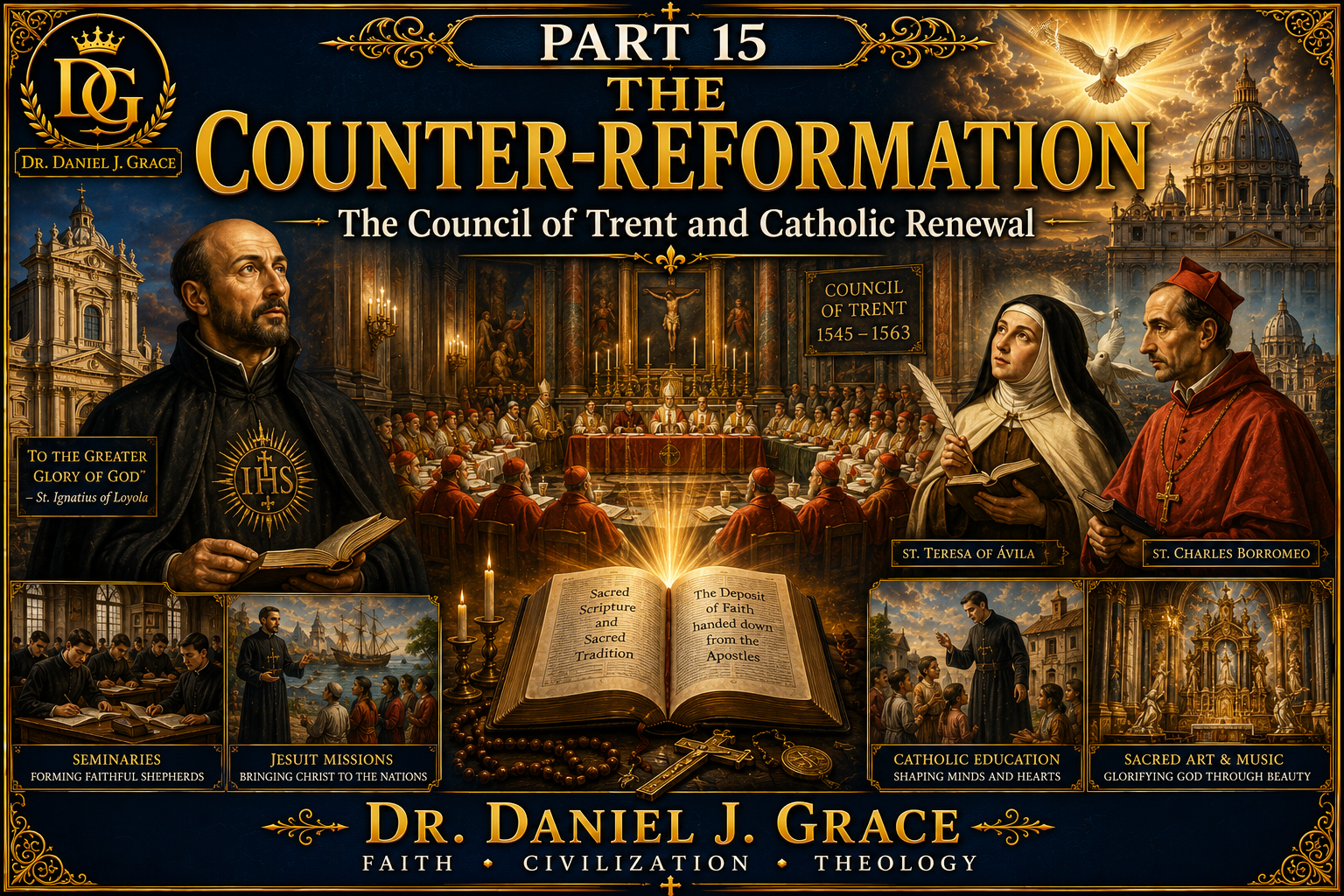
The Protestant Reformation shook Western Christianity in ways few could have imagined. What began as a movement calling for reform rapidly developed into a profound religious division that transformed Europe and eventually much of the world. By the middle of the sixteenth century, large regions of Germany, Switzerland, Scandinavia, England, and parts of Central Europe had separated from Rome.
For the Catholic Church, the challenge was immense.
The Church faced theological criticism, political opposition, internal corruption, declining discipline among some clergy, and the loss of millions of believers. Yet this period of crisis also became an opportunity for renewal.
The Catholic response to the Reformation is commonly known as the Counter-Reformation, although many historians prefer the term ‘Catholic Reformation’ because reform efforts had already begun within the Church before Martin Luther’s protest in 1517.
The Counter-Reformation was far more than a reaction against Protestantism. It was a comprehensive movement of spiritual, intellectual, educational, pastoral, and missionary renewal.
At the heart of this renewal stood the Council of Trent, one of the most important councils in Christian history.
This chapter explores the origins of the Counter-Reformation, the Council of Trent, the rise of new religious orders, Catholic spirituality, missionary expansion, educational reform, artistic renewal, and the lasting legacy of Catholic reform.
The Crisis Facing the Catholic Church
By the early sixteenth century, many Catholics had come to recognise the need for reform.
Several problems contributed to growing dissatisfaction.
These included:
Clerical corruption
Poor education among some clergy
Political interference
Financial abuses
Weak pastoral leadership
Declining spiritual discipline
Not every region experienced these problems equally, but concerns were widespread.
The Protestant Reformation exposed many of these weaknesses.
Reform Before Luther
It is important to remember that Catholic reform did not begin with Luther.
Throughout mediaeval history, numerous reform movements had emerged.
Examples included:
Cluniac Reform
Gregorian Reform
Cistercian Renewal
Franciscan Renewal
Many Church leaders were already discussing reform before the Protestant movement appeared.
The Reformation accelerated these efforts.
The Need for a General Council
As Protestant ideas spread, church leaders increasingly recognised the need for a major council.
A council could:
Clarify doctrine
Address abuses
Strengthen discipline
Promote unity
After years of political delays and disagreements, such a council was finally convened.
The Council of Trent
The Council of Trent met intermittently between
1545–1563
It became one of the most influential councils in Catholic history.
The council met in the city of Trent in northern Italy.
Its work extended across eighteen years due to political and military interruptions.
The Goals of Trent
The council pursued two major objectives.
Doctrinal Clarification
The Church needed to respond to Protestant theological claims.
Institutional Reform
The Church needed to address genuine problems and abuses.
Both goals proved essential.
Who Attended?
Participants included:
Bishops
Cardinals
Theologians
Papal representatives
While most attendees came from Catholic regions of Europe, the council represented the universal Church.
Scripture and Tradition
One of the first major topics involved authority.
Protestant reformers emphasized:
Sola Scriptura
(Scripture Alone)
The Council of Trent reaffirmed that divine revelation comes through:
Sacred Scripture
Sacred Tradition
The council taught that both belong to the apostolic deposit of faith.
The Biblical Canon
The council also officially reaffirmed the biblical canon.
This included books often called the Deuterocanonical Books, such as the following:
Tobit
Judith
Wisdom
Sirach
Baruch
1 Maccabees
2 Maccabees
These books remained part of Catholic Scripture.
Justification
Perhaps the most important theological debate involved justification.
How are sinners made right with God?
The council rejected the idea that human beings can earn salvation.
Instead, it affirmed that salvation begins entirely through God’s grace.
At the same time, Trent taught that faith is not merely intellectual belief but a living faith expressed through love and obedience.
Grace and Human Cooperation
The council emphasised two key truths.
Salvation Is God’s Gift
No one can save themselves.
Human Response Matters
Believers must respond to grace through faith and discipleship.
This balanced approach remains central to Catholic theology.
The Seven Sacraments
Trent reaffirmed the traditional seven sacraments:
Baptism
Confirmation
Eucharist
Reconciliation
Anointing of the Sick
Holy Orders
Matrimony
The council taught that the sacraments are effective signs of God’s grace.
The Eucharist
The Eucharist became a major focus of the council.
Many Protestant groups questioned aspects of Catholic Eucharistic teaching.
Trent reaffirmed belief in the Real Presence of Christ in the Eucharist.
The council taught that Christ is truly present in the sacrament.
The Mass
The council defended the Mass as a central act of Christian worship.
Catholics believe the Mass makes present the sacrifice of Christ in a sacramental manner.
This teaching became one of the defining distinctions between Catholicism and many Protestant traditions.
Clerical Reform
One of Trent’s greatest achievements involved reforming clergy education.
The council recognised that many priests lacked adequate theological training.
The solution was revolutionary.
The Creation of Seminaries
Trent required dioceses to establish seminaries.
These institutions would provide proper education and formation for future priests.
This reform dramatically improved clergy quality throughout the Catholic world.
The seminary system remains in place today.
Episcopal Responsibility
The council required bishops to reside within their dioceses.
Previously some bishops held multiple positions and spent little time among their people.
Trent insisted upon active pastoral leadership.
This strengthened local church life.
Reforming Religious Life
The council also addressed religious orders.
Monasteries and convents were encouraged to renew discipline and spiritual commitment.
Many communities experienced significant renewal during this period.
The Catechism of the Council of Trent
Following the council, a new catechism was produced.
Its purpose was to
Educate clergy
Clarify doctrine
Promote consistency
The catechism became an important teaching resource.
Liturgical Renewal
The council also influenced Catholic worship.
Efforts were made to standardise liturgical practices across the Church.
This contributed to greater unity within global Catholicism.
The Roman Missal
Pope Pius V later issued a revised Roman Missal.
The liturgy became more uniform across Catholic regions.
This form of worship remained largely unchanged for centuries.
Spiritual Renewal
The Counter-Reformation was not merely institutional.
It was deeply spiritual.
A remarkable revival of prayer, holiness, and devotion emerged throughout the Catholic world.
Many of the greatest saints in Christian history appeared during this period.
Saint Ignatius of Loyola
One of the most influential figures was Saint Ignatius of Loyola.
Originally a soldier, Ignatius experienced a profound conversion after a battle wound changed his life.
He dedicated his life to serving Christ.
His influence would reshape Catholicism.
The Society of Jesus
Ignatius founded the Society of Jesus, commonly known as the Jesuits.
The order became one of the most influential forces of the Counter-Reformation.
Jesuits emphasised:
Education
Mission
Scholarship
Spiritual formation
Their impact reached every continent.
The Spiritual Exercises
Ignatius wrote a guide known as the Spiritual Exercises.
This work helps believers deepen their relationship with God through prayer and reflection.
The Spiritual Exercises continue influencing Christians worldwide.
Jesuit Education
The Jesuits established schools and universities across Europe and beyond.
Their commitment to intellectual excellence became legendary.
Many educational institutions founded during this period still exist today.
Saint Francis Xavier
Among the first Jesuits was Saint Francis Xavier.
He became one of Christianity’s greatest missionaries.
His travels took him to:
India
Japan
Southeast Asia
His missionary work helped expand Catholicism throughout Asia.
Saint Teresa of Ávila
The Counter-Reformation produced remarkable female leaders.
One of the greatest was Saint Teresa of Ávila.
A Carmelite nun, Teresa sought deeper spiritual renewal.
She emphasised prayer, contemplation, and personal holiness.
Interior Prayer
Teresa taught that prayer involves a living relationship with God.
Her writings remain among the greatest works of Christian spirituality.
Many regard her as one of Christianity’s finest mystics.
Saint John of the Cross
A close collaborator of Teresa was Saint John of the Cross.
His writings explore the soul’s journey toward union with God.
Works such as Dark Night of the Soul remain spiritual classics.
Mysticism and Renewal
The Counter-Reformation produced a rich tradition of mystical spirituality.
Mystics emphasised:
Prayer
Holiness
Love of God
Transformation
Their influence extended far beyond their era.
Saint Philip Neri
Another important reformer was Saint Philip Neri.
Known for his joy and humility, Philip attracted people through kindness rather than severity.
His ministry demonstrated that holiness and joy belong together.
Saint Charles Borromeo
Saint Charles Borromeo became one of the most important bishops of the Counter-Reformation.
He implemented Trent’s reforms with remarkable dedication.
His leadership transformed pastoral ministry.
Catholic Art and the Counter-Reformation
Art became a powerful tool of renewal.
The Church recognised that beauty could convey spiritual truth.
The result was the flourishing of Baroque art.
The Baroque Style
Baroque art emphasised:
Drama
Emotion
Beauty
Movement
Artists sought to inspire faith and devotion.
Churches became visual expressions of Catholic spirituality.
Caravaggio
Caravaggio transformed religious painting.
His realistic portrayals made biblical scenes feel more immediate.
His work remains among the most influential in Western art.
Bernini
The sculptor and architect Bernini became one of the great artistic figures of the Counter-Reformation.
His masterpieces combined beauty, emotion, and theological depth.
Sacred Music
Music also flourished.
Composers such as Palestrina produced works that enriched Catholic worship.
Their music continues to be performed today.
Missionary Expansion
The Counter-Reformation coincided with global exploration.
Missionaries carried Catholicism to:
Asia
Africa
The Americas
Oceania
This expansion transformed the Church into a truly global institution.
Catholic Missions in Asia
Missionaries such as Matteo Ricci sought to engage local cultures respectfully.
Ricci learnt the Chinese language and philosophy.
His approach demonstrated exceptional cultural sensitivity.
Catholic Missions in the Americas
Missionaries established:
Churches
Schools
Hospitals
They evangelised vast regions.
At the same time, complex relationships with colonial systems created lasting debates.
Catholic Missions in Africa
Missionary efforts expanded significantly throughout Africa.
The foundations laid during this period contributed to the remarkable growth of African Christianity in later centuries.
Defending the Faith
The Counter-Reformation also emphasised the importance of apologetics, with Catholic theologians developing sophisticated responses to Protestant arguments.
Catholic theologians developed sophisticated responses to Protestant arguments.
These debates shaped Christian theology for centuries.
Education as Evangelization
The Church increasingly recognised education as a powerful form of mission.
Schools became centres for:
Faith formation
Scholarship
Leadership development
Catholic education remains one of the most enduring legacies of the Counter-Reformation.
Long-Term Impact
The reforms initiated during this period transformed Catholicism.
The Church became:
Better organized
Better educated
More missionary
More disciplined
Many structures created during this era remain influential today.
Strengths of the Counter-Reformation
The movement achieved remarkable successes.
Clergy Formation
Seminaries improved priestly education.
Spiritual Renewal
New saints inspired believers.
Global Mission
Catholicism expanded worldwide.
Education
Schools and universities flourished.
Artistic Achievement
Some of history’s greatest religious art emerged.
Limitations and Criticisms
A balanced assessment acknowledges limitations.
Some critics argue that the following:
Certain reforms came slowly.
Opportunities for reconciliation were missed.
Religious conflicts continued.
These concerns remain subjects of historical discussion.
The Catholic Identity That Emerged
By the end of the Counter-Reformation, Catholic identity had become more clearly defined.
The Church possessed:
Clear doctrine
Strong institutions
Global missions
Renewed spirituality
This identity would shape Catholicism for the next four centuries.
Lessons for the Modern Church
The Counter-Reformation offers enduring lessons.
Crisis Can Lead to Renewal
Challenges sometimes inspire growth.
Education Matters
Well-formed leaders strengthen the Church.
Holiness Matters
Institutions alone cannot renew faith.
Beauty Matters
Art and worship can inspire devotion.
Mission Matters
The Church exists to share the Gospel.
Conclusion
The Counter-Reformation was one of the most important periods in Catholic history.
Faced with profound challenges, the Church responded through reform, education, missionary expansion, spiritual renewal, and theological clarification.
At the centre of this movement was the Council of Trent, whose decisions shaped Catholic life for centuries.
The era produced extraordinary saints, missionaries, scholars, artists, and reformers who transformed the Church from within.
Far from being merely a reaction to Protestantism, the Counter-Reformation became a powerful renewal movement that helped define modern Catholicism.
In Part 16 — Vatican I and Vatican II: Major Developments in Modern Catholicism, we will explore how the Catholic Church responded to the modern world, addressed new intellectual challenges, and entered a new era of global engagement and reform.
Dr Daniel J. Grace
Faith • Civilization • Theology
Research • Journalism • Truth
© 2026 Dr Daniel J. Grace. All Rights Reserved.
No part of this article may be reproduced, distributed, transmitted, or published in any form or by any means without prior written permission from the author, except for brief quotations used in academic citation, review, or research purposes.
Leave a Reply