
Challenges Faced by the Catholic Church
Introduction
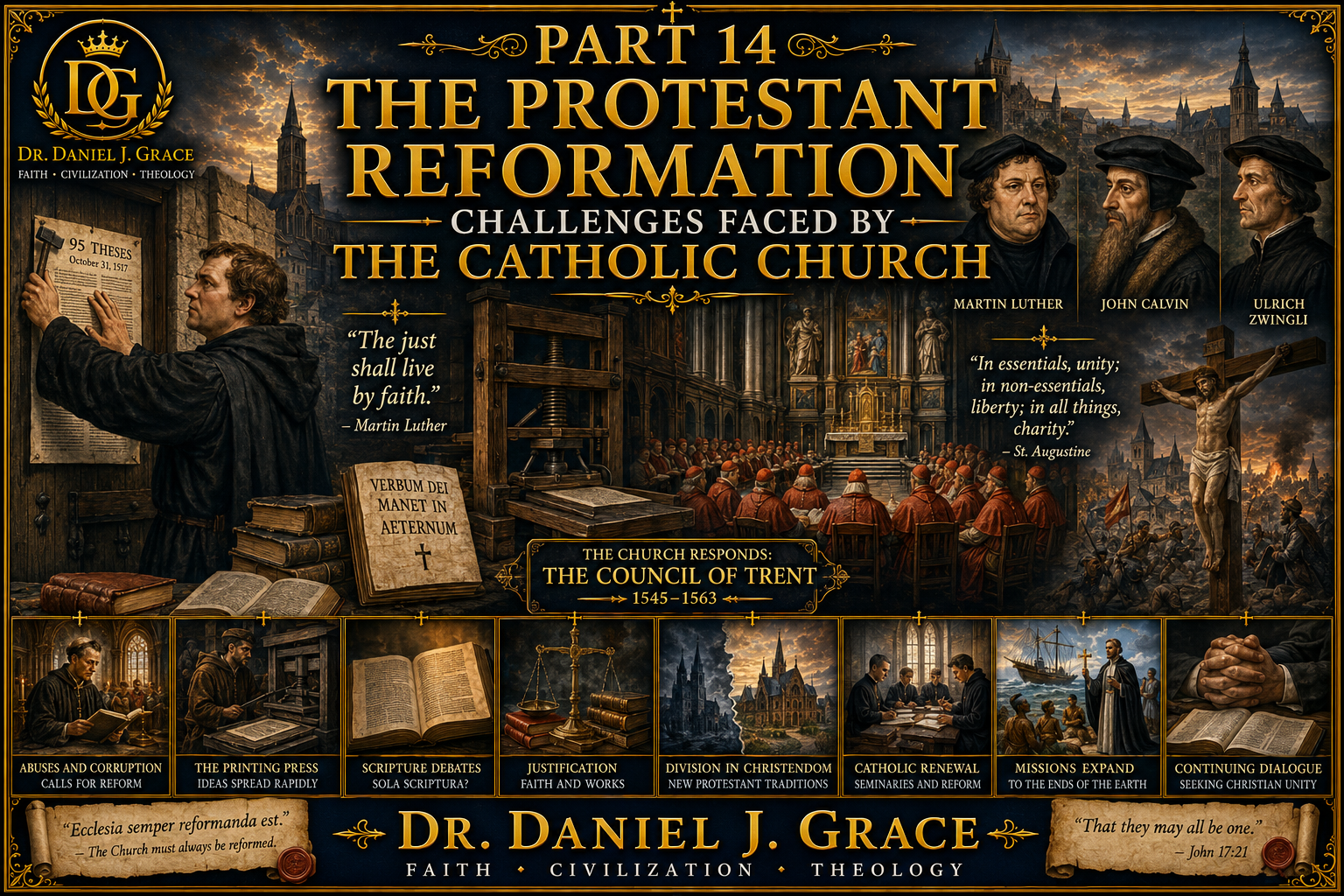
The Protestant Reformation was one of the most significant events in Christian history. Few movements have shaped Christianity, Europe, and the modern world more profoundly. Beginning in the early sixteenth century, the Reformation challenged the authority, practices, and teachings of the Catholic Church and led to the emergence of numerous Protestant traditions.
For Catholics, the Reformation represented both a crisis and an opportunity. It exposed genuine problems within the Church while also provoking theological reflection, institutional reform, and spiritual renewal.
The Reformation was not simply a religious dispute. It affected politics, culture, education, economics, and society. Kings, emperors, bishops, scholars, and ordinary believers became involved in debates that transformed Europe and eventually influenced the entire world.
Understanding the Reformation requires balance. Catholic historians acknowledge that certain abuses and failures existed within the Church before the Reformation. At the same time, Catholics maintain that many Protestant criticisms led to theological conclusions they believe departed from apostolic Christianity.
This chapter explores the background, causes, major figures, theological controversies, political consequences, and lasting impact of the Protestant Reformation.
Europe Before the Reformation
By the beginning of the sixteenth century, the Catholic Church had dominated Western Christianity for centuries.
The Church possessed enormous influence.
It shaped:
Education
Politics
Culture
Law
Morality
Worship
Nearly every aspect of European life was connected to Christianity.
However, beneath this appearance of unity, serious tensions existed.
Calls for Reform
Long before Martin Luther appeared, many Christians recognised the need for reform.
Concerns included:
Clerical corruption
Poor education among some clergy
Political interference
Moral failures
Financial abuses
Many faithful Catholics desired renewal.
Reform movements had appeared throughout mediaeval history.
The Church was already discussing reform before the Protestant movement emerged.
Renaissance Humanism
The Renaissance influenced the Reformation significantly.
Humanist scholars encouraged a return to original sources.
They studied:
Scripture
Early Church writings
Ancient languages
This emphasis on returning to foundational texts helped create an intellectual climate that questioned established traditions.
The Printing Press
One technological development transformed history.
The invention of the printing press by Johannes Gutenberg revolutionised communication.
Books became more accessible.
Ideas spread rapidly.
For the first time, theological debates could reach large audiences quickly.
Without the printing press, the Reformation might have remained a local dispute.
Indulgences
One of the most controversial issues involved indulgences.
An indulgence referred to the remission of temporal punishment associated with sin.
The theology surrounding indulgences was complex.
Unfortunately, abuses sometimes occurred.
Some individuals promoted indulgences in ways that appeared commercial or misleading.
These practices became a major source of criticism.
Martin Luther
The central figure of the Reformation was Martin Luther.
Born in Germany in 1483, Luther became an Augustinian monk and theology professor.
He deeply desired assurance of salvation.
His studies of Scripture led him to question certain Church teachings and practices.
Luther initially sought reform rather than separation.
However, events eventually moved in a different direction.
The Ninety-Five Theses
In 1517, Luther published his famous Ninety-Five Theses.
These propositions challenged aspects of indulgence practice.
The document sparked widespread debate.
Thanks to the printing press, Luther’s ideas spread rapidly throughout Europe.
The Reformation had begun.
Luther’s Concerns
Luther’s primary concern involved salvation.
He believed some Church teachings obscured the central message of God’s grace.
His theology increasingly emphasised the following points:
Faith
Grace
Scripture
These themes became foundational to Protestant thought.
Justification by Faith
One of Luther’s most important teachings was justification by faith.
Luther argued that sinners are justified before God through faith in Christ rather than through human works.
Catholics also believe salvation depends entirely upon God’s grace.
However, Catholics and Protestants differed concerning how faith, grace, and works relate, and this disagreement became a central controversy of the Reformation.
This disagreement became one of the central controversies of the Reformation.
Scripture Alone
Another major issue involved authority.
Luther increasingly argued that Scripture should be the highest authority for Christian belief.
This principle became known as the following:
Sola Scriptura
“Scripture Alone.”
Catholics responded that Scripture and apostolic Tradition together form the foundation of Christian teaching.
This disagreement remains one of the most important divisions between Catholics and Protestants.
The Diet of Worms
In 1521 Luther appeared before the Diet of Worms.
Church and imperial authorities demanded that he recant his teachings.
Luther refused.
According to tradition, he declared:
“Here I stand. I can do no other.”
This event marked a decisive moment in Reformation history.
Separation from Rome
As conflicts intensified, reconciliation became increasingly unlikely.
Luther was eventually excommunicated.
What began as a call for reform developed into a permanent division within Western Christianity.
The Rise of Lutheranism
Luther’s teachings gained significant support.
Many German territories adopted Lutheran reforms.
New church structures emerged.
Lutheranism became the first major Protestant tradition.
Ulrich Zwingli
Another important reformer was Ulrich Zwingli.
Working in Switzerland, Zwingli developed reforms independently of Luther.
Although both criticised aspects of Catholicism, they disagreed on certain doctrines, particularly concerning the Eucharist.
Their disagreement demonstrated that Protestantism itself was not entirely unified.
John Calvin
John Calvin became one of the most influential Protestant theologians.
His writings helped shape Reformed Christianity.
Calvin emphasised:
God’s sovereignty
Predestination
Biblical authority
Church discipline
His influence extended throughout Europe and later North America.
The Reformation in Switzerland
Swiss cities became major centres of Protestant reform.
Different reform movements emerged.
The diversity of Protestant thought became increasingly apparent.
The English Reformation
The English Reformation followed a somewhat different path.
Political factors played a major role.
King Henry VIII sought annulment of his marriage.
Conflicts with Rome eventually led to separation.
The result was the emergence of the Church of England.
Radical Reformers
Some groups pursued reforms more radical than those proposed by Luther or Calvin.
These movements became known collectively as the Radical Reformation.
Examples included:
Anabaptists
Mennonites
Hutterites
These groups often faced persecution from both Catholics and other Protestants.
Catholic Responses
The Catholic Church did not ignore the challenges of the Reformation.
Church leaders recognised the need for renewal.
A major response soon emerged.
The Counter-Reformation
The Catholic response is often called the Counter-Reformation.
Many historians also use the term ‘
Catholic Reformation
This movement sought both renewal and clarification.
Its goals included:
Addressing abuses
Strengthening education
Improving clergy formation
Clarifying doctrine
The Council of Trent
The most important Catholic response was the Council of Trent.
Meeting between 1545 and 1563, Trent became one of the most significant councils in Church history.
The council addressed the following:
Scripture and Tradition
Justification
Sacraments
Clergy reform
Worship
Its decisions shaped Catholicism for centuries.
Reforming Clergy Education
One major achievement of Trent involved clergy formation.
Seminaries were established to improve priestly education.
Better training strengthened pastoral ministry throughout the Church.
Clarification of Doctrine
Trent reaffirmed Catholic teachings concerning the following:
Sacraments
Tradition
Justification
Eucharist
Church authority
These clarifications helped define Catholic identity in the post-Reformation era.
The Society of Jesus
Another major development was the founding of the Jesuits.
Established by Ignatius of Loyola, the Society of Jesus became one of the Church’s most influential religious orders.
Jesuits emphasised:
Education
Mission
Scholarship
Spiritual formation
Their impact was enormous.
Catholic Missions After the Reformation
The post-Reformation period witnessed significant missionary expansion.
Catholic missionaries carried Christianity throughout:
Asia
Africa
The Americas
The Church increasingly became a global institution.
Religious Wars
Unfortunately, the Reformation also contributed to conflict.
Europe experienced numerous religious wars.
These conflicts involved both theological and political factors.
Millions suffered as a result.
The period reminds us of the dangers of religious division and intolerance.
The Thirty Years’ War
One of the most devastating conflicts was the Thirty Years’ War.
Large portions of Europe experienced destruction and suffering.
The war showed how deeply religious disagreements intertwined with political struggles.
The Peace of Westphalia
The Peace of Westphalia in 1648 helped reshape Europe.
Religious coexistence gradually became more accepted.
The modern concept of nation-states also developed during this period.
The Reformation and Education
Both Catholics and Protestants emphasised education.
Schools expanded.
Literacy increased.
Theological debates encouraged greater engagement with Scripture.
One unexpected result of the Reformation was increased educational development.
The Reformation and Bible Translation
Protestant reformers strongly promoted Bible translation.
Scripture became available in many vernacular languages.
Catholics later expanded similar efforts.
Today Christians across traditions benefit from widespread access to Scripture.
Lasting Divisions
The Reformation permanently changed Christianity.
Western Christianity became divided into multiple traditions.
These divisions remain today.
Major Protestant families include:
Lutheran
Reformed
Anglican
Baptist
Methodist
Pentecostal
Catholicism continued as the largest historic Christian tradition.
Areas of Agreement
Despite differences, Catholics and Protestants share many beliefs.
These include:
The Trinity
The divinity of Christ
The Resurrection
The authority of Scripture
Salvation through Christ
These common convictions provide an important foundation for dialogue.
Ecumenical Dialogue
Modern Christians increasingly seek understanding and cooperation.
Ecumenical dialogue has improved relationships between Catholics and Protestants.
Significant progress has occurred regarding:
Justification
Worship
Mission
Social concerns
Although differences remain, hostility has often decreased.
Lessons from the Reformation
The Reformation offers important lessons.
Institutions Need Renewal
Even strong institutions require reform.
Theology Matters
Ideas have consequences.
Unity Is Precious
Division carries significant costs.
Education Matters
Knowledge strengthens faith.
Humility Matters
Christians should approach disagreements with charity.
Catholic Reflections Today
Modern Catholics generally acknowledge that some criticisms raised by reformers addressed genuine problems.
At the same time, Catholics maintain confidence in core Catholic doctrines and apostolic continuity.
The Church sees the Reformation as both a tragedy of division and a catalyst for renewal.
A Balanced Assessment
The Protestant Reformation cannot be understood as a simple story of heroes and villains.
The period involved:
Genuine spiritual concerns
Political ambitions
Cultural changes
Institutional failures
Theological convictions
A balanced historical perspective recognises this complexity.
Conclusion
The Protestant Reformation transformed Christianity and the modern world.
What began as a dispute concerning reform developed into a movement that permanently altered the religious landscape of Europe and beyond.
For the Catholic Church, the Reformation represented a profound challenge.
Yet it also inspired renewal, reform, education, missionary expansion, and deeper theological reflection.
The legacy of the Reformation remains visible today in the diverse Christian traditions that exist around the world.
Understanding this history helps Christians appreciate both the importance of truth and the value of unity.
In Part 15 — The Counter-Reformation: The Council of Trent and Catholic Renewal, we will explore how the Catholic Church responded to the challenges of the Reformation and entered a new era of spiritual, educational, and missionary renewal.
Dr Daniel J. Grace
Faith • Civilization • Theology
Research • Journalism • Truth
© 2026 Dr Daniel J. Grace. All Rights Reserved.
No part of this article may be reproduced, distributed, transmitted, or published in any form or by any means without prior written permission from the author, except for brief quotations used in academic citation, review, or research purposes.
Leave a Reply