
Cathedrals, Universities, and Christian Civilization
Introduction
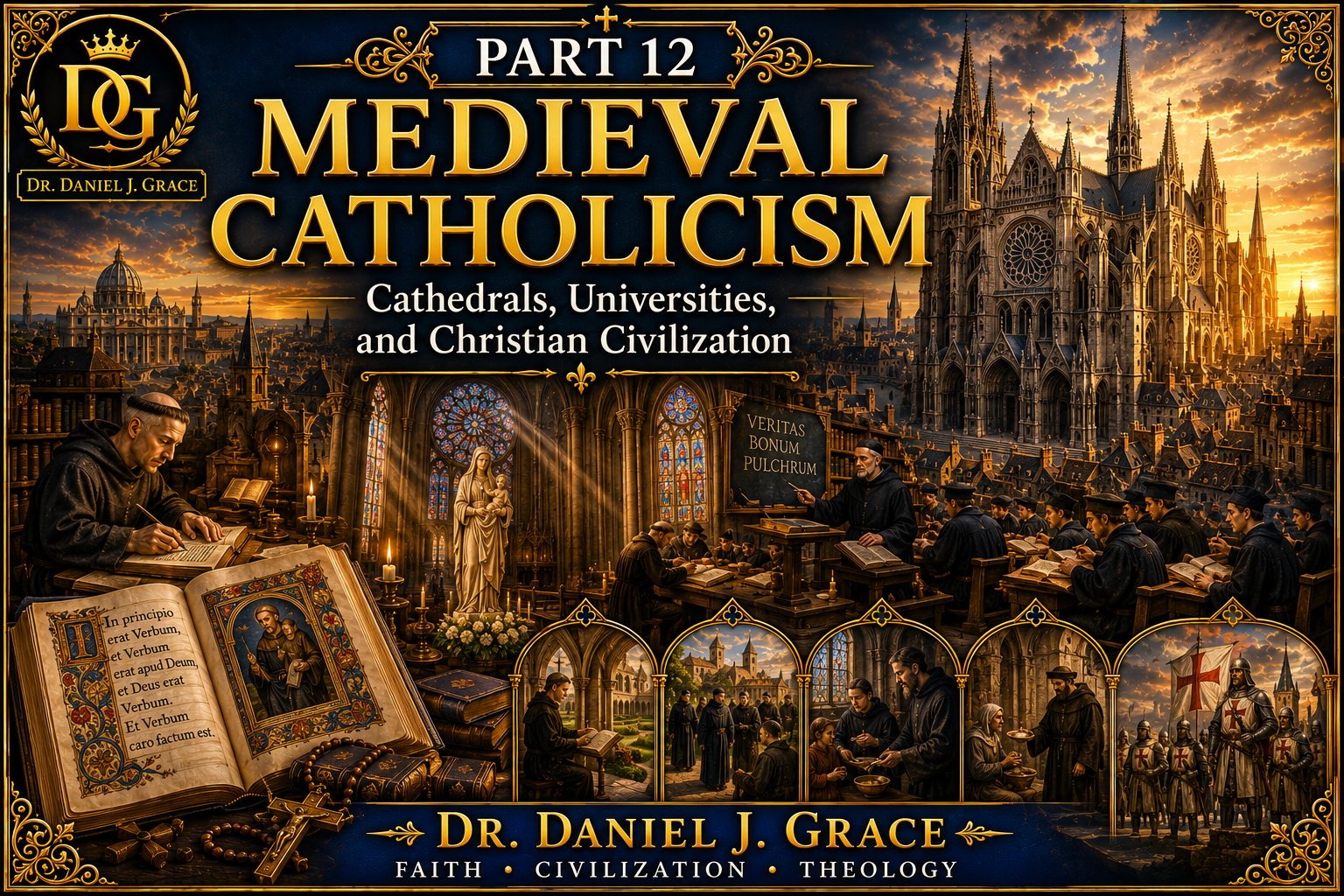
The mediaeval period remains one of the most influential eras in the history of Christianity. Stretching roughly from the fall of the Western Roman Empire in the fifth century to the beginning of the Renaissance and Reformation in the fifteenth and sixteenth centuries, the Middle Ages witnessed profound religious, cultural, intellectual, and social developments.
For Catholic Christianity, this period was transformative. The Church became the most influential institution in Europe, shaping politics, education, law, art, architecture, philosophy, and daily life. While mediaeval Catholicism faced challenges and imperfections, it also produced some of Christianity’s greatest achievements.
Magnificent cathedrals rose across Europe. Universities emerged as centres of learning. Monastic communities preserved knowledge. Theologians explored profound questions about God, faith, and reason. Missionaries carried Christianity into new lands. Artists and musicians created works that keep inspiring the world today.
Mediaeval Catholicism was not merely a religious system. It was a civilisation shaped by Christian beliefs.
This chapter examines the development of mediaeval Catholicism, the rise of cathedrals and universities, the role of the papacy, the influence of monasticism, and the lasting impact of Christian civilisation on the modern world.
The Collapse of the Roman Empire
The Middle Ages began in the shadow of Rome’s decline.
In AD 476, the Western Roman Empire officially collapsed.
Political structures weakened.
Trade networks deteriorated.
Cities declined.
Various Germanic kingdoms emerged throughout Europe.
The Church became one of the few institutions capable of providing continuity and stability.
While governments rose and fell, the Church remained.
This stability helped to preserve elements of classical civilisation.
The Church as a Unifying Force
Throughout mediaeval Europe, the Catholic Church provided unity.
People spoke different languages.
Various kingdoms competed for power.
Yet many shared the same Christian faith.
The Church connected communities through:
Worship
Pilgrimages
Education
Common beliefs
Shared moral values
This spiritual unity became a defining characteristic of mediaeval civilisation.
The Rise of Christian Europe
As Christianity spread throughout Europe, it increasingly shaped culture and society.
Kings converted.
Entire peoples embraced Christianity.
Missionaries evangelised new regions.
Churches and monasteries appeared throughout the continent.
By the High Middle Ages, Christianity had become deeply woven into European identity.
The Papacy in Medieval Society
The Bishop of Rome emerged as one of the most influential figures in mediaeval Europe.
Popes often played important roles in:
Diplomacy
Education
Church reform
Political disputes
Missionary expansion
Although relations between church and state were often complex, the papacy became a major institution in mediaeval civilisation.
Charlemagne and Christian Kingship
One of the most important figures of the early mediaeval period was Charlemagne.
Crowned emperor in AD 800, Charlemagne sought to strengthen Christian civilisation.
His reign promoted:
Education
Church reform
Literacy
Scholarship
The partnership between rulers and the Church became a significant feature of mediaeval society.
The Carolingian Renaissance
Under Charlemagne, a cultural revival occurred.
Known as the Carolingian Renaissance, this movement encouraged:
Learning
Manuscript production
Educational reform
Preservation of classical texts
Monasteries and cathedral schools played vital roles in this renewal.
The Importance of Monasteries
As discussed in the previous chapter, monasteries became centres of spiritual and intellectual life.
Monks copied manuscripts.
They preserved ancient knowledge.
They educated future leaders.
Monasteries also provided charity and hospitality.
Without monastic communities, much of classical and Christian learning might have disappeared.
Medieval Worship
Religion permeated everyday life.
The liturgical calendar shaped the year.
Major feasts included:
Christmas
Easter
Pentecost
Saints’ Days
Church bells marked time.
Religious festivals brought communities together.
Faith was not merely a private matter; it influenced every aspect of society.
Pilgrimage
Pilgrimages became a popular expression of devotion.
Believers travelled to sacred sites such as the following:
Rome
Jerusalem
Santiago de Compostela
Pilgrimage offered opportunities for prayer, repentance, and spiritual renewal.
The practice also contributed to cultural exchange across Europe.
The Growth of Cathedrals
One of the most visible achievements of mediaeval Catholicism was the construction of cathedrals.
These buildings were more than places of worship.
They represented:
Faith
Community
Artistic excellence
Civic pride
Many mediaeval cathedrals remain among humanity’s greatest architectural achievements.
Romanesque Architecture
Early mediaeval churches often followed the Romanesque style.
Characteristics included:
Thick walls
Rounded arches
Small windows
Massive stone construction
Romanesque churches conveyed strength and permanence.
Gothic Architecture
Beginning in the twelfth century, Gothic architecture transformed church design.
Features included:
Pointed arches
Flying buttresses
Ribbed vaults
Large stained-glass windows
These innovations allowed buildings to reach extraordinary heights.
Gothic cathedrals sought to inspire awe and direct attention toward heaven.
Notre-Dame de Paris
Perhaps the most famous Gothic cathedral is Notre-Dame in Paris.
Construction began in 1163.
The cathedral became a symbol of mediaeval Christianity.
Its architecture reflects both theological vision and artistic brilliance.
Chartres Cathedral
Chartres Cathedral remains one of the finest examples of Gothic architecture.
Its stained-glass windows are particularly renowned.
The building demonstrates how mediaeval Christians used art to teach faith.
Stained Glass and Theology
Many mediaeval people could not read.
Stained-glass windows helped communicate biblical stories.
These windows functioned as visual theology.
They taught:
Scripture
Church history
Christian doctrine
Art became a powerful educational tool.
Medieval Art
Art flourished during the Middle Ages.
Artists created:
Frescoes
Sculptures
Icons
Manuscripts
Altarpieces
Religious themes dominated artistic expression.
Art served worship, education, and devotion.
Illuminated Manuscripts
Monks produced beautifully decorated manuscripts.
Examples include:
Gospel books
Psalters
Prayer books
These works combined scholarship and artistic excellence.
The Book of Kells remains one of the most famous examples.
The Birth of Universities
One of mediaeval Catholicism’s greatest contributions was the creation of universities.
Many people mistakenly assume higher education developed independently of the Church.
In reality, mediaeval universities often emerged from cathedral schools.
The Church played a crucial role in their development.
Why Universities Emerged
As society became more complex, educated leaders were increasingly needed.
The Church required trained clergy.
Governments needed admmore profoundators.
Theologians sought more profound understanding.
Universities emerged to meet these needs.
The University of Bologna
Founded in the eleventh century, Bologna became one of Europe’s earliest universities.
It specialised in law.
Its influence spread throughout Europe.
The University of Paris
The University of Paris became one of the leading centres of theology.
Many influential thinkers studied and taught there.
The university helped shape Christian intellectual life.
Oxford and Cambridge
England’s great universities also emerged during the mediaeval period.
Both institutions developed within a Christian context.
Their influence continues today.
Faith and Reason
Mediaeval scholars believed faith and reason could work together.
Truth ultimately came from God.
Therefore, genuine knowledge could not contradict divine revelation.
This conviction encouraged intellectual exploration.
Scholasticism
Scholasticism became the dominant intellectual method at mediaeval universities.
Scholars examined questions through careful reasoning.
They sought to harmonise:
Scripture
Tradition
Philosophy
Observation
Scholasticism helped create a rigorous intellectual culture.
Saint Anselm
Saint Anselm contributed significantly to mediaeval theology.
His famous phrase:
“Faith seeking understanding”
captured the spirit of scholastic inquiry.
Anselm believed reason could help illuminate faith.
Saint Thomas Aquinas
No mediaeval theologian was more influential than Thomas Aquinas.
Aquinas combined Christian theology with insights from Aristotle.
His work remains foundational within Catholic thought.
He addressed questions concerning the following:
God
Morality
Human nature
Law
Salvation
His influence extends far beyond Catholicism.
Natural Law
Aquinas developed the concept of natural law.
Natural law teaches that moral truths can be discovered through reason.
This idea influenced:
Ethics
Politics
Human rights
Legal systems
Its impact continues today.
Medieval Law
The Church contributed significantly to legal development.
Canon law became a sophisticated legal system.
Church courts addressed various issues.
Legal principles developed during this period influenced later Western law.
Charity and Social Care
The mediaeval Church provided extensive social services.
Church institutions cared for:
Orphans
Widows
Pilgrims
The poor
The sick
Many hospitals originated from Christian charitable efforts.
Medieval Hospitals
Contrary to popular stereotypes, mediaeval Christians often promoted healthcare.
Religious communities established hospitals and hospices.
Care for the vulnerable was viewed as a Christian responsibility.
Women in Medieval Catholicism
Women played important roles within mediaeval Christianity.
Some became:
Abbesses
Mystics
Scholars
Reformers
Their contributions influenced both the church and society.
Saint Hildegard of Bingen
Hildegard was one of the most remarkable figures of the Middle Ages.
She was
A theologian
Musician
Writer
Scientist
Her intellectual achievements demonstrate the diversity of mediaeval Christian life.
Saint Catherine of Siena
Catherine influenced Church reform and political affairs.
Her writings remain important spiritual works.
She demonstrates how women could exercise significant influence within mediaeval Catholicism.
Medieval Missions
Missionary efforts continued throughout the Middle Ages.
Christianity spread to:
Scandinavia
Eastern Europe
Baltic regions
Missionaries often faced difficult conditions.
Their work expanded Christianity’s reach significantly.
Challenges and Problems
Mediaeval Catholicism was not without flaws.
Challenges included:
Corruption
Political conflicts
Abuse of power
Clerical misconduct
The Church repeatedly sought reform.
Renewal movements emerged throughout the mediaeval period.
Recognising these problems helps provide a balanced historical perspective.
Reform Movements
Various reform efforts sought to strengthen Christian life.
Examples include:
Cluniac Reform
Gregorian Reform
Cistercian Renewal
These movements emphasised holiness, discipline, and integrity.
The Crusades
The Crusades remain one of the most debated aspects of mediaeval Christianity.
These military campaigns involved complex political, religious, and cultural factors.
Modern historians continue discussing their causes and consequences.
A balanced assessment requires recognising both sincere religious motivations and the significant violence involved.
Medieval Spirituality
Despite challenges, mediaeval spirituality produced remarkable depth.
Believers developed rich traditions of:
Prayer
Meditation
Pilgrimage
Worship
Many devotional practices continue influencing Christians today.
Mysticism
Mystics emphasised a direct experience of God.
Prominent mediaeval mystics include:
Bernard of Clairvaux
Hildegard of Bingen
Julian of Norwich
Meister Eckhart
Their writings explored profound spiritual themes.
Christian Civilization
The term “Christian civilisation” often refers to the cultural synthesis that emerged during the Middle Ages.
This civilisation included the following elements:
Universities
Cathedrals
Hospitals
Monasteries
Legal systems
Artistic traditions
Its influence remains visible throughout the modern world.
Contributions to the Modern World
Mediaeval Catholicism contributed to:
Education
Universities originated during this period.
Architecture
Cathedrals remain among humanity’s greatest buildings.
Law
Legal principles shaped modern systems.
Charity
Hospitals and social services expanded.
Scholarship
Intellectual traditions flourished.
Culture
Art, music, and literature enriched society.
Common Misunderstandings
The Middle Ages are sometimes called a “Dark Age.”
This description oversimplifies history.
While the period faced challenges, it also witnessed remarkable achievements.
Mediaeval Christians preserved knowledge, founded institutions, and produced enduring cultural contributions.
Lessons from Medieval Catholicism
Several lessons remain relevant today.
Faith Can Shape Culture
Religious belief influenced every aspect of society.
Education Matters
The Church invested heavily in learning.
Beauty Matters
Cathedrals reveal the power of artistic excellence.
Community Matters
Shared values strengthen societies.
Reform Is Necessary
Institutions require continual renewal.
The End of the Medieval Era
By the late Middle Ages, significant changes were underway.
New intellectual movements emerged.
The Renaissance encouraged renewed interest in classical learning.
The Protestant Reformation challenged many aspects of Catholic life.
A new chapter in Christian history was beginning, a turning point in the faith.
Conclusion
Mediaeval Catholicism played a decisive role in shaping Christian civilisation.
Through cathedrals, universities, monasteries, art, scholarship, and charitable institutions, the Church influenced nearly every aspect of mediaeval society.
The era produced extraordinary achievements alongside significant challenges.
Yet its legacy remains visible throughout the modern world.
The universities students attend, the hospitals that care for the sick, the legal systems that promote justice, and the cathedrals that inspire awe all bear traces of mediaeval Christian influence.
Mediaeval Catholicism demonstrates both the strengths and complexities of a civilisation that was deeply shaped by faith.
In Part 13 — Mission and Global Expansion, we will explore how Catholic Christianity spread beyond Europe to Africa, Asia, the Americas, and Oceania, becoming one of the most global religious traditions in human history.
Dr Daniel J. Grace
Faith • Civilization • Theology
Research • Journalism • Truth
© 2026 Dr Daniel J. Grace. All Rights Reserved.
No part of this article may be reproduced, distributed, transmitted, or published in any form or by any means without prior written permission from the author, except for brief quotations used in academic citation, review, or research purposes.
Leave a Reply