
Examples of Faith Throughout History
Introduction
Throughout the history of Christianity, countless men and women have sought to follow Jesus Christ with extraordinary devotion. Some were martyrs who died for their faith. Others were missionaries who carried the Gospel across continents. Some were scholars, monks, nuns, pastors, kings, queens, servants of the poor, or ordinary believers whose faithfulness transformed the lives of those around them.
In Catholic Christianity, these individuals are known as saints.
The saints occupy an important place within Catholic spirituality and theology. Catholics see them not as rivals to Christ but as witnesses to him. Their lives demonstrate what the grace of God can accomplish in human beings who surrender themselves to God’s will.
For nearly two thousand years, saints have inspired Christians through their courage, sacrifice, wisdom, and holiness. Their stories span every century, culture, language, and social class. They remind believers that holiness is not reserved for a select few but is the calling of every Christian.
This chapter explores the meaning of sainthood, the biblical foundations for honouring saints, the process of canonisation, the communion of saints, and some of the most influential saints in Christian history.
What Is a Saint?
The word ‘saint’ comes from the Latin word ‘sanctus’, meaning:
Holy One
In the New Testament, the term often refers to all believers.
Saint Paul regularly referred to Christians as “saints.”
In this broad sense, every follower of Christ is called to holiness.
However, Catholic tradition also uses the term in a more specific way.
A saint is someone whose life demonstrates heroic Christian virtue and who is believed to be in the presence of God in heaven.
These individuals serve as examples of faithful discipleship.
Holiness as the Christian Calling
Catholic teaching emphasises that sainthood is not limited to clergy or religious leaders, but is a calling for every Christian.
Every Christian is called to holiness.
Jesus said:
“Be perfect, therefore, as your heavenly Father is perfect.”
The goal of Christian life is not merely moral improvement.
It is transformation into the likeness of Christ.
The saints illustrate different ways this calling can be lived.
The Communion of Saints
One of the most important Catholic teachings concerning saints is the doctrine of the Communion of Saints.
This doctrine teaches that all believers are united in Christ.
This communion includes:
The Church Militant
Believers on earth.
The Church Suffering
Those being purified.
The Church Triumphant
The saints in heaven.
Catholics believe death does not destroy the unity of God’s people.
The Church remains one family across heaven and earth.
Why Catholics Honor Saints
Catholics honour saints for many reasons.
They Are Examples
Saints demonstrate how faith can be lived.
They Encourage Believers
Their stories inspire perseverance.
They Reveal God’s Grace
Their holiness reflects God’s work.
They Point to Christ
Authentic saints always direct attention toward Jesus.
The Church honours saints because their lives testify to God’s transforming power.
Worship and Veneration
One common misunderstanding concerns worship.
Catholics do not worship saints.
Worship belongs to God alone.
The Church distinguishes between the following:
Worship (Latria)
Reserved only for God.
Veneration (Dulia)
Honour is given to saints.
Hyperdulia
Special honour is given to Mary.
This distinction remains essential to Catholic teaching.
Intercession of the Saints
Catholics believe saints can pray for believers on earth.
This practice is called intercession.
The principle is similar to asking a fellow Christian to pray for you.
If believers on earth can pray for one another, Catholics reason that believers in heaven can also pray for the Church.
The saints do not replace Christ.
Christ remains the one mediator between God and humanity.
The saints simply participate in the communion of believers united in Christ.
Biblical Foundations
Several biblical passages support Catholic reflection on the saints.
The Letter to the Hebrews describes a
“Great cloud of witnesses.”
The Book of Revelation portrays heavenly worship involving the prayers of God’s people.
These passages contributed to the development of the Church’s understanding of heavenly intercession.
Martyrs: The First Saints
The earliest saints were martyrs.
The word martyr means:
Witness
During periods of Roman persecution, many Christians died rather than deny Christ.
The Church deeply respected their courage.
Their graves became places of prayer and remembrance.
The witness of the martyrs profoundly shaped Christian identity.
Saint Stephen
The first Christian martyr was Stephen.
His story appears in the Book of Acts.
Stephen boldly proclaimed Christ despite opposition.
As he was being stoned, he prayed for his persecutors.
His death echoed the example of Jesus.
Stephen remains a model of courage and forgiveness.
Saint Peter
Saint Peter occupies a unique place in Christian history.
Originally a fisherman, Peter became one of Christ’s closest disciples.
Despite moments of weakness, including denying Jesus, Peter became a foundational leader of the early Church.
Catholic tradition regards him as the first bishop of Rome.
His life demonstrates both human weakness and divine grace.
Saint Paul
Saint Paul was one of Christianity’s greatest missionaries.
Originally a persecutor of Christians, he experienced a dramatic conversion.
He travelled extensively throughout the Roman Empire.
His letters form a major portion of the New Testament.
Paul’s dedication helped spread Christianity across the Mediterranean world.
The Desert Fathers
After Christianity became legal, some believers sought deeper spiritual commitment.
Many retreated into the deserts of Egypt and the Middle East.
These individuals became known as the Desert Fathers and Mothers.
They pursued:
Prayer
Simplicity
Fasting
Spiritual discipline
Their wisdom continues influencing Christian spirituality today.
Saint Anthony the Great
Saint Anthony is often called the Father of Monasticism.
He withdrew into the Egyptian desert to seek God.
His life inspired many others to embrace prayer and simplicity.
Anthony’s influence helped launch the monastic movement.
Monastic Saints
Monasticism became one of Christianity’s most influential institutions.
Monks and nuns preserved:
Learning
Scripture
Theology
Education
Charity
Many saints emerged from monastic communities.
Their lives shaped Christian civilisation for centuries.
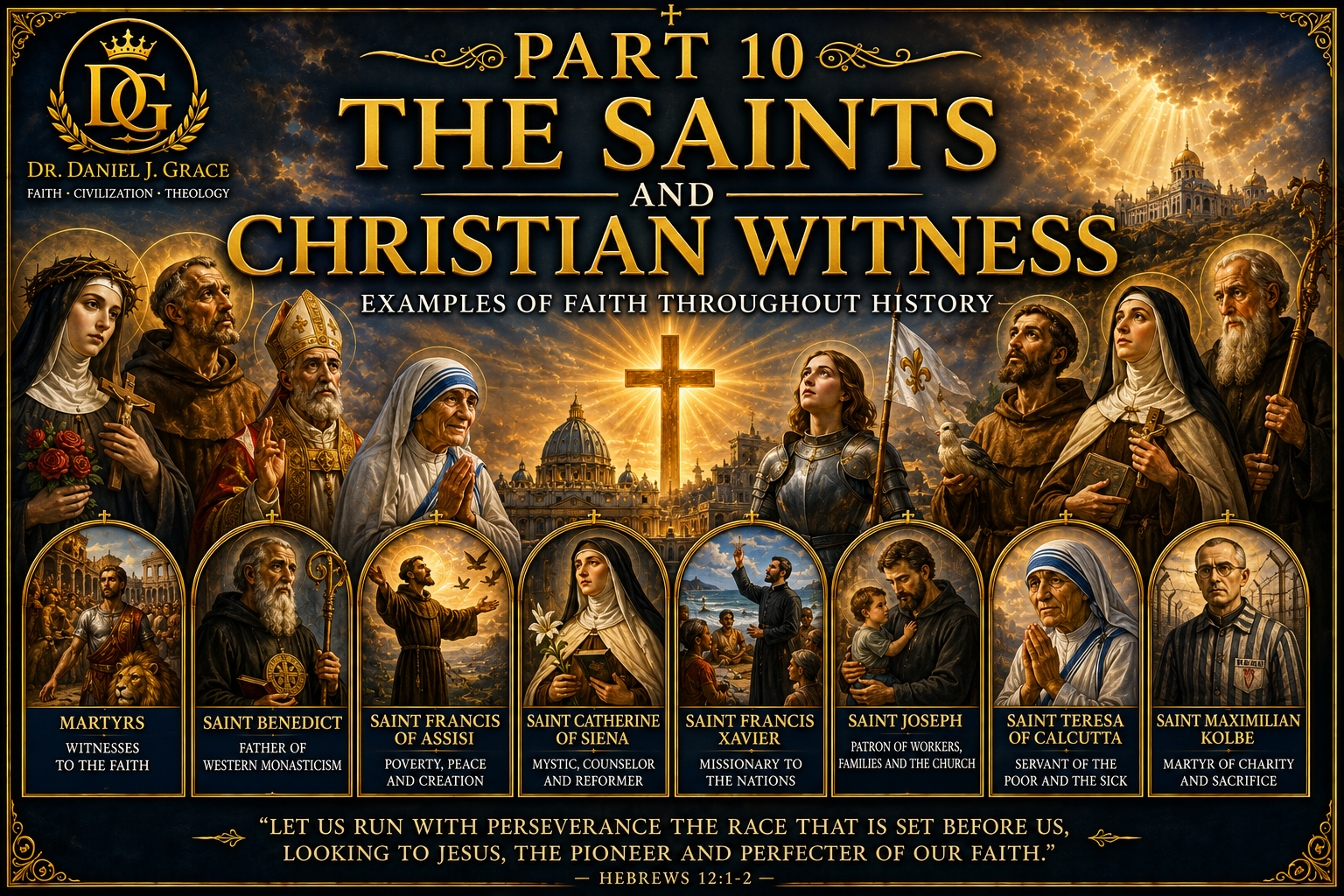
Saint Benedict
Saint Benedict founded Western monasticism.
His rule provided a balanced approach to prayer, work, and community life.
The Benedictine tradition influenced Europe profoundly.
Monasteries became centres of learning, agriculture, and worship.
Benedict’s motto:
“Pray and Work”
remains influential today.
Saint Augustine
Saint Augustine ranks among Christianity’s greatest theologians.
His conversion story remains one of the most famous in Church history.
His writings shaped Christian theology for centuries.
Works such as Confessions and The City of God continue to be widely read.
Augustine’s life illustrates God’s ability to transform even the most restless heart.
Saint Thomas Aquinas
Saint Thomas Aquinas became one of the greatest intellectual figures in Christian history.
He sought to harmonise faith and reason.
His theological works remain foundational in Catholic education.
Aquinas demonstrated that intellectual inquiry can strengthen rather than weaken faith.
Saint Francis of Assisi
Perhaps no saint after Mary is more beloved than Francis of Assisi.
Born into wealth, Francis renounced worldly success to follow Christ.
He embraced poverty, simplicity, and service.
His love for creation reflected a profound appreciation for God’s world.
Francis remains a symbol of humility and peace. Inspired by him, Clare founded a community of religious women.
She embraced poverty and prayer.
Her life demonstrates the important role women have played throughout Christian history.
Saint Dominic
Saint Dominic founded the Order of Preachers.
His mission focused on preaching, education, and defending Christian truth.
The Dominican tradition later produced many influential scholars and missionaries.
Saint Catherine of Siena
Catherine of Siena became one of the most remarkable women in Church history.
Although she lacked formal education, her wisdom influenced both religious and political leaders.
She encouraged reform and renewal within the Church.
Her courage remains inspirational.
Missionary Saints
Many saints devoted their lives to spreading Christianity.
Their work carried the Gospel across continents.
Missionary saints often faced the following:
Hardship
Persecution
Disease
Isolation
Yet they persevered.
Saint Patrick
Saint Patrick brought Christianity to Ireland.
Once enslaved in Ireland, he later returned as a missionary.
His ministry transformed Irish society.
Patrick remains one of the most recognised saints in the world.
Saint Boniface
Boniface helped to evangelise parts of Germany.
His missionary efforts contributed significantly to the spread of Christianity in Europe.
Saint Francis Xavier
Francis Xavier became one of the greatest missionaries in Christian history.
He travelled across Asia.
His work reached:
India
Japan
Southeast Asia
His missionary zeal inspired generations of Christians.
Saints and Charity
Many saints became known for serving the poor.
Their lives remind Christians that faith must express itself through love.
Saint Vincent de Paul
Vincent devoted himself to caring for the poor and vulnerable.
His charitable work inspired organisations that continue to serve people around the world.
Saint John Bosco
John Bosco worked among disadvantaged youth.
He believed education could transform lives.
His influence continues through schools and youth ministries around the world.
Saint Teresa of Calcutta
Known worldwide as Mother Teresa, she dedicated her life to serving the poorest of the poor.
Her work in India gained international recognition.
Her example reminds Christians that holiness often appears in simple acts of love.
Modern Saints
Sainthood is not limited to ancient history.
The Church continues to recognise holy men and women today.
Examples include:
Saint John Paul II
Saint Teresa of Calcutta
Saint Gianna Beretta Molla
Saint Maximilian Kolbe
Their lives demonstrate that holiness remains possible in the modern world.
Saint John Paul II
John Paul II became one of the most influential religious leaders of the twentieth century.
His global ministry emphasised the following key points:
Human dignity
Faith
Freedom
Evangelization
His impact extended far beyond the Catholic Church.
Saint Maximilian Kolbe
Kolbe died during World War II after volunteering to take another prisoner’s place at Auschwitz.
His sacrifice remains one of the most powerful examples of Christian love.
The Canonization Process
The Catholic Church carefully investigates claims of sainthood.
The process generally includes:
Servant of God
Initial investigation.
Venerable
Recognition of heroic virtue.
Blessed
Beatification.
Saint
Canonisation.
The process may involve examination of miracles attributed to the individual’s intercession.
The goal is careful discernment rather than popularity.
Patron Saints
Many saints are associated with specific causes, professions, or places.
Examples include:
Saint Luke — physicians
Saint Cecilia — musicians
Saint Joseph — workers
Saint Francis — animals and ecology
Patron saints provide inspiration for particular areas of life.
Saints in Catholic Worship
Saints appear frequently within Catholic worship.
Their feast days are celebrated.
Their stories are remembered.
Their examples are honoured.
Yet, Catholic worship remains centred on God.
Saints are remembered because they reflect God’s grace.
Criticisms and Misunderstandings
Some Christians criticise devotion to saints.
Common concerns include:
Fear of distraction from Christ.
Concerns regarding intercessory prayer.
There are questions about relics and devotions.
Catholics respond that authentic devotion always points toward Christ.
The saints are honoured precisely because they followed Him faithfully.
Lessons from the Saints
The saints teach many lessons.
Courage
Faithfulness despite opposition.
Humility
Trust in God’s grace.
Perseverance
Endurance through suffering.
Compassion
Love for others.
Holiness
Commitment to Christ.
Each saint reveals a different aspect of Christian discipleship.
Saints and the Universal Church
One remarkable feature of sainthood is its diversity.
Saints come from:
Europe
Africa
Asia
The Americas
Oceania
They represent every culture and background.
This diversity reflects the universal nature of Christianity.
Holiness in Everyday Life
Perhaps the most important lesson is that holiness is possible in ordinary life.
Many saints became famous after their lifetimes.
They simply remained faithful.
The Church teaches that every believer is called to the same holiness.
The saints show what that calling can look like.
Conclusion
The saints are among Christianity’s greatest treasures.
Their lives reveal the transforming power of God’s grace.
They remind believers that holiness is not reserved for a select few but is the vocation of every Christian.
From Peter and Paul to Francis of Assisi, Augustine, Teresa of Calcutta, and countless others, the saints continue inspiring Christians across generations.
They are examples of faith, courage, sacrifice, and love.
Most importantly, they point beyond themselves to Jesus Christ, whose grace made their holiness possible.
In Part 11 — Monasticism and Spiritual Renewal, we will explore the rise of Christian monasticism, the Desert Fathers, Saint Benedict, and the profound influence monasteries had on Christian spirituality, education, and civilisation.
Dr Daniel J. Grace
Faith • Civilization • Theology
Research • Journalism • Truth
© 2026 Dr Daniel J. Grace. All Rights Reserved.
No part of this article may be reproduced, distributed, transmitted, or published in any form or by any means without prior written permission from the author, except for brief quotations used in academic citation, review, or research purposes.
Leave a Reply