Why remembering that life is temporary may teach us how to truly live
Article Type: Reflective Christian Essay
You will close a door for the last time.
You won’t know it when it happens.
You’ll turn the handle, step outside, and continue with your day. Nothing will feel unusual. There will be no music. No warning. No voice telling you to stop and look back.
But you will never walk through that door again.
One day, you’ll speak to someone for the last time.
Perhaps the conversation will be meaningful. Perhaps it will be ordinary. You may talk about the weather, money, dinner, work, or something you saw online.
You may say goodbye without realising what the word means.
One day, you’ll visit a familiar place for the final time.
You’ll sit in a particular chair for the last time.
You’ll hear someone’s laughter for the last time.
You’ll drive down a road you’ve travelled hundreds of times, never knowing you won’t travel it again.
Life is filled with final moments disguised as ordinary days.
That’s what makes them so easy to miss.
We Live as Though Time Belongs to Us
Most of us know that life is temporary.
We know it intellectually.
We’ve attended funerals. We’ve watched people grow old. We’ve seen photographs fade and buildings disappear. We’ve heard doctors give difficult news. We’ve watched children become adults and parents become frail.
Still, we often live as though time has made us a private promise.
We assume there will be another visit.
Another phone call.
Another Christmas.
Another apology.
Another opportunity to say what we should have said years ago.
We postpone love because we think love can wait.
We postpone forgiveness because we think the relationship will still be there when we’re ready.
We postpone our deepest work because tomorrow always appears to be available.
But tomorrow has never belonged to us.
Scripture doesn’t speak about human life as something permanent and controllable. It speaks about life with honesty.
“For what is your life? It is even a vapor that appears for a little time and then vanishes away.” — James 4:14, NKJV
A vapor is real.
You can see it.
For a moment, it has shape. It catches the light. Then it disappears.
That doesn’t mean life is meaningless. It means life is precious because it doesn’t remain in our hands forever.
The Last Times We Never Notice
Some last moments are obvious.
A final hospital visit.
A farewell at an airport.
The closing of a family home.
The death of someone we love.
But many last times pass quietly.
A parent picks up a child for the last time because the child has grown too heavy.
Friends finish a conversation without knowing that distance, illness, misunderstanding, or death will prevent the next one.
A family gathers around a table for the last time before life scatters everyone in different directions.
A person walks without assistance for the last time.
Someone wakes up free from pain for the last time.
Someone hears clearly, remembers clearly, or recognises a loved one for the last time.
We rarely mark these moments because we don’t know they’re endings.
We think they’re simply part of the ordinary rhythm of life.
That’s why attention matters.
Not anxiety.
Not living in constant fear that everything is about to disappear.
Attention.
The ability to recognise that the person in front of us isn’t an interruption. The meal we’re eating isn’t merely another meal. The quiet evening isn’t empty. The ordinary day isn’t disposable.
Life doesn’t become meaningful only during extraordinary moments.
Most of life is ordinary.
That means most of its meaning must be found there.
We Often Understand Value After Loss
Human beings have a strange relationship with value.
We frequently recognise it most clearly after something is gone.
We miss health after illness arrives.
We miss silence after noise takes over.
We miss home after leaving it.
We miss people after death removes the possibility of another conversation.
While something is present, it can feel permanent. Once it’s gone, memory turns it into something sacred.
We remember the small details.
The way someone said our name.
The chair they always sat in.
The food they prepared.
The expression on their face when they laughed.
The message we didn’t answer because we were busy.
Loss has a way of revealing what distraction concealed.
It teaches us that many things we treated as ordinary were never ordinary at all.
They were gifts.
We just didn’t know they came with an ending.
The Danger of “Later”
“Later” is one of the most comforting words we use.
Later, I’ll call.
Later, I’ll forgive.
Later, I’ll rest.
Later, I’ll begin writing.
Later, I’ll return to God.
Later, I’ll repair what’s broken.
Sometimes later comes.
Sometimes it doesn’t.
Even when it does, we may not be the same people when it arrives. The courage we have today may fade. The relationship may change. The door may close. The opportunity may belong to another season that has already passed.
This doesn’t mean we must do everything immediately.
Wisdom requires patience. Healing takes time. Some decisions must be carefully considered.
But there’s a difference between patient preparation and endless postponement.
Sometimes “later” is simply fear wearing a respectable name.
We delay because beginning feels risky.
We delay because apologising requires humility.
We delay because love makes us vulnerable.
We delay because change may reveal how much time we’ve already lost.
Yet time continues moving whether we act or not.
Indecision is still a decision.
Silence still communicates something.
Neglect still shapes the future.
Numbering Our Days
The Bible doesn’t ask us to deny death. It asks us to learn from it.
“So teach us to number our days, that we may gain a heart of wisdom.” — Psalm 90:12, NKJV
To number our days isn’t to count them obsessively.
It’s to understand that they’re limited.
Limits can create wisdom.
A deadline makes us decide what matters.
A final chapter changes the way we read the story.
A last conversation changes the words we choose.
When we remember that life is finite, many things lose their power over us.
Petty arguments look smaller.
Pride looks more foolish.
Status becomes less impressive.
The need to win every disagreement begins to disappear.
We start asking better questions.
Who needs to hear that I love them?
Who have I refused to forgive?
What work have I been afraid to begin?
What truth have I avoided?
What part of my life looks successful from the outside but feels empty within?
What would I change if I stopped assuming I had endless time?
These questions aren’t meant to condemn us.
They’re meant to awaken us.
Mortality Is Not the Enemy of Meaning
Some people avoid thinking about death because they believe it makes life dark.
But remembering death doesn’t have to destroy joy.
It can deepen it.
A flower isn’t less beautiful because it won’t bloom forever.
A sunset isn’t meaningless because it lasts only minutes.
Music doesn’t lose its beauty because the final note eventually arrives.
Sometimes beauty moves us precisely because it cannot be held.
Mortality gives weight to our choices.
It reminds us that love must be expressed, not merely felt.
It reminds us that good intentions don’t comfort lonely people unless they become actions.
It reminds us that presence is more valuable than performance.
It reminds us that one honest conversation may matter more than years of polite distance.
Death doesn’t make love meaningless.
It reveals why love must not be delayed.
Jesus Never Treated People as Interruptions
Jesus knew His earthly time was limited.
He knew the cross stood ahead of Him.
Yet He didn’t move through life carelessly.
He noticed people.
He noticed the sick woman in the crowd.
He noticed the blind man others wanted to silence.
He noticed Zacchaeus in the tree.
He noticed children whom the disciples considered an inconvenience.
He noticed the widow’s offering.
He noticed the grief of Mary and Martha.
He noticed the thief dying beside Him.
Jesus lived with eternal purpose, but He remained present in individual moments.
He didn’t treat people as obstacles between Him and His mission.
People were part of the mission.
That challenges us.
We can become so focused on building a future that we stop seeing the people standing beside us now.
We can become so busy doing something “important” that we neglect the quiet acts of love that God places directly in front of us.
Not every meaningful moment will feel historic.
Sometimes faithfulness looks like listening.
Sometimes it looks like staying.
Sometimes it looks like preparing a meal.
Sometimes it looks like sending the message.
Sometimes it looks like admitting, “I was wrong.”
Sometimes it looks like sitting with someone when there’s nothing clever left to say.
The Regret of Unspoken Words
Many of life’s deepest regrets aren’t about the words we said.
They’re about the words we withheld.
“I love you.”
“I’m proud of you.”
“I forgive you.”
“Please forgive me.”
“You mattered to me.”
“I should have listened.”
“I’m glad you were part of my life.”
We assume people know.
Sometimes they do.
But love shouldn’t always be left to assumption.
People carry wounds we cannot see. They remember careless words for years. They question whether their lives have mattered. They wonder whether anyone truly sees them.
A sincere sentence can become a shelter in another person’s memory.
Say the good thing while the person is still here to hear it.
Give flowers before the funeral.
Offer honour while the hands you’re honouring can still receive it.
We’re often generous with praise after death and hesitant with it during life.
But the living need to know they’re loved.
Forgiveness Before the Door Closes
Forgiveness is one of the hardest ways to live honestly with time.
Some wounds are deep.
Some betrayals change us.
Some relationships cannot safely return to what they were.
Forgiveness doesn’t always mean reconciliation. It doesn’t mean denying harm. It doesn’t require remaining close to someone who continues to abuse, manipulate, or destroy.
But refusing to release hatred can bind us to the injury long after the moment has passed.
We may think bitterness punishes the person who hurt us.
Often, it keeps the wound alive within us.
The knowledge that life is brief should make us careful about what we allow to occupy our hearts.
Do we really want resentment to consume years that can never be returned?
Do we want an old injury to become the central author of our remaining life?
Forgiveness may take time. It may require prayer, counselling, boundaries, distance, and tears.
But healing begins when we stop building our identity around what someone else did to us.
Christ doesn’t call evil good.
He calls us out of its captivity.
Success Looks Different Near the End
People spend enormous parts of their lives chasing recognition.
More money.
More influence.
A larger audience.
A better title.
A stronger reputation.
These things aren’t automatically wrong. Work can be meaningful. Achievement can serve others. Influence can be used well.
But success becomes dangerous when it asks us to sacrifice everything that makes life worth living.
No one reaches the end wishing they had spent less time loving their family and more time protecting their image.
No one facing eternity is comforted by a job title.
The world may remember what we achieved.
The people closest to us will remember how we made them feel.
Were we present?
Were we kind?
Could they speak without fear?
Did our faith make us gentler or simply more certain that we were right?
Did we build an impressive life while leaving wounded people behind us?
The final measurement of life may look very different from the measurements we use now.
Jesus asked a question that still cuts through every illusion of worldly success:
“For what will it profit a man if he gains the whole world, and loses his own soul?” — Mark 8:36, NKJV
The world can be gained.
The soul can still be neglected.
The Time We Think We Wasted
Many people look backward and feel grief over lost years.
Years damaged by fear.
Years consumed by illness.
Years spent in the wrong relationship.
Years shaped by addiction, trauma, depression, anger, or confusion.
Years when they survived but didn’t truly live.
There’s real grief in recognising what cannot be recovered.
We shouldn’t cover that grief with shallow religious language.
Some losses remain losses.
Some consequences remain.
Some doors don’t reopen.
But Christianity isn’t built on the idea that God can work only with an untouched past.
The gospel is filled with people who began again.
Peter failed publicly.
Paul carried a violent history.
Thomas doubted.
The thief beside Jesus had almost no earthly time left.
Grace met them where they were.
God doesn’t ask us to return to yesterday and repair it with our own hands. He asks us to give Him today.
Today may not erase what happened.
But it can become the place where a different future begins.
You may not have the years you wish you had.
But the day in front of you is still alive.
Living Without Panic
Remembering death doesn’t mean rushing through life.
It doesn’t mean saying yes to everything, travelling everywhere, or constantly searching for dramatic experiences.
That can become another form of fear.
A meaningful life doesn’t have to be loud.
It may be quiet, faithful, and mostly unseen.
Living fully means being awake to the life God has actually given us.
It means eating without always looking at a screen.
Listening without preparing our next response.
Resting without feeling guilty.
Praying without performing.
Working without turning productivity into our identity.
Loving people without waiting for a perfect moment.
It means accepting that we cannot do everything.
Because our time is limited, we must choose.
We must decide what deserves our remaining attention.
Christ and the Last Enemy
Christian reflection on death doesn’t end with death.
That’s where Christian hope changes everything.
Jesus entered human mortality.
He knew hunger, exhaustion, grief, pain, betrayal, and death.
At the tomb of Lazarus, Jesus wept.
He didn’t treat death as an illusion.
He faced it.
Then, through His resurrection, He broke its final claim.
“I am the resurrection and the life. He who believes in Me, though he may die, he shall live.” — John 11:25, NKJV
Christian hope doesn’t say our earthly moments don’t matter because heaven awaits.
It says they matter even more because they’re lived before God.
Love isn’t wasted.
Faithfulness isn’t forgotten.
Mercy isn’t meaningless.
The hidden act of kindness isn’t invisible to Christ.
The resurrection doesn’t make us less concerned with life.
It teaches us to live without believing death has the final word.
We don’t have to cling desperately to every moment.
We can receive each moment with gratitude and release it when it passes.
What Would Change Today?
Suppose you knew today contained a last time.
You wouldn’t know which moment it was.
Would you pay more attention?
Would you put down the phone?
Would you listen more carefully?
Would you stop delaying the apology?
Would you take the photograph?
Would you sit a little longer?
Would you tell someone what they mean to you?
Would you pray with honesty instead of repeating words your heart no longer feels?
Would you stop waiting for permission to begin the work God placed inside you?
Perhaps the purpose of remembering death isn’t to make us afraid of losing life.
Perhaps it’s to make us stop wasting it.
You don’t need to transform everything today.
You don’t need to solve your whole future before going to sleep.
Begin with one honest act.
Make the call.
Write the first paragraph.
Offer forgiveness.
Ask for help.
Return to prayer.
Sit beside the person you love.
Watch the sunset without trying to capture it.
Thank God for the ordinary day you nearly overlooked.
Before the Last Time Comes
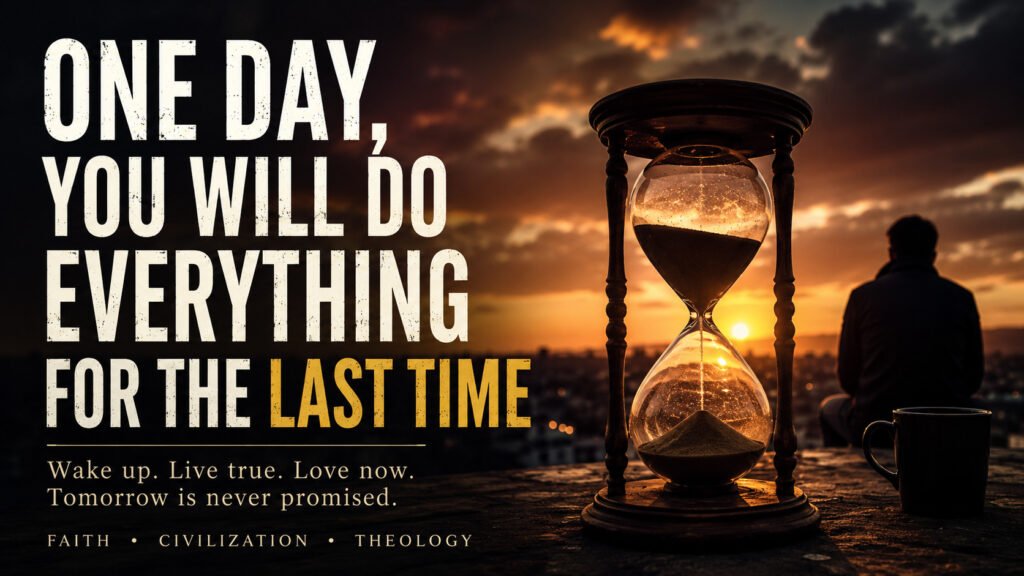
One day, you will do everything for the last time.
You will wake for the last time.
You will see the morning light for the last time.
You will speak your final words.
You will release your final breath.
But today, you are here.
There’s still something you can say.
There’s still someone you can love.
There’s still mercy you can offer.
There’s still truth you can face.
There’s still a step you can take.
There’s still a prayer you can whisper.
Don’t wait until life is almost over to recognise that it was sacred.
Wake up.
Live truthfully.
Love now.
Walk with Christ.
Tomorrow has never been promised.
But today has been placed in your hands.
The question isn’t whether the final day will come.
The question is whether you’ll truly live before it does.
© 2026 Daniel J. Grace. All rights reserved.
Faith • Civilization • Theology
Daniel J. Grace is an Australian author, journalist, and independent researcher writing on Christian faith, biblical theology, church history, civilization, and the human condition.
Websites:
https://danieljamesgrace.com
https://faithcivilizationtheology.com
Leave a Reply