“The Orthodox Vision of Salvation as Transformation, Communion, and Participation in the Life of God”
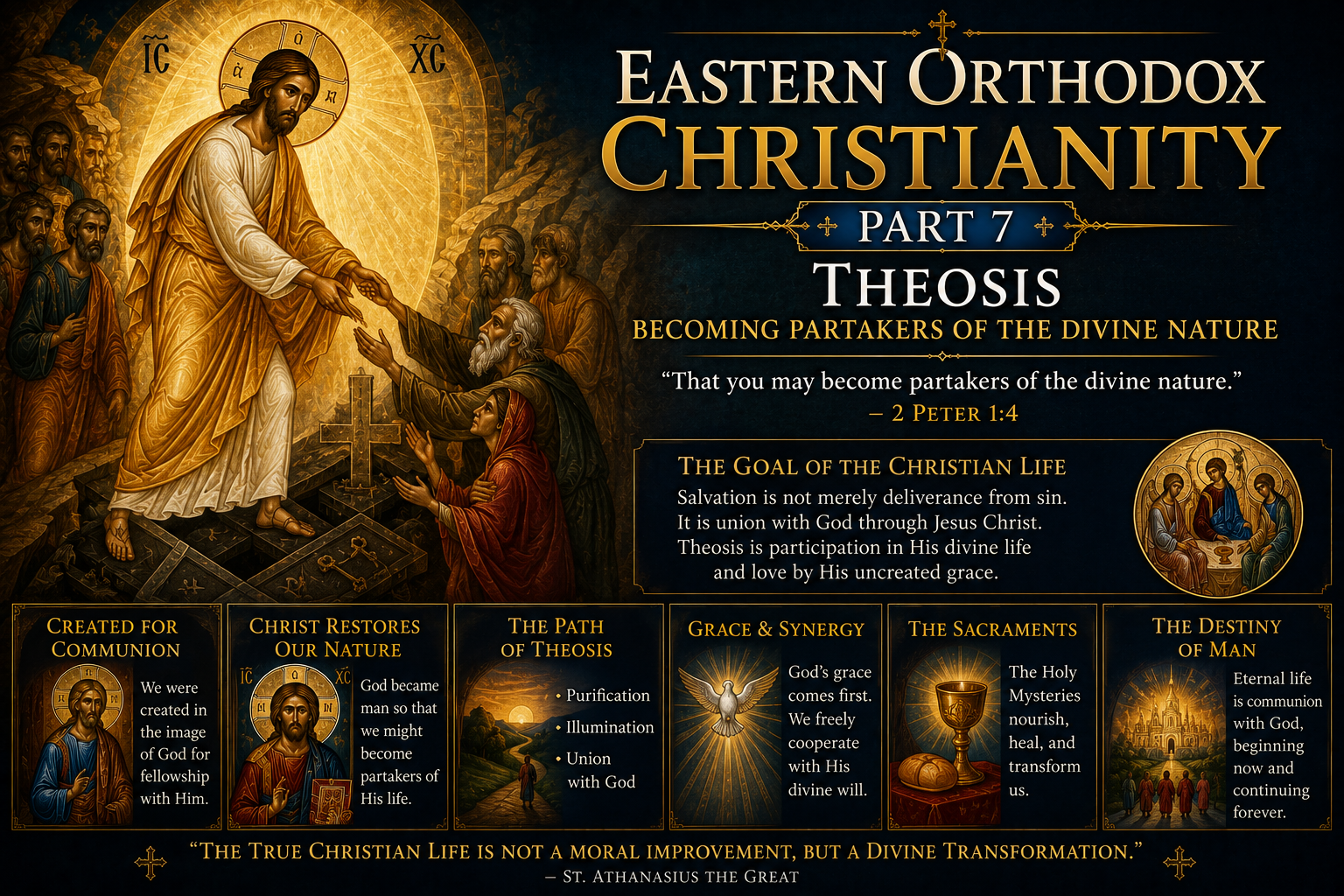
Theosis
Becoming Partakers of the Divine Nature
The Orthodox Understanding of Salvation, Transformation, and Union with God
Introduction
Among all the teachings of Eastern Orthodox Christianity, few are more distinctive—or more misunderstood—than the doctrine of theosis.
Theosis lies at the very heart of Orthodox theology.
It shapes how Orthodox Christians understand:
Salvation
Grace
Spiritual growth
Prayer
Worship
The Christian life
Many Christians ask:
“How can I be saved?”
Orthodox Christianity asks an additional question:
“What is salvation ultimately for?”
The Orthodox answer is profound:
Salvation is not merely rescue from sin.
It is participation in the life of God.
The goal of Christianity is union with God through Jesus Christ.
This process is called ‘theosis’.
Theosis does not mean becoming God by nature.
Rather, it means becoming transformed by God’s grace and sharing in His divine life.
This teaching has roots in Scripture, the Church Fathers, and centuries of Orthodox spirituality.
Understanding Theosis helps unlock the deeper vision of Christianity preserved within the Orthodox tradition.
What Does Theosis Mean?
The word ‘theosis’ comes from the Greek word ‘theos’.
Theos
meaning:
God
‘Theosis’ can be translated as:
Deification
Divinization
Participation in the divine life
The Apostle Peter provides one of the clearest biblical foundations:
“That you may become partakers of the divine nature.”
(2 Peter 1:4)
This verse occupies a central place in Orthodox theology.
The Fathers repeatedly cited it when explaining salvation.
For Orthodoxy, Christianity is not simply about avoiding punishment.
It is about sharing in God’s life through Christ.
The Problem of Sin
To understand Theosis, one must first understand humanity’s condition.
Orthodox Christianity teaches that humanity was created in God’s image.
Human beings were made for:
Communion with God
Holiness
Eternal life
However, sin disrupted this relationship.
The Fall introduced:
Corruption
Death
Alienation
Spiritual darkness
Humanity became separated from the fullness of life God intended.
The Gospel announces God’s plan to restore that relationship.
Theosis is the restoration of humanity to its intended destiny.
Created in the Image of God
The Book of Genesis teaches:
“Let us make man in our image and likeness.”
Orthodox theology carefully distinguishes between:
Image
and
Likeness
The image of God refers to qualities such as:
Reason
Freedom
Creativity
Spiritual capacity
The likeness of God refers to growth toward holiness.
Human beings possess the image from creation.
The likeness develops through cooperation with divine grace.
Theosis represents the fulfilment of that likeness.
God Became Man
The doctrine of theosis depends entirely upon the Incarnation.
Orthodox Christianity teaches:
God became human so that humanity could be united with God.
The Fathers often summarised this truth in a well-known statement.
Saint Athanasius wrote:
“God became man so that man might become god.”
This statement shocks many readers.
Yet Athanasius did not mean humans become divine beings.
He meant humanity can participate in God’s life through grace.
Christ connects God and humanity.
The Incarnation makes theosis possible.
The Difference Between God’s Essence and Energies
One of the most important Orthodox teachings concerns the distinction between:
God’s Essence
and
God’s Energies
God’s essence remains beyond human comprehension.
No created being can fully know God’s essence.
However, God shares Himself through His divine energies.
These energies are:
God’s presence
God’s grace
God’s action
Through the divine energies, believers genuinely experience God.
Theosis occurs through participation in these energies.
This distinction helps explain how humans can share in God’s life without becoming God by nature.
Salvation as Healing
Many Western Christians primarily understand salvation in legal terms.
Orthodoxy often uses medical language instead.
Sin is viewed as a disease.
Salvation is viewed as healing.
Christ is the Great Physician.
The Church functions as a spiritual hospital.
Theosis describes the process of healing and transformation.
The Christian life therefore becomes a journey toward spiritual wholeness.
The Three Stages of Spiritual Growth
Orthodox spiritual writers frequently describe three stages of growth.
Purification
Freedom from sinful passions.
Illumination
Growth in holiness and spiritual understanding.
Union
Participation in God’s life through grace.
These stages are not rigid categories.
They often overlap.
Together they describe the journey toward theosis.
Purification
The first stage involves purification.
Believers seek freedom from passions such as:
Pride
Anger
Greed
Envy
Lust
This process requires:
Prayer
Repentance
Fasting
Sacramental life
Purification does not mean becoming perfect instantly.
It involves gradual transformation.
Orthodox spirituality emphasises patience and perseverance.
Illumination
As believers grow spiritually, they enter a stage often called illumination.
The mind becomes increasingly focused on God.
Scripture becomes clearer.
Prayer deepens.
Love grows.
The Holy Spirit works within the believer.
Illumination prepares Christians for deeper communion with God.
Union with God
The highest stage is union.
This does not mean absorption into God.
Orthodoxy rejects such ideas.
The believer remains fully human.
Yet through grace, the believer participates in God’s life.
This communion represents the fulfilment of human existence.
The saints provide examples of this reality.
Their lives demonstrate the transformative power of divine grace.
The Role of Grace
Theosis depends entirely upon grace.
Human effort alone cannot achieve union with God.
Everything begins with God’s initiative.
However, Orthodoxy teaches cooperation between grace and freedom.
This cooperation is known as:
Synergy
Meaning:
Working together
God acts.
Humanity responds.
Both dimensions are essential.
Synergy and Human Freedom
Orthodox Christianity strongly emphasises human freedom.
God never forces salvation.
Love requires freedom.
The Christian life involves responding freely to God’s grace.
This response includes:
Faith
Prayer
Obedience
Worship
Synergy preserves both divine sovereignty and human responsibility.
The Sacraments and Theosis
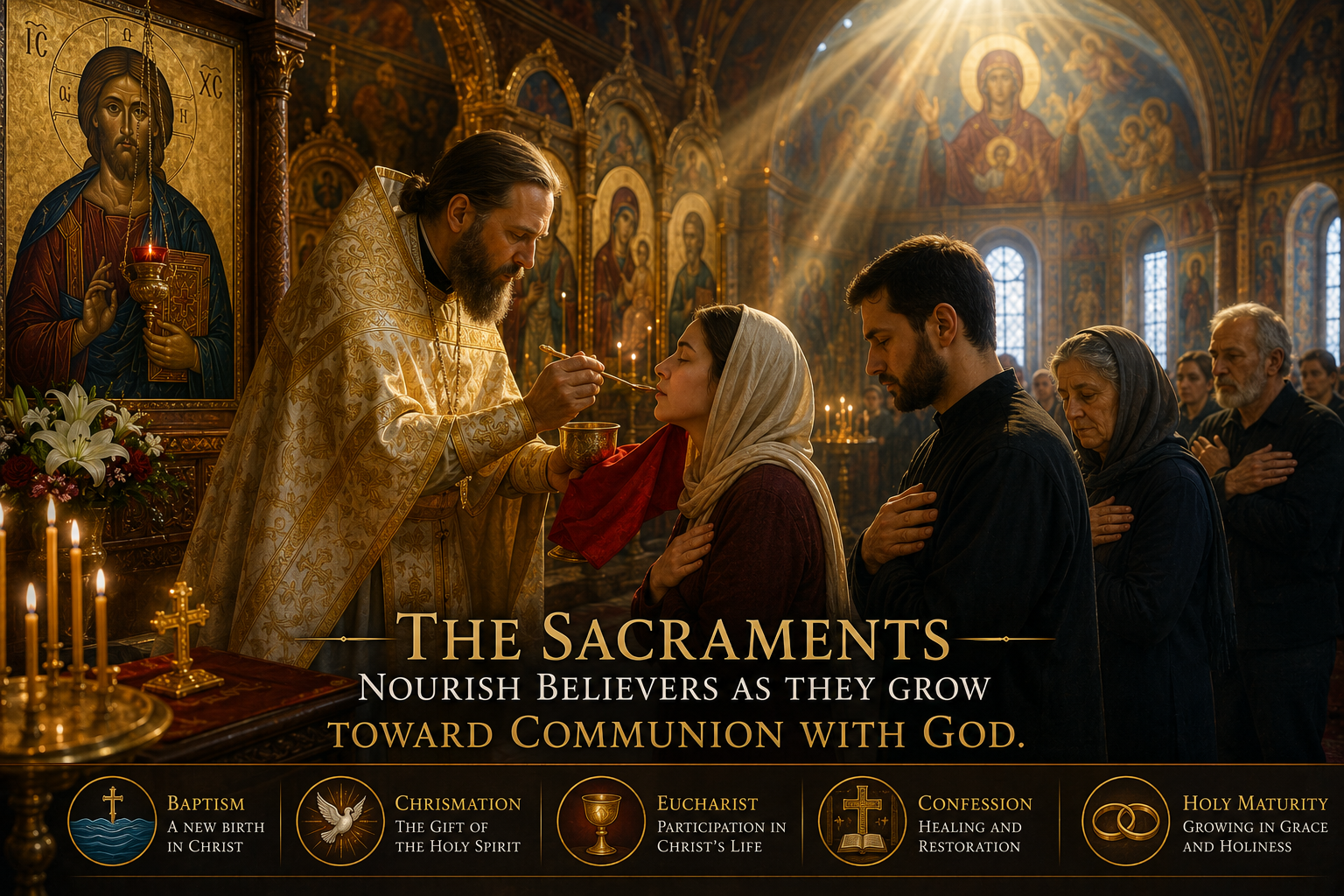
The sacraments play a central role in Theosis.
They are means through which believers encounter divine grace.
Important sacraments include:
Baptism
Entrance into new life.
Chrismation
Receiving the Holy Spirit.
Eucharist
Participation in Christ’s life.
Confession
Healing and restoration.
The sacraments nourish believers on the journey toward union with God.
Prayer and Theosis
Prayer occupies a central place in Orthodox spirituality.
The goal of prayer is not merely obtaining blessings.
The goal is communion with God.
Orthodox Christians seek:
Stillness
Repentance
Awareness of God’s presence
Prayer transforms the heart.
It opens believers to divine grace.
It strengthens the journey toward theosis.
The Jesus Prayer
One of the most beloved Orthodox prayers is:
“Lord Jesus Christ, Son of God, have mercy on me, a sinner.”
Known as the Jesus Prayer, it occupies a special place within Orthodox spirituality.
Repeated prayer cultivates:
Humility
Attention
Inner peace
Awareness of Christ
The Jesus Prayer helps believers focus continually upon God.
Monasticism and Theosis
Orthodox monasticism developed largely around the pursuit of theosis.
Monks and nuns dedicate themselves to:
Prayer
Fasting
Simplicity
Worship
Their goal is deeper union with God.
Although not everyone becomes a monastic, monastic spirituality influences the entire Orthodox tradition.
The saints often emerged from monastic communities.
The Saints as Examples of Theosis
The saints provide living examples of transformed humanity.
Orthodox Christians honour the saints because they demonstrate:
Holiness
Faithfulness
Communion with God
Their lives reveal what divine grace can accomplish.
Icons of saints often display radiant faces that symbolise spiritual transformation.
The saints show believers what humanity can become through Christ.
The Transfiguration of Christ
One of the most important biblical images for theosis is the Transfiguration.
On Mount Tabor:
Christ’s glory became visible.
His face shone like the sun.
Divine light surrounded Him.
Orthodox theology views this event as revealing humanity’s ultimate destiny.
The divine light seen at the Transfiguration represents participation in God’s glory.
The saints are called to share in that light.
Theosis and Eternal Life
Orthodox Christianity views eternal life as more than endless existence.
Eternal life is communion with God.
Heaven is not merely a location.
It is participation in divine life.
Theosis begins now and continues forever.
Because God is infinite, believers never exhaust the depths of communion with Him.
The journey continues eternally.
Common Misunderstandings
Theosis is often misunderstood.
Orthodox Christianity does not teach:
Humans become gods by nature.
Humans replace God.
Humans lose their individuality.
Instead:
Believers remain creatures.
God remains God.
Yet, through grace, believers genuinely participate in God’s life.
Theosis preserves both divine transcendence and intimate communion.
Why Theosis Matters Today
Modern culture often reduces Christianity to rules or moral behaviour.
Theosis presents a much larger vision.
It reminds believers:
Salvation is transformation.
Grace changes lives.
Holiness is possible.
Communion with God is the goal.
Theosis offers hope in a world marked by brokenness.
It reveals humanity’s true destiny.
Conclusion
Theosis stands at the centre of Eastern Orthodox spirituality.
It expresses the Orthodox understanding of salvation as participation in the life of God through Jesus Christ.
Grounded in Scripture, developed by the Church Fathers, and experienced through worship, prayer, and the sacraments, Theosis reveals the extraordinary calling of humanity.
God created human beings for communion.
Christ restored that possibility through His Incarnation, death, and resurrection.
Through grace, believers are transformed into the likeness of Christ and become partakers of the divine nature.
The journey of Theosis is ultimately a journey of love—a lifelong movement toward union with the God who first loved humanity.
In the next chapter, we will explore:
Byzantine Christianity and Christian Civilization
How the Byzantine Empire shaped Orthodox theology, worship, culture, art, and the Christian world for more than a thousand years.
Dr Daniel J. Grace
Faith • Civilization • Theology
Research • Journalism • Truth
© 2026 Dr Daniel J. Grace. All Rights Reserved.
No part of this article may be reproduced, distributed, transmitted, or published in any form or by any means without prior written permission from the author, except for brief quotations used in academic citation, review, or research purposes.
Leave a Reply