“How the Seven Ecumenical Councils Defended the Faith and Shaped Orthodox Christianity”
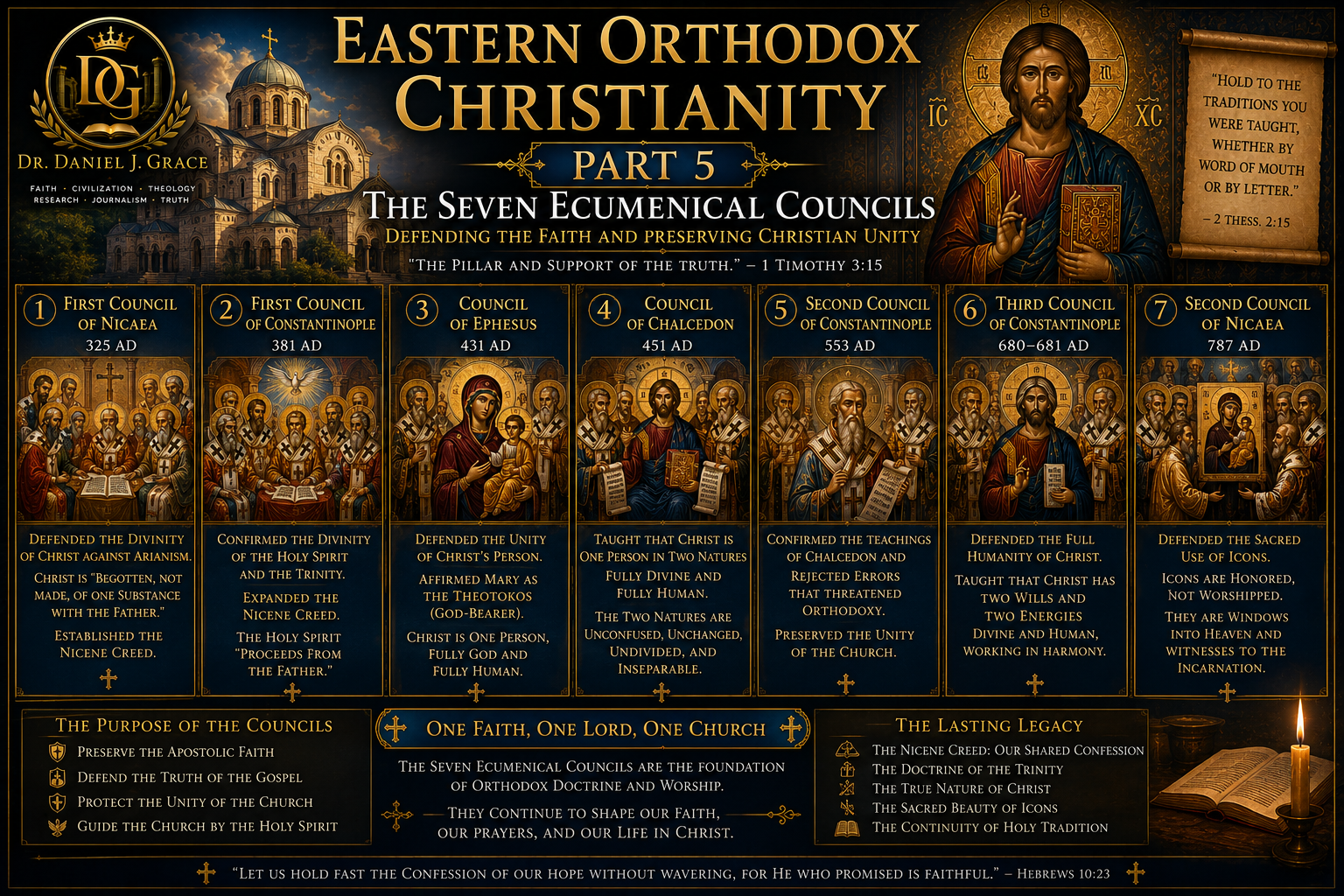
The Seven Ecumenical Councils
Defending the Faith and Preserving Christian Unity
Introduction
Among the most important events in Christian history are the Seven Ecumenical Councils.
Eastern Orthodox Christianity regards these councils as milestones in the life of the Church. Through them, the Church clarified doctrine, defended the truth of the Gospel, and preserved unity during times of theological controversy.
The councils did not invent new doctrines. Rather, they sought to articulate faithfully what the Church had always believed concerning God, Jesus Christ, the Holy Spirit, salvation, and Christian worship.
Orthodox Christians view the councils as gatherings guided by the Holy Spirit. They represent the Church’s collective effort to preserve Apostolic faith in the face of misunderstanding, error, and division.
The decisions of the councils continue to shape Orthodox theology today. The Nicene Creed, the doctrine of the Trinity, the understanding of Christ’s person, and the place of icons in worship all bear the influence of these historic gatherings.
This chapter explores each of the Seven Ecumenical Councils and their lasting significance for Orthodox Christianity.
What Is an Ecumenical Council?
The word “ecumenical” comes from a Greek term meaning:
“The whole inhabited world.”
An Ecumenical Council brought together bishops from across the Christian world to address major theological disputes.
These councils sought:
Unity
Truth
Faithfulness to Scripture
Preservation of Apostolic teaching
The bishops gathered not as independent thinkers but as guardians of the faith received from Christ and the Apostles.
Orthodox Christians believe that the authority of these councils comes from their faithfulness to Apostolic Tradition and their reception by the Church as a whole.
Why the Councils Were Necessary
The early Church grew rapidly.
As Christianity spread throughout the Roman Empire, believers encountered different cultures, languages, and philosophical traditions.
Important questions emerged:
Who is Jesus Christ?
What does it mean that He is divine?
How is God one and yet three Persons?
What role does the Holy Spirit play?
How should Christians understand salvation?
Different answers produced controversy.
The councils helped the Church clarify doctrine and preserve unity.
Without them, Christianity might have fragmented into countless competing interpretations.
The First Ecumenical Council
Nicaea (AD 325)
The first Ecumenical Council met in Nicaea under Emperor Constantine.
The primary issue involved a priest named Arius.
Arius taught that Christ was not fully divine.
He argued that the Son had been created by the Father.
If true, this teaching would undermine Christian salvation.
The council rejected Arianism.
The bishops declared:
Christ is fully God.
He is:
“Begotten, not made, of one substance with the Father.”
This teaching became a cornerstone of Christian orthodoxy.
The council also produced the foundation of the Nicene Creed.
The Second Ecumenical Council
Constantinople (AD 381)
Although Nicaea addressed the divinity of Christ, further questions remained concerning the Holy Spirit.
Some groups denied the Spirit’s full divinity.
The Council of Constantinople expanded the Nicene Creed and affirmed:
The divinity of the Holy Spirit
The doctrine of the Trinity
The equality of Father, Son, and Holy Spirit
The council confirmed that the Holy Spirit
“Proceeds from the Father.”
This teaching remains central to Orthodox theology.
Together Nicaea and Constantinople established the classical Christian doctrine of the Trinity.
The Doctrine of the Trinity
The councils taught:
There is one God.
Within the one divine essence, three distinct Persons exist:
Father
Son
Holy Spirit
The Trinity remains the heart of Orthodox theology.
Everything in Christian life flows from participation in the life of the Triune God.
Orthodox worship continually reflects this Trinitarian faith.
The Third Ecumenical Council
Ephesus (AD 431)
The Council of Ephesus addressed teachings associated with Nestorius.
Nestorius emphasised the distinctions between Christ’s humanity and divinity in a way that many believed divided Christ into two separate persons.
The council affirmed:
Jesus Christ is one Person.
Fully God.
Fully Human.
The council also affirmed the title:
Theotokos
Meaning:
“God-Bearer”
for the Virgin Mary.
Orthodox Christians continue using this title because it protects the truth that the child born of Mary was truly God incarnate.
The issue was ultimately about Christ rather than Mary.
The Importance of Theotokos
The title ‘Theotokos’ remains central in Orthodox theology.
It emphasises:
The reality of the Incarnation
Christ’s full divinity
Christ’s full humanity
The Church honours Mary because of her unique role in God’s plan of salvation.
Yet Orthodox devotion to Mary always points toward Christ.
The Fourth Ecumenical Council
Chalcedon (AD 451)
The Council of Chalcedon addressed further questions concerning Christ’s nature.
Some groups emphasised Christ’s divinity so strongly that His humanity seemed diminished.
Others risked separating His humanity and divinity.
The council taught:
Christ is one Person in two natures.
Fully divine.
Fully human.
The two natures remain:
Distinct
Unconfused
Undivided
Inseparable
This definition remains one of the most important statements in Christian theology.
Orthodox Christians regard Chalcedon as a masterpiece of doctrinal clarity.
Why Chalcedon Matters
Without Chalcedon, Christians might misunderstand who Christ truly is.
If Christ were not fully human:
Humanity could not be redeemed.
If Christ were not fully divine:
Salvation would be impossible.
The council protected both truths.
The Fifth Ecumenical Council
Constantinople II (AD 553)
The fifth council sought to preserve the teachings of Chalcedon while addressing ongoing disputes.
The bishops clarified earlier teachings and rejected interpretations that threatened Christian unity.
The council emphasised continuity with previous councils.
Orthodox Christianity values this continuity because doctrine develops through clarification rather than contradiction.
Each council builds upon those before it.
The Sixth Ecumenical Council
Constantinople III (AD 680–681)
Another controversy emerged concerning Christ’s will.
Some argued Christ possessed only one will.
The council rejected this view.
It taught:
Christ possesses:
A divine will
A human will
Both wills operate in harmony.
This teaching preserves Christ’s complete humanity.
Orthodox Christians believe Christ redeemed every aspect of human nature.
Therefore, He must possess a truly human will.
Human Freedom and Salvation
The sixth council has important implications for salvation.
Orthodoxy teaches:
God does not force salvation upon humanity.
Human beings freely cooperate with divine grace.
This cooperation is often described as:
Synergy
meaning:
Working together.
The council helped preserve this understanding by affirming Christ’s complete humanity.
The Seventh Ecumenical Council
Nicaea II (AD 787)
The seventh council addressed one of the most dramatic controversies in Church history:
Iconoclasm.
Some Christians opposed religious images and sought their destruction.
Others defended the use of icons.
The council affirmed:
Icons may be honored but not worshipped.
Worship belongs only to God.
Icons serve as:
Windows into heavenly reality
Visual expressions of the Incarnation
Educational tools for believers
Because Christ truly became human, He can be depicted in sacred art.
The council therefore defended both icons and the doctrine of the Incarnation.
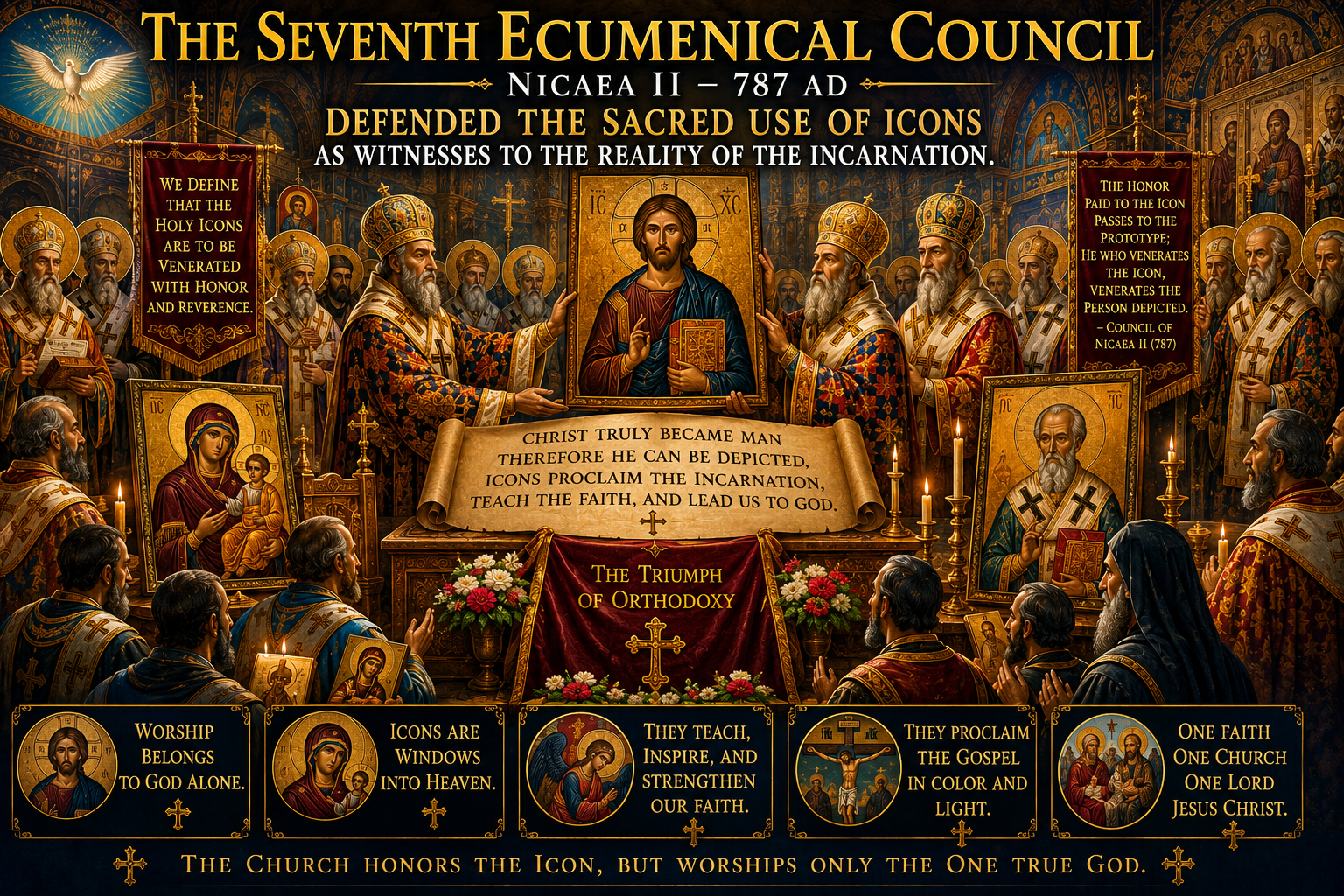
The Triumph of Orthodoxy
The restoration of icons became known as:
The Triumph of Orthodoxy.
This event is still celebrated annually in the Orthodox Church on the first Sunday of Great Lent.
The feast commemorates:
Faithfulness
Perseverance
Victory of truth
It remains one of the most significant celebrations in the Orthodox liturgical calendar.
The Councils and Church Unity
A major goal of the councils was preserving unity.
The bishops did not seek division.
They sought consensus rooted in Scripture and Apostolic Tradition.
The councils remind Christians that theology matters.
Ideas have consequences.
Correct doctrine protects the Church’s understanding of God and salvation.
The Councils and Worship
Orthodox worship reflects the teachings of the councils.
Every Divine Liturgy proclaims truths established by them.
The Nicene Creed is recited regularly.
Prayers emphasise:
The Trinity
The Incarnation
The work of the Holy Spirit
Thus, the councils continue shaping Christian worship more than fifteen centuries later.
The Councils and Modern Christianity
Modern Christians often view doctrine as secondary.
The Fathers and councils disagreed.
They believed truth matters because salvation matters.
The councils addressed questions that remain relevant today:
Who is Christ?
What is salvation?
Who is God?
How should Christians worship?
Orthodox Christianity continues turning to the councils for guidance.
The Councils as Guardians of the Faith
The Seven Ecumenical Councils function as guardians of Apostolic Christianity.
They preserved the Church from serious errors.
They provided language for expressing Christian belief.
They united believers around a shared confession of faith.
Orthodox Christians continue viewing them as authoritative because they faithfully transmit the faith received from the Apostles.
The Legacy of the Seven Councils
The councils gave Christianity the following:
The Nicene Creed
The doctrine of the Trinity
Orthodox Christology
The defense of icons
A model for resolving disputes
Their influence extends far beyond Orthodoxy.
Most Christian traditions continue affirming teachings developed through these councils.
Why the Councils Matter Today
The modern world often values personal opinion above historical wisdom.
The councils remind Christians that faith is communal.
The Church does not reinvent doctrine every generation.
It receives, preserves, and proclaims the truth.
The Seven Ecumenical Councils stand as monuments to the Church’s commitment to truth and unity.
Conclusion
The Seven Ecumenical Councils represent some of the most significant moments in Christian history.
They defended the divinity of Christ, clarified the doctrine of the Trinity, protected the reality of the Incarnation, and affirmed the sacred use of icons.
For Orthodox Christians, the councils are not merely historical events.
They are living expressions of the Church guided by the Holy Spirit.
Their teachings continue to shape worship, theology, spirituality, and Christian identity.
Through these councils, the Church preserved the Apostolic faith and handed it faithfully to future generations.
In the next chapter, we will explore one of the most distinctive and beautiful aspects of Eastern Orthodox Christianity:
Icons and Sacred Beauty—windows into heaven and witnesses to the mystery of the Incarnation.
Dr Daniel J. Grace
Faith • Civilization • Theology
Research • Journalism • Truth
© 2026 Dr Daniel J. Grace. All Rights Reserved.
No part of this article may be reproduced, distributed, transmitted, or published in any form or by any means without prior written permission from the author, except for brief quotations used in academic citation, review, or research purposes.
Leave a Reply