
The Christian Empire That Preserved Ancient Wisdom and Influenced the World for a Thousand Years
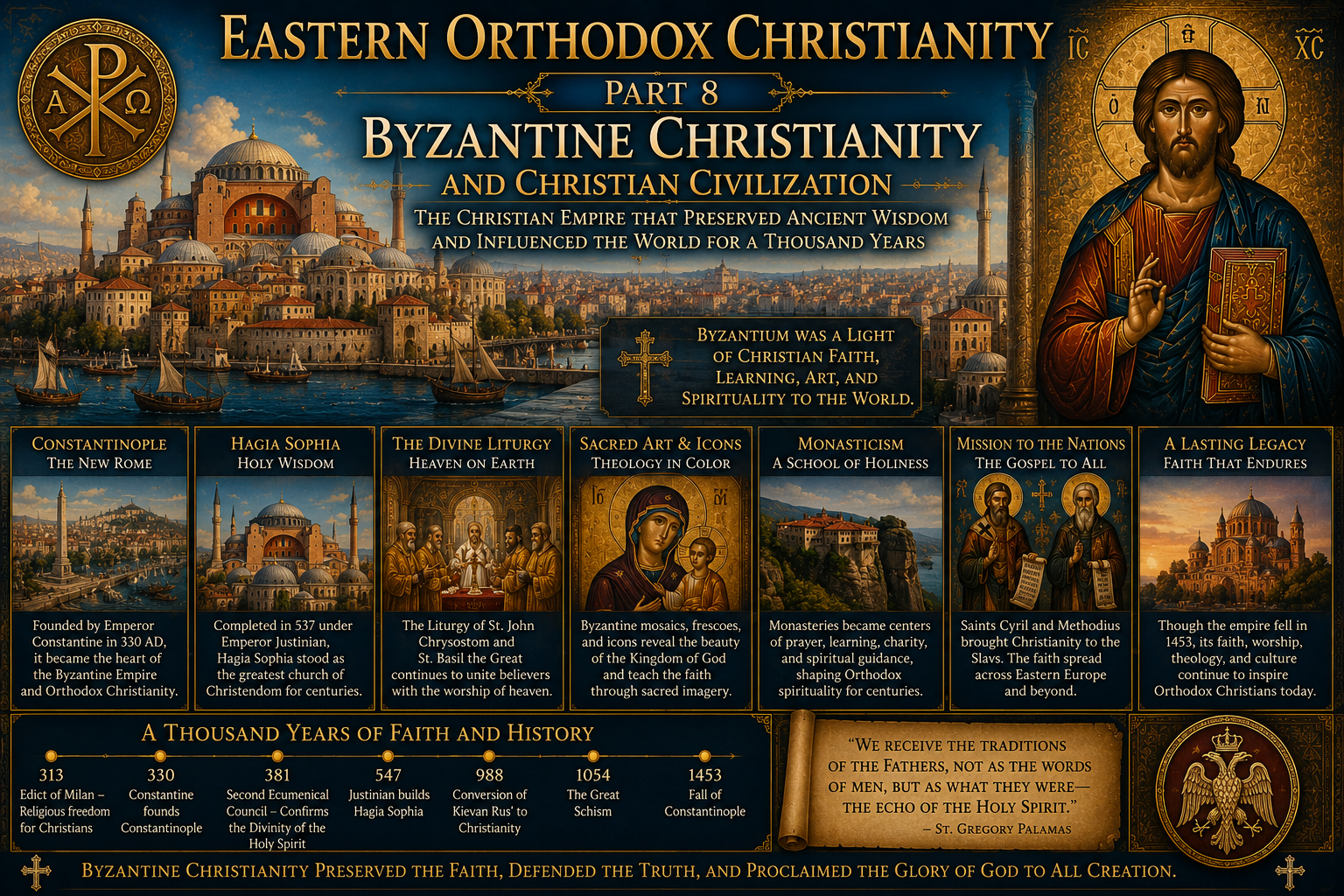
Byzantine Christianity and Christian Civilization
How the Byzantine Empire Shaped Orthodox Faith, Worship, Culture, and History
Introduction
Few civilisations have shaped Christianity more profoundly than the Byzantine Empire.
For over one thousand years, Byzantium served as the political, cultural, theological, and spiritual center of Eastern Christianity. It preserved the heritage of the ancient world, defended Christian doctrine, produced extraordinary art and architecture, and nurtured the development of Orthodox theology and worship.
To understand Eastern Orthodox Christianity, one must understand Byzantium.
The Orthodox Church did not emerge from a vacuum. It grew within a civilisation deeply influenced by Christian faith. Byzantine Christianity shaped how Orthodox believers worshipped, prayed, governed the Church, created sacred art, and understood the relationship between faith and society.
Although the Byzantine Empire disappeared in 1453 with the fall of Constantinople, its influence remains visible throughout the Orthodox world today.
Orthodox churches, liturgies, icons, architecture, spirituality, and theological traditions continue to bear the imprint of Byzantine Christianity.
This chapter explores the remarkable civilisation that helped shape Eastern Orthodoxy and left an enduring legacy on Christian history.
What Was the Byzantine Empire?
The Byzantine Empire was the continuation of the Eastern Roman Empire.
Although modern historians use the term “Byzantine”, its citizens generally referred to themselves as
Romans
The empire began when Emperor Constantine established a new capital city.
This city became:
Constantinople
Founded in AD 330.
Located strategically between Europe and Asia, Constantinople became one of the most important cities in world history.
For more than a thousand years it served as:
A center of government
A center of commerce
A center of learning
A center of Christianity
Orthodox Christians often regard Constantinople as one of the great spiritual capitals of Christian history.
Constantine and the Christian Empire
The story of Byzantine Christianity begins with Emperor Constantine.
Before Constantine, Christianity often faced persecution.
Many believers suffered imprisonment and martyrdom.
In AD 313, Constantine issued the
Edict of Milan
This decree granted religious freedom throughout the Roman Empire.
Christianity could now be practiced openly.
This transformed Christian history.
Churches could be built.
Theology could develop publicly.
Christian leaders could gather freely.
The relationship between Christianity and society entered a new era.
Constantinople: The New Rome
Constantine chose Byzantium as the site of his new capital.
The city was renamed:
Constantinople
Meaning:
“City of Constantine”
The city rapidly became:
Wealthy
Influential
Cosmopolitan
Magnificent churches, palaces, and public buildings were constructed.
Constantinople eventually became one of the largest cities in the world.
Orthodox Christianity flourished within its walls.
The city’s bishops gained increasing influence within the Church.
Christianity and Public Life
One distinctive feature of Byzantium was the close relationship between church and state.
Byzantine rulers viewed themselves as protectors of Christianity.
The emperor often supported:
Church construction
Theological education
Charitable works
Missionary efforts
Orthodox Christians do not view the Byzantine system as perfect.
Conflicts frequently arose between Church leaders and emperors.
Nevertheless, Byzantine society sought to integrate faith into public life.
Religion was not confined to private belief.
It shaped the culture of the entire civilisation.
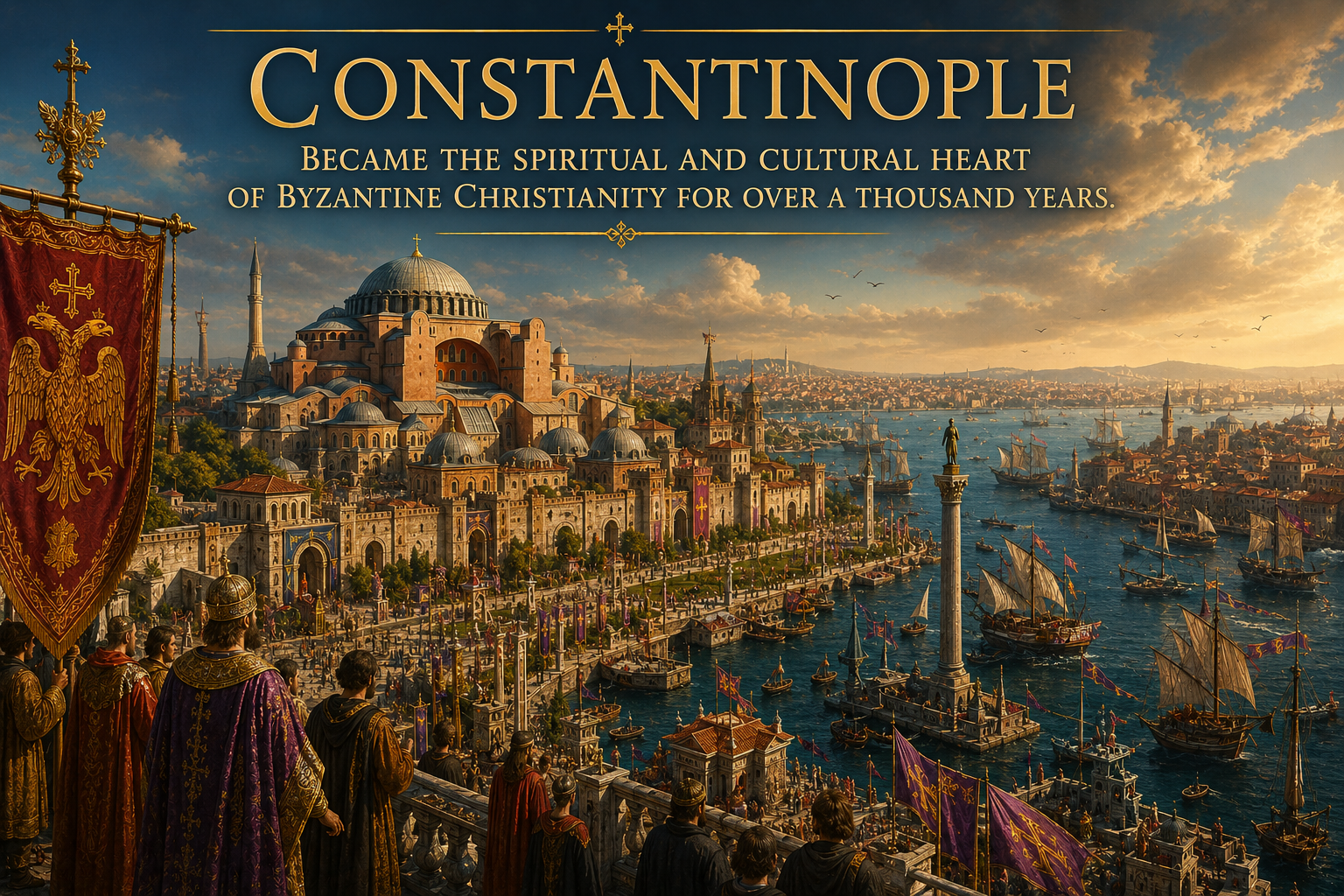
Hagia Sophia: The Crown of Byzantine Christianity
No building symbolises Byzantine Christianity more than:
Hagia Sophia
Completed under Emperor Justinian in AD 537.
Its name means:
Holy Wisdom
For nearly a thousand years it served as the greatest church in Christendom.
Visitors described entering Hagia Sophia as an overwhelming spiritual experience.
Its features included:
Massive domes
Golden mosaics
Marble columns
Sacred icons
The building reflected the Byzantine vision of worship as participation in heavenly reality.
Even today Hagia Sophia remains one of the most influential religious structures ever built.
The Divine Liturgy
Byzantine Christianity profoundly shaped Orthodox worship.
The Divine Liturgy gradually developed into the form still used throughout much of the Orthodox world.
Two liturgies became especially important:
The Divine Liturgy of St John Chrysostom
The Divine Liturgy of St Basil the Great
These services emphasised:
Scripture
Prayer
Eucharist
Sacred beauty
The liturgy sought to unite believers with the worship of heaven itself.
Orthodox Christians continue celebrating these liturgies today.
The Role of Monasticism
Monasticism played a central role in Byzantine spirituality.
Monks and nuns dedicated their lives to:
Prayer
Fasting
Worship
Study
Monasteries became centres of:
Education
Charity
Spiritual guidance
Many of Orthodoxy’s greatest saints emerged from monastic communities.
Monasticism helped preserve Christian learning during difficult periods of history.
Its influence remains visible throughout Orthodoxy today.
Mount Athos
One of the most famous centres of Orthodox monasticism is:
Mount Athos
Located in modern Greece.
Often called:
The Holy Mountain
Mount Athos became home to numerous monasteries representing different Orthodox traditions.
For over one thousand years monks have pursued lives of prayer and contemplation there.
Mount Athos remains one of Orthodoxy’s most important spiritual centres.
Byzantine Theology
The Byzantine period produced many influential theologians.
These thinkers explored questions concerning:
The Trinity
Christology
Prayer
Salvation
Theosis
Among the most important were:
Maximus the Confessor
John of Damascus
Gregory Palamas
Their writings continue shaping Orthodox theology today.
Byzantine theology emphasised both intellectual depth and spiritual experience.
Sacred Art and Mosaics
The Byzantine civilisation produced some of the most beautiful religious art in history.
Churches featured:
Mosaics
Frescoes
Icons
Decorative architecture
These works served theological purposes.
They taught the faith visually.
They reminded believers of heavenly realities.
They reflected the beauty of God’s Kingdom.
Orthodox sacred art continues drawing inspiration from Byzantine models.
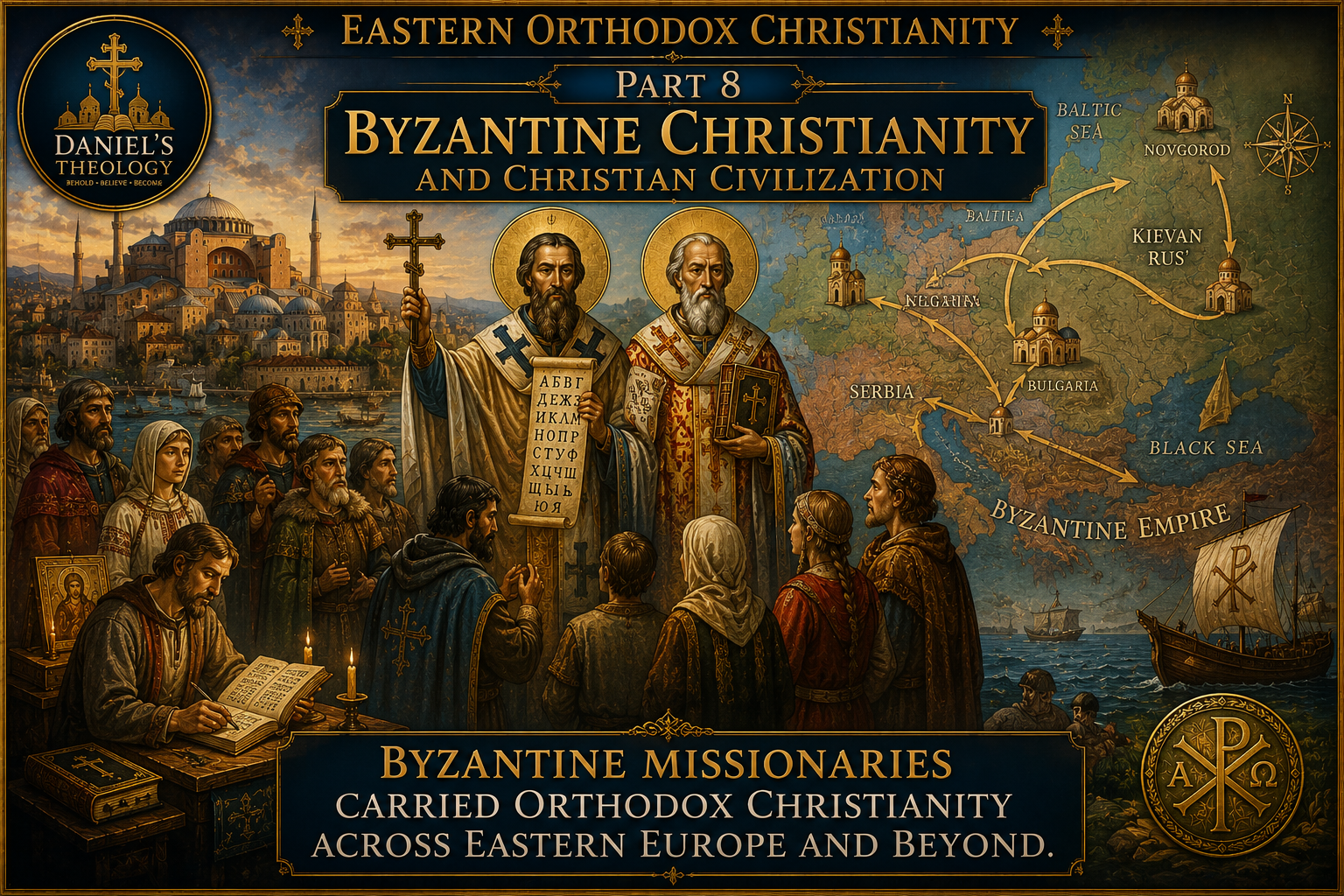
Byzantine Missionary Activity
Byzantine Christianity was missionary in character.
The Gospel spread far beyond imperial borders.
Missionaries carried Christianity to:
The Slavs
Bulgaria
Serbia
Russia
Among the most famous missionaries were:
Saints Cyril and Methodius
These brothers translated Christian texts into Slavic languages.
Their efforts helped bring Christianity to millions.
Their influence continues throughout Eastern Europe today.
”
The Conversion of Rus’
One of Byzantium’s greatest missionary successes involved the conversion of Kievan Rus’.
In AD 988:
Prince Vladimir
accepted Christianity.
This decision transformed Eastern European history.
The Christianisation of Rus’ eventually influenced:
Russia
Ukraine
Belarus
Today some of the largest Orthodox populations trace their roots to this event.
Byzantine Christianity became a global force through such missionary efforts.
Education and Learning
Byzantium preserved much of the intellectual heritage of the ancient world.
Scholars copied and preserved:
Greek literature
Philosophy
Historical works
Christian writings
Without Byzantine preservation, many ancient texts might have disappeared.
The empire served as a bridge between antiquity and the modern world.
Orthodox Christians often view learning as compatible with faith.
This attitude owes much to Byzantine tradition.
Challenges and Crises
The Byzantine Empire faced numerous difficulties.
These included:
Wars
Invasions
Political instability
Economic challenges
Religious controversies
Despite these struggles, Byzantine Christianity endured.
Its resilience became one of its defining characteristics.
The Church often survived periods of hardship through strong spiritual leadership and deep faith.
The Great Schism
One of the most significant events in Christian history occurred during the Byzantine period.
In 1054:
The Great Schism
formalised divisions between Eastern and Western Christianity.
Several issues contributed:
Authority
Theology
Culture
Language
The Eastern Church continued developing as what became known as Eastern Orthodoxy.
The Schism remains one of Christianity’s most significant historical events.
The Fall of Constantinople
In 1453, Constantinople fell to the Ottoman Turks.
This event marked the end of the Byzantine Empire.
Many Christians viewed the fall as a catastrophe.
Yet Orthodox Christianity survived.
The Church adapted to new circumstances.
Orthodox faith continued flourishing in:
Greece
Russia
The Balkans
The Middle East
The empire disappeared.
The Church remained.
The Legacy of Byzantium
Although the Byzantine Empire no longer exists, its legacy remains powerful.
Orthodox Christians continue inheriting:
Liturgical traditions
Theology
Sacred art
Spiritual practices
Church architecture
Byzantine Christians would immediately recognise many features of Orthodox worship today.
The connection remains remarkably strong.
Byzantine Christianity and Modern Orthodoxy
Modern Orthodox believers continue to draw inspiration from Byzantine civilisation.
The Byzantine heritage reminds Christians:
Faith shapes culture.
Worship shapes identity.
Beauty reflects truth.
Theology matters.
Byzantium demonstrates how Christianity can influence every dimension of life.
Its legacy continues inspiring believers around the world.
Why Byzantium Matters Today
Many modern societies struggle with questions concerning:
Identity
Meaning
Community
Faith
Byzantine Christianity offers important lessons.
It shows how spiritual values can deeply influence a civilisation.
It demonstrates the importance of preserving tradition while engaging with changing circumstances.
Orthodox Christians continue viewing Byzantium as a source of wisdom and inspiration.
Conclusion
The Byzantine Empire played a central role in shaping Eastern Orthodox Christianity.
Through its theology, worship, art, architecture, monasticism, and missionary activity, Byzantium helped preserve and transmit the Christian faith for more than a thousand years.
Its influence remains visible throughout the Orthodox world today.
The churches, icons, liturgies, and spiritual traditions of Orthodoxy continue reflecting the rich heritage of Byzantine Christianity.
Although the empire itself has passed into history, its spiritual legacy endures.
In the next chapter, we will explore:
Orthodox Worship and Spirituality
How prayer, liturgy, fasting, monastic traditions, and the Jesus Prayer shape the daily spiritual life of Orthodox Christians around the world.
Dr Daniel J. Grace
Faith • Civilization • Theology
Research • Journalism • Truth
© 2026 Dr Daniel J. Grace. All Rights Reserved.
No part of this article may be reproduced, distributed, transmitted, or published in any form or by any means without prior written permission from the author, except for brief quotations used in academic citation, review, or research purposes.
Leave a Reply