“How the Apostles, Martyrs, and Early Christians Established the Foundations of Orthodox Faith”
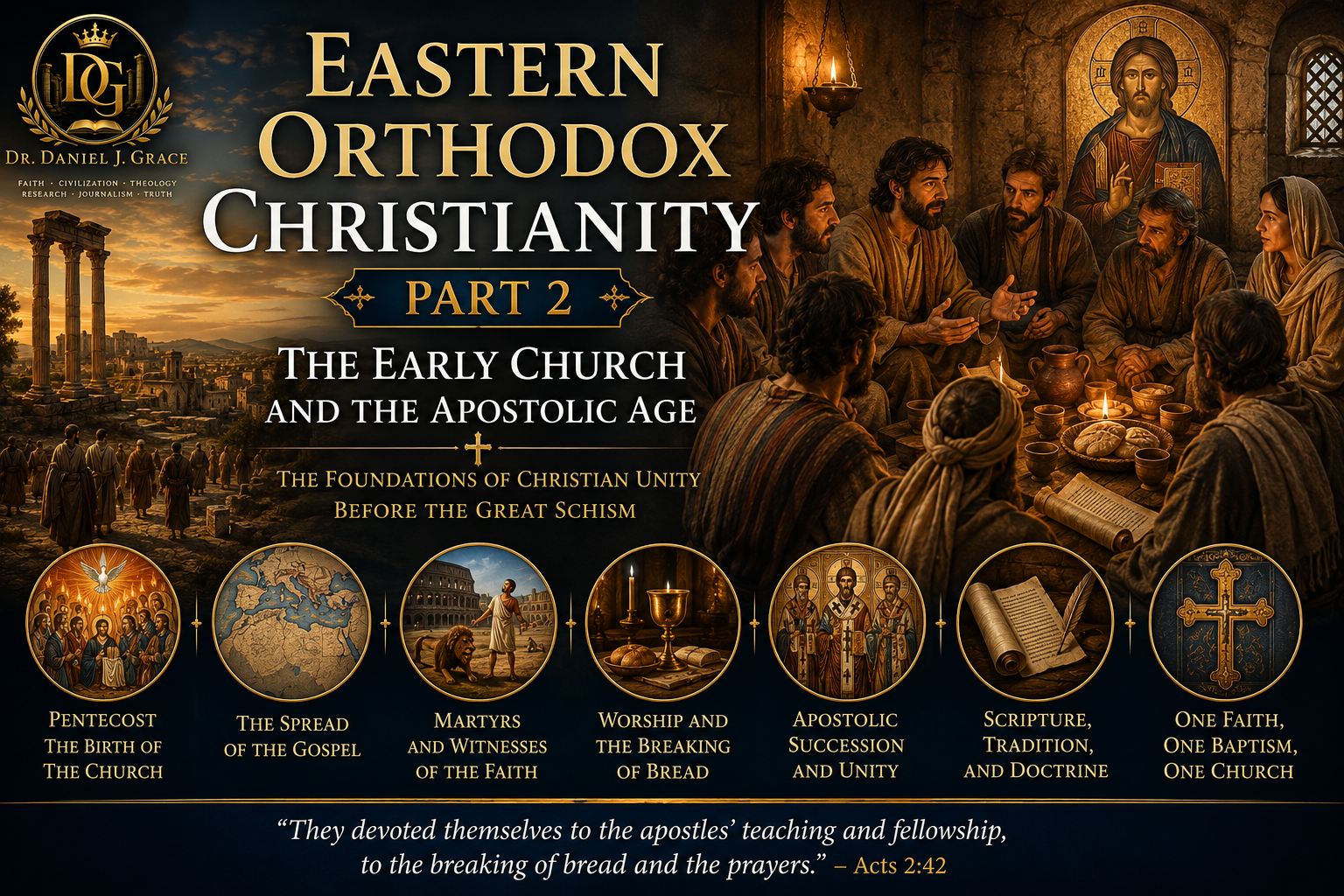
The Early Church and the Apostolic Age
The Foundations of Christian Unity Before the Great Schism
Introduction
To understand Eastern Orthodox Christianity, one must first understand the world of the Early Church. Orthodox Christians believe their faith is not a later invention but the continuation of the Church founded by Jesus Christ and His apostles.
The first centuries of Christianity occupy a unique place in Orthodox thought. During this period, the Church received the teachings of Christ, proclaimed the Gospel throughout the Roman world, endured persecution, defended orthodox doctrine, and established the foundations of Christian worship and theology.
For Orthodox believers, the Early Church is not merely a subject of historical study. It serves as the model for Christian faith and practice. The life of the Apostles, the witness of the martyrs, the teachings of the Church Fathers, and the decisions of the Ecumenical Councils continue to guide Orthodox Christianity today.
This chapter explores the Apostolic Age and the development of the Early Church, showing why Orthodoxy places such importance on these foundational centuries.
The Ministry of Jesus Christ
The story of the Church begins with Jesus Christ.
Orthodox Christianity confesses that Jesus is:
Fully God
Fully Human
The Messiah
The Savior of the World
Christ’s earthly ministry transformed history.
He proclaimed:
The Kingdom of God
Repentance
Forgiveness
Eternal Life
He healed the sick, raised the dead, forgave sins, and revealed the love of God.
Most importantly, He called disciples who would continue His mission after His death and resurrection.
Orthodox theology views Christ not merely as a teacher but as the incarnate Son of God who came to restore humanity’s relationship with the Creator.
The Calling of the Apostles
Jesus chose twelve Apostles to serve as witnesses of His ministry.
These men were ordinary individuals:
Fishermen
Tax collectors
Working people
Yet Christ entrusted them with an extraordinary mission.
The Apostles learned directly from Jesus.
They observed:
His teachings
His miracles
His death
His resurrection
After Christ’s resurrection, they became the primary leaders of the early Christian movement.
Orthodox Christianity places tremendous importance on apostolic succession because of this foundational role.
Pentecost: The Birth of the Church
The Book of Acts records the coming of the Holy Spirit on the Day of Pentecost.
This event marks the beginning of the Church’s public mission.
The apostles received divine power to proclaim the Gospel.
People from many nations heard the message in their languages.
Thousands embraced Christianity.
Pentecost remains one of the most important feasts in Orthodox Christianity.
Pentecost is understood by the Church as the fulfilment of Christ’s promise to send the Holy Spirit.
The Church was born not through human planning but through divine action.
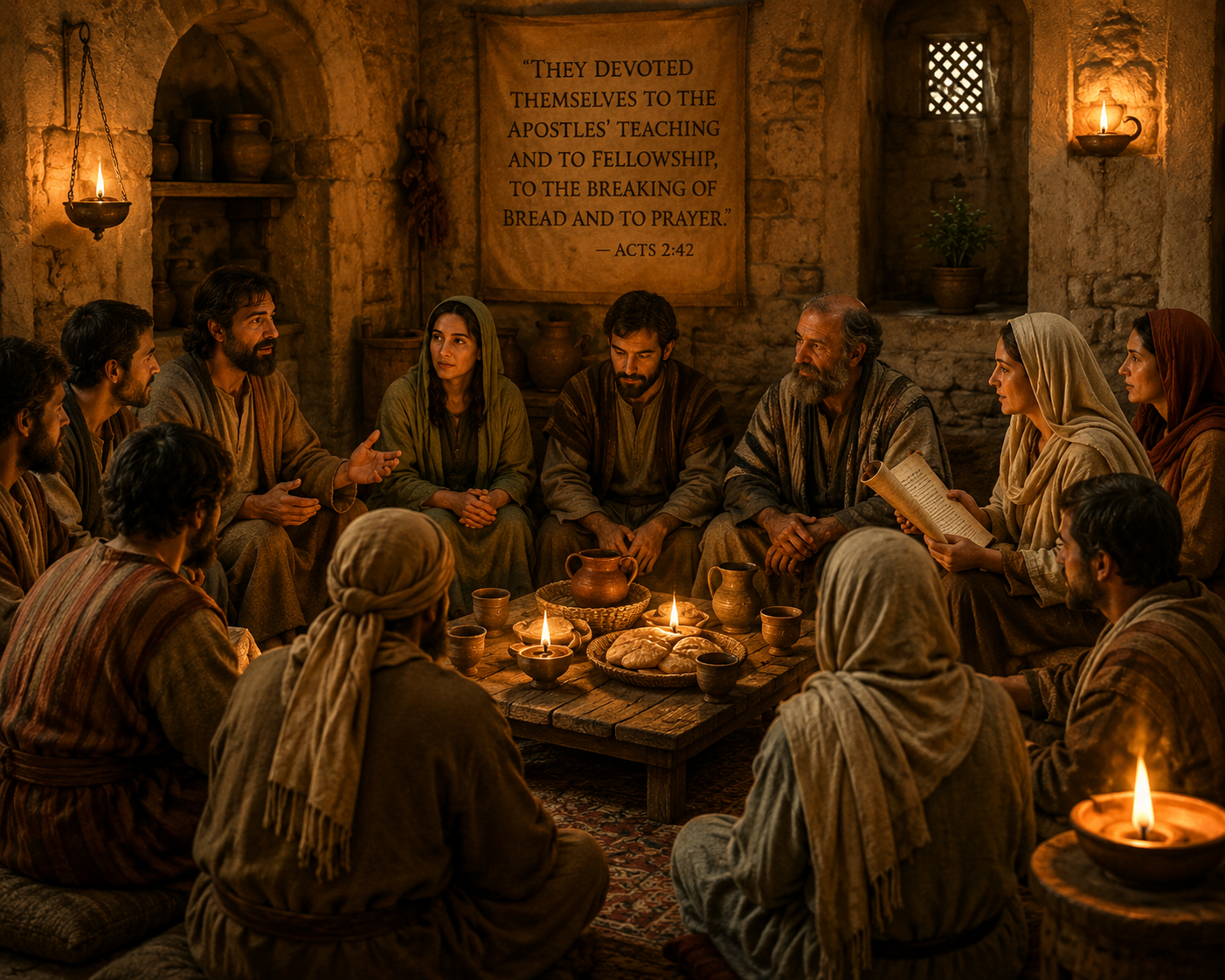
The First Christian Community
The earliest Christians formed a distinctive community.
Acts describes believers who
Prayed together
Shared meals
Studied the Apostles’ teaching
Supported one another
Their lives reflected a deep sense of unity.
The Church was not just an organisation.
It was a spiritual family united in Christ.
Orthodox Christians often look to this early community as an example of authentic Christian life.
Many aspects of Orthodox spirituality reflect the communal nature of the Apostolic Church.
The Spread of the Gospel
Christianity spread remarkably quickly throughout the Roman Empire.
The Apostles and their companions travelled widely.
Tradition associates the Apostles with missionary activity throughout:
Palestine
Syria
Asia Minor
Greece
Egypt
Rome
Mesopotamia
The Apostle Paul played a particularly significant role.
His missionary journeys established Christian communities across the Mediterranean world.
The letters he wrote to these churches became part of the New Testament.
Orthodox Christianity regards these missionary efforts as evidence of the Church’s universal calling.
Jerusalem: The Mother Church
Jerusalem occupies a special place in Christian history.
It was:
The city of Christ’s death and resurrection
The location of Pentecost
The center of the earliest Christian community
The Church in Jerusalem provided leadership during Christianity’s formative years.
The Council of Jerusalem described in Acts 15 addressed important questions concerning Gentile converts.
This council established a pattern of conciliar decision-making that continues within Orthodoxy today.
Orthodox Christians see this event as an early example of how the Church resolves theological questions through collective discernment.
Persecution and Faithfulness
The Early Church faced severe persecution.
Roman authorities often viewed Christians with suspicion.
Believers were accused of:
Disloyalty to the Empire
Refusal to worship Roman gods
Social disruption
Many Christians suffered imprisonment, torture, and execution.
Yet persecution often strengthened rather than weakened the Church.
The courage of the martyrs inspired others.
Orthodox Christians continue to honour these witnesses through feast days and liturgical commemorations.
The martyrs remain examples of faithfulness and devotion to Christ.
The Witness of the Martyrs
The Greek word “martyr” means witness.
Early Christian martyrs testified to their faith through extraordinary courage.
Among the most famous were:
Ignatius of Antioch
Polycarp of Smyrna
Perpetua and Felicity
Justin Martyr
Their stories continue to inspire Christians.
Orthodox theology views martyrdom as the ultimate expression of faithfulness to Christ.
The blood of the martyrs became the seed of the Church.
The Formation of Christian Worship
The Apostolic Church developed patterns of worship that continue influencing Orthodoxy.
Early Christian gatherings included:
Scripture readings
Prayer
Teaching
Singing
Eucharistic celebration
These practices gradually developed into the liturgical traditions of the Church.
Orthodox Christians believe modern worship preserves many elements inherited from the Apostolic era.
The Divine Liturgy reflects continuity with ancient Christian practice.
The Development of Church Leadership
The New Testament reveals emerging structures of leadership.
Three primary ministries developed:
Bishops
Responsible for oversight and unity.
Presbyters (Priests)
Responsible for pastoral ministry.
Deacons
Responsible for service and assistance.
Orthodox Christianity maintains these ministries today.
The Church sees them as extensions of apostolic leadership.
This continuity contributes to the Orthodox understanding of Apostolic succession.
Apostolic Succession
One of the most important concepts in Orthodox Christianity is apostolic succession.
This refers to the transmission of Church leadership through successive generations of bishops.
Orthodox Christians believe bishops stand within an unbroken line reaching back to the apostles.
This continuity maintains:
Doctrine
Sacramental life
Church unity
Apostolic succession is viewed not merely as historical continuity but as spiritual continuity.
The New Testament Canon
The books of the New Testament emerged from the life of the Early Church.
The Apostles and their companions produced writings that circulated among Christian communities.
Over time the Church recognised certain writings as inspired Scripture.
These became the New Testament.
Orthodox Christians emphasise that Scripture arose within the life of the Church.
The Church did not create Scripture but recognised the books as inspired by God.
This understanding reinforces the close relationship between Scripture and Tradition.
The Growth of Christian Doctrine
The Apostolic Age established essential Christian beliefs.
The Church proclaimed:
The Trinity
The divinity of Christ
The resurrection
Salvation through Christ
These truths were later clarified through councils and theological reflection.
Orthodox Christians believe these doctrines originated with the Apostles themselves.
Later generations preserved and defended what had already been received.
The Church as the Body of Christ
One of Saint Paul’s most important images describes the Church as the Body of Christ.
This image remains central to Orthodox theology.
The Church is not merely a gathering of individuals.
It is a living organism united to Christ.
Every believer participates in this spiritual body.
This understanding shapes Orthodox views of worship, sacraments, and community.
Unity Before Division
One reason Orthodox Christians place such importance on the Early Church is that it existed before later divisions.
The first centuries witnessed remarkable unity despite cultural diversity.
Christians spoke different languages and lived in different regions.
Yet they shared:
One faith
One baptism
One Eucharist
One Church
Orthodox Christians often look to this period as the ideal expression of Christian unity.
The Legacy of the Apostolic Age
The Apostolic Age established foundations that continue influencing Christianity today.
From the Apostles came:
The Gospel
The New Testament
Christian worship
Church leadership
Missionary vision
Orthodox Christianity sees itself as preserving this inheritance.
The Church remains connected to the Apostolic era through faith, worship, doctrine, and sacramental life.
Why the Early Church Matters Today
Modern Christians often face questions concerning:
Identity
Authority
Truth
Unity
The Early Church provides important guidance.
It reminds believers that Christianity possesses deep historical roots.
The Church did not begin in the modern era.
Its foundations were laid by Christ and His apostles.
Orthodox Christianity invites believers to rediscover this heritage and learn from the wisdom of the ancient Church.
Conclusion
The Apostolic Age stands at the heart of Eastern Orthodox Christianity.
The ministry of Christ, the witness of the Apostles, the coming of the Holy Spirit, and the growth of the Early Church established the foundations upon which Christianity continues to stand.
Orthodox Christians regard these centuries not as distant history but as a living source of faith and inspiration.
The Church today remains connected to the Apostles through Scripture, worship, doctrine, and Apostolic succession.
As we continue this series, we will move from the Apostolic Age to the great teachers who preserved and explained the faith.
In the next chapter we will explore the remarkable lives and teachings of the Church Fathers—those influential leaders whose wisdom continues to shape Orthodox theology and spirituality to this day.
Dr Daniel J. Grace
Faith • Civilization • Theology
Research • Journalism • Truth
🌐 danieljamesgrace.com
© 2026 Dr Daniel J. Grace. All Rights Reserved.
No part of this article may be reproduced, distributed, transmitted, or published in any form or by any means without prior written permission from the author, except for brief quotations used in academic citation, review, or research purposes.
Leave a Reply