
Prayer, Holiness, and Discipleship in the Anglican Tradition
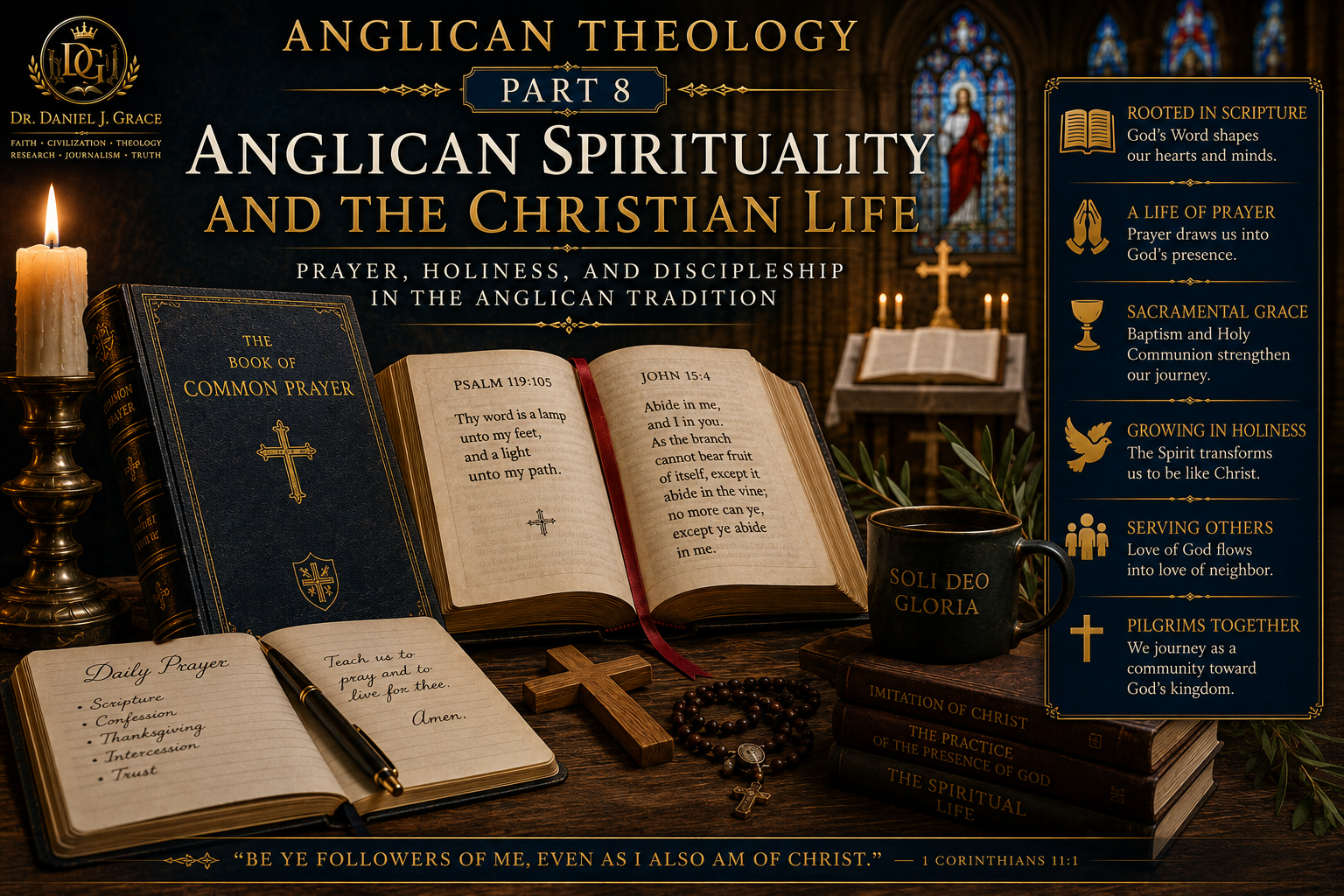
Anglican Spirituality and the Christian Life
Introduction
Theology is not merely about understanding God; it is about walking with God. Throughout Christian history, believers have sought not only correct doctrine but also transformed lives. Anglican spirituality stands within this ancient Christian tradition, emphasising that faith must shape the whole person—mind, heart, soul, and daily conduct.
One of the strengths of Anglicanism is its ability to unite doctrine and devotion. Anglican spirituality is deeply biblical, rooted in prayer, nourished by worship, strengthened by the sacraments, and expressed through faithful service. It avoids both cold intellectualism and uncontrolled emotionalism, seeking instead a balanced Christian life centred on Jesus Christ.
The Anglican tradition has produced countless saints, missionaries, scholars, pastors, and ordinary believers whose lives reflected a profound commitment to God. While Anglican theology explains what Christians believe, Anglican spirituality demonstrates how Christians live.
This chapter explores the foundations of Anglican spirituality, its practices, its historical development, and its continuing relevance in a rapidly changing world.
The Goal of Anglican Spirituality
At its heart, Anglican spirituality seeks one primary goal:
Union with God through Jesus Christ.
Christianity is not merely a set of moral rules or theological propositions. It is a relationship with the living God.
Jesus declared:
“Abide in me, and I in you.” (John 15:4)
This idea of abiding in Christ stands at the centre of Anglican spiritual life.
Anglican spirituality aims to cultivate:
Love for God
Love for neighbor
Growth in holiness
Faithful discipleship
Lifelong transformation
Spiritual growth is understood as a journey rather than a single event.
The Christian life begins with conversion but continues through daily growth in grace.
IMAGE PLACEMENT 1
Suggested Image:
A solitary Anglican priest praying at sunrise in an ancient stone chapel, with light streaming through stained-glass windows.
Caption:
“Prayer remains the heartbeat of Anglican spirituality.”
Scripture as the Foundation of Spiritual Life
Anglican spirituality begins with Scripture.
The Bible is not viewed merely as a historical document or theological textbook. It is God’s living Word.
Anglicans traditionally read Scripture for:
Knowledge
Worship
Guidance
Spiritual formation
The famous collect from the Book of Common Prayer encourages believers to
“Read, mark, learn, and inwardly digest.”
This phrase captures the Anglican approach beautifully.
Scripture should not simply be studied.
It should be absorbed into one’s life.
Historically, Anglicans have practised regular Bible reading through the following:
Daily offices
Personal devotion
Corporate worship
Bible study
This constant exposure to Scripture shapes Christian character over time.
Prayer: The Heartbeat of Anglican Life
Prayer occupies a central place in Anglican spirituality.
From the earliest centuries of Christianity, believers have understood prayer as communication with God.
The Anglican tradition emphasises both:
Corporate prayer
Personal prayer
Through prayer, Christians worship God, confess sins, seek guidance, and intercede for others.
Prayer is not merely asking for things.
It is learning to live in God’s presence.
Thomas Cranmer’s prayers continue to guide millions because they combine theological depth with spiritual simplicity.
They teach believers how to pray when words are difficult to find.
Morning and Evening Prayer
Among Anglicanism’s greatest gifts is the practice of daily prayer.
Morning Prayer and Evening Prayer provides a rhythm that sanctifies the day.
Morning prayer begins the day with:
Scripture
Praise
Confession
Thanksgiving
Evening prayer closes the day with the following:
Reflection
Gratitude
Repentance
Trust in God
These practices remind believers that every part of life belongs to God.
Daily prayer transforms ordinary time into sacred time.
The Sacramental Life
Anglican spirituality is deeply sacramental.
The sacraments are not viewed merely as symbols.
They are means through which God strengthens believers.
Baptism marks entry into the Christian community.
Holy Communion nourishes spiritual life.
Through regular participation in the Eucharist, Christians remember Christ’s sacrifice and experience His grace.
The sacraments connect spiritual realities with physical actions.
Water, bread, and wine become reminders that God’s grace touches every aspect of life.
Worship as Spiritual Formation
Anglican worship is designed to shape the soul.
Every service includes:
Scripture
Prayer
Confession
Praise
Sacrament
These elements gradually form Christian character.
Week after week, believers are reminded of the following:
God’s holiness
Human sinfulness
Divine grace
Christian hope
Worship is therefore more than an event.
It is a school of discipleship.
Holiness in Anglican Spirituality
Holiness is a major theme throughout Anglican tradition.
The goal is not perfection through human effort.
Rather, holiness is the work of God’s grace transforming believers into the likeness of Christ.
Saint Paul wrote:
“Be transformed by the renewing of your mind.” (Romans 12:2)
Anglicans understand holiness as the following:
Growth in love
Growth in obedience
Growth in Christlikeness
It involves both personal devotion and ethical living.
True spirituality must be visible in daily conduct.
The Importance of Character
Anglican spirituality places strong emphasis on Christian character.
The Christian life should produce the following:
Humility
Compassion
Integrity
Patience
Faithfulness
Spiritual maturity is measured not by reliprofound experiences but by transformed behaviour.
A person may possess great theological knowledge, yet without love their faith remains incomplete.
The fruits of the Spirit remain essential indicators of spiritual growth.
The Anglican Via Media and Spiritual Balance
The famous Anglican “via media” or “middle way” also shapes spirituality.
Historically, Anglicanism has sought balance between the following:
Tradition and reform
Reason and devotion
Sacrament and Scripture
Personal faith and community life
This balanced approach helps prevent extremes.
It encourages believers to cultivate both intellectual depth and heartfelt devotion.
Faith should engage the whole person.
Anglican Spiritual Writers
Throughout history, Anglicanism has produced remarkable spiritual writers.
Among them are:
Richard Hooker
Hooker emphasised reason, Scripture, and church tradition working together.
Jeremy Taylor
Known for his devotional writings, Taylor explored holiness and Christian living.
George Herbert
He is a poet-priest whose works continue to inspire believers.
C. S. Lewis
Though not always considered a theologian in the formal sense, Lewis profoundly influenced modern Christian spirituality.
His writings help believers understand faith, suffering, prayer, and discipleship.
These figures demonstrate the richness of Anglican spiritual tradition.
Fasting and Self-Discipline
Anglican spirituality includes practices of self-discipline.
Historically, these have included the following:
Fasting
Simplicity
Self-examination
Acts of mercy
Such practices are not intended to earn God’s favour.
Instead, they help believers focus on spiritual priorities.
Lent remains an important season for reflection, repentance, and renewal.
The Role of Silence
Modern life is often noisy and distracted.
Anglican spirituality recognises the importance of silence.
Silence allows believers to
Listen to God
Reflect upon Scripture
Examine their hearts
Rest in God’s presence
Many Anglican retreat centres continue this tradition today.
In a culture of constant activity, silence becomes a powerful spiritual discipline.
IMAGE PLACEMENT 2
Suggested Image:
An open Bible beside a lit candle, prayer beads, and a wooden cross on a simple prayer desk.
Caption:
“Scripture, prayer, and reflection nurture the Christian soul.”
Community and Fellowship
Christian spirituality is never purely individual.
Anglicanism emphasises the importance of community.
Believers grow through:
Worship
Fellowship
Service
Accountability
The Church provides encouragement and support.
Together Christians learn how to follow Christ faithfully.
The New Testament consistently presents the Christian life as a shared journey.
Service and Compassion
Authentic spirituality must express itself through action.
Jesus taught His followers to love their neighbours.
Anglican spirituality therefore includes:
Charity
Justice
Compassion
Service
Throughout history Anglicans have founded the following:
Schools
Hospitals
Charities
Mission organizations
Faith without action remains incomplete.
Love for God naturally leads to love for others.
Anglican Spirituality in the Modern World
The twenty-first century presents unique challenges.
Many people experience the following:
Busyness
Anxiety
Isolation
Digital distraction
Anglican spirituality offers a countercultural alternative.
Its practices encourage:
Reflection
Prayer
Community
Stability
The ancient rhythms of worship provide spiritual grounding amid modern uncertainty.
This is one reason Anglican spirituality continues to attract people around the world.
The Communion of Saints
Anglicans affirm the importance of learning from faithful Christians who have gone before us.
The saints remind believers that holiness is possible.
Their lives provide:
Inspiration
Encouragement
Examples of faithfulness
However, Anglicans ultimately direct worship to God alone.
The saints are honoured as witnesses, not worshipped as divine beings.
The Christian Life as Pilgrimage
A recurring theme in Anglican spirituality is pilgrimage.
The Christian life is viewed as a journey toward God’s kingdom.
Along the way believers experience:
Joy
Suffering
Growth
Failure
Renewal
God remains faithful throughout the journey.
The destination is not merely heaven but eternal communion with God.
Conclusion
Anglican spirituality represents a rich and balanced approach to Christian living.
It is rooted in Scripture, nourished by prayer, strengthened through worship, sustained by the sacraments, and expressed through service.
Its goal is not merely religious activity but genuine transformation into the likeness of Christ.
For centuries Anglican believers have discovered that spiritual growth occurs through ordinary means: daily prayer, faithful worship, regular Scripture reading, Christian fellowship, and acts of love.
In a world searching for meaning and stability, Anglican spirituality continues to offer a timeless path of discipleship.
Its message remains simple yet profound:
To know Christ, to follow Christ, and to become more like Christ every day.

Dr Daniel J. Grace
Faith • Civilization • Theology
Research • Journalism • Truth
🌐 danieljamesgrace.com
© 2026 Dr Daniel J. Grace. All Rights Reserved.
No part of this article may be reproduced, distributed, transmitted, or published in any form or by any means without prior written permission from the author, except for brief quotations used in academic citation, review, or research purposes.
Leave a Reply