
Grace, Faith, and the Journey of Redemption in Anglican Thought
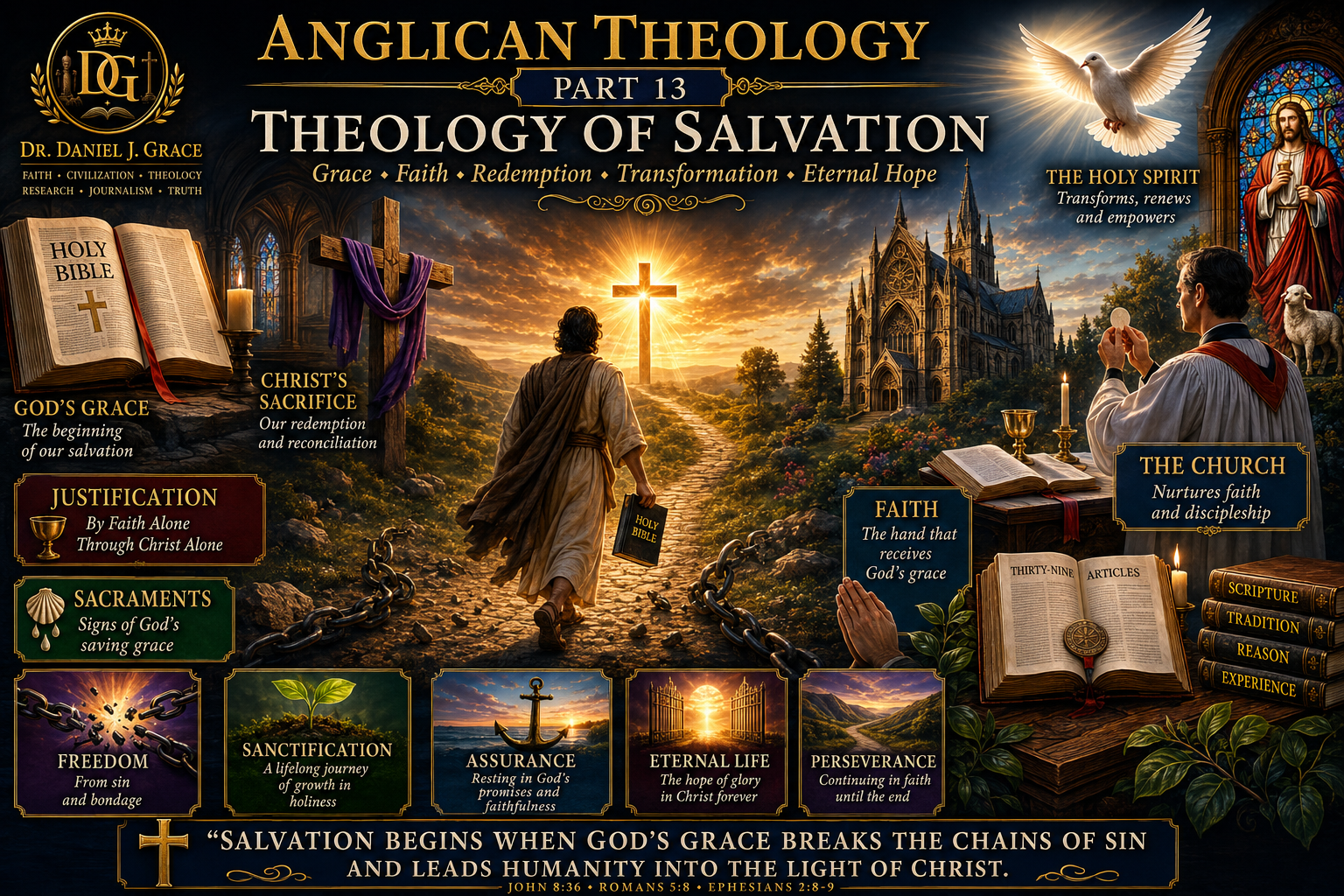
Anglican Theology of Salvation
Introduction
Few questions are more important than this:
How are human beings saved?
From the earliest centuries of Christianity, believers have wrestled with questions concerning sin, grace, faith, forgiveness, and eternal life. The Anglican tradition inherited these discussions from the Early Church, developed them during the Reformation, and continues to explore them today.
Salvation stands at the heart of the Christian Gospel. It is good news that God has acted through Jesus Christ to rescue humanity from sin and restore people to a relationship with Himself.
Anglican theology approaches salvation with a balance characteristic of the tradition itself. It emphasises God’s grace, the necessity of faith, the transforming work of the Holy Spirit, and the lifelong journey of discipleship.
Unlike some theological systems that focus exclusively on a single aspect of salvation, Anglican theology seeks to embrace the fullness of biblical teaching.
This chapter explores the Anglican understanding of sin, grace, justification, sanctification, assurance, perseverance, and eternal hope.
Humanity’s Need for Salvation
The doctrine of salvation begins with the reality of sin.
Scripture teaches that humanity was created in God’s image.
Human beings were designed for:
Fellowship with God
Holiness
Love
Stewardship of creation
Yet something went wrong.
The Fall described in Genesis introduced sin into human experience.
As a result:
Humanity became separated from God.
Relationships were damaged.
Death entered the world.
Human nature became distorted.
Saint Paul writes:
“For all have sinned and fall short of the glory of God.” (Romans 3:23)
Anglican theology fully acknowledges this universal human problem.
Every person needs redemption.
Original Sin
The Thirty-Nine Articles speak clearly about original sin.
Article IX teaches that humanity possesses a fallen nature inherited from Adam.
This does not mean people are as evil as possible.
Rather, sin has affected every aspect of human life.
Human beings cannot save themselves.
No amount of moral effort can erase guilt before God.
Salvation must come from God Himself.
This conviction forms the foundation of Anglican soteriology.
The Grace of God
Grace occupies a central place in Anglican theology.
Grace refers to God’s undeserved favour toward sinners.
Salvation is not earned.
It is received.
The New Testament repeatedly emphasises that salvation originates from God’s initiative.
Before humanity sought God, God sought humanity.
Before humanity loved God, God loved humanity.
Grace is therefore:
Free
Unmerited
Transforming
Divine
The Church of England inherited this strong emphasis from both Augustine and the Protestant Reformers.
The Person and Work of Christ
At the center of salvation stands Jesus Christ.
Christianity teaches that salvation is possible only because of Christ’s life, death, and resurrection.
Jesus accomplished what humanity could never accomplish.
Through His perfect obedience:
Sin was defeated.
God’s justice was satisfied.
Reconciliation became possible.
The cross remains the central event of salvation history.
Anglican theology proclaims that Christ died:
For sinners
For the world
For redemption
For reconciliation
His resurrection demonstrates victory over death and the promise of eternal life.
Justification by Faith
One of the most important Reformation doctrines adopted by Anglicanism is justification by faith.
The Thirty-Nine Articles state:
“We are accounted righteous before God only for the merit of our Lord and Saviour Jesus Christ by faith.”
Justification refers to God’s declaration that sinners are forgiven and accepted.
This occurs not because of human merit but because of Christ.
Faith becomes the means by which believers receive God’s saving grace.
Anglican theology therefore rejects salvation through works alone.
Salvation is grounded entirely in God’s grace.
Faith and Good Works
A common misunderstanding is that good works become unnecessary once faith is emphasised.
Anglican theology strongly rejects this idea.
Good works do not earn salvation.
However, genuine faith produces excellent works.
Faith and obedience belong together.
As James writes:
“Faith without works is dead.”
The Anglican tradition consistently teaches that transformed lives reveal the reality of saving faith.
Good works are evidence of salvation rather than the cause of salvation. works are evidence of salvation rather than the cause of salvation.
Baptism and Salvation
Anglican theology places significant importance on baptism.
Baptism is understood as:
A sacrament
A sign of grace
Entrance into the covenant community
The Book of Common Prayer speaks of baptism as a means through which believers are incorporated into Christ.
However, Anglican theology avoids simplistic sacramentalism.
The outward sign must be accompanied by genuine faith and spiritual transformation.
Baptism points believers toward God’s saving work.
The Holy Spirit and New Birth
Salvation involves more than forgiveness.
It includes spiritual renewal.
Jesus described this reality as being:
“Born again.”
The Holy Spirit works within believers to:
Convict of sin
Create faith
Renew the heart
Transform character
This work is often called regeneration.
Without the Holy Spirit, true Christian life is impossible.
The Spirit enables believers to grow in grace and holiness.
Sanctification
While justification concerns acceptance before God, sanctification concerns spiritual growth.
Sanctification is the lifelong process of becoming more like Christ.
This transformation occurs through:
Prayer
Scripture
Worship
Sacraments
Christian fellowship
Anglican spirituality places strong emphasis on sanctification.
The goal is not merely forgiveness but Christlikeness.
The Christian life becomes a journey of continual growth.

Assurance of Salvation
Can Christians know they are saved?
Anglican theology answers carefully.
Believers may possess genuine assurance because salvation rests upon God’s promises rather than human performance.
At the same time, Anglicanism generally avoids presumption.
Christians are encouraged to trust God’s faithfulness while continuing in faith and obedience.
Assurance grows through:
Trust in Christ
Scripture
Prayer
The witness of the Holy Spirit
Confidence ultimately rests in God’s grace.
Predestination and Election
The doctrine of predestination has long been discussed within Anglican theology.
Article XVII addresses the subject.
Anglicanism affirms God’s sovereign initiative in salvation.
However, it generally avoids excessive speculation.
Historically, Anglicans have held diverse views regarding predestination.
What unites them is the conviction that salvation originates in God’s grace rather than human effort.
Salvation and the Church
The Church plays an important role in God’s saving purposes.
The Church:
Proclaims the Gospel
Administers the sacraments
Nurtures believers
Provides fellowship
Yet the Church itself does not save.
Christ alone saves.
The Church serves as God’s instrument for communicating the message of salvation.
The Hope of Eternal Life
Salvation extends beyond the present life.
Christians look forward to:
Resurrection
Final judgment
New creation
Eternal fellowship with God
The Anglican burial service beautifully expresses this hope.
Christian confidence rests not in human achievement but in Christ’s victory over death.
The resurrection of Jesus guarantees the future resurrection of believers.
Salvation in Anglican Worship
The themes of salvation permeate Anglican worship.
Throughout the liturgy believers encounter:
Confession
Forgiveness
Grace
Redemption
Hope
Every service points toward God’s saving work in Christ.
The Eucharist especially reminds believers of Christ’s sacrifice and victory.
Worship therefore becomes both celebration and proclamation of salvation.
Anglicanism Between Extremes
One strength of Anglican theology is its balance.
It avoids extremes that can distort biblical teaching.
Anglicanism affirms:
Grace without legalism
Faith without antinomianism
Sacraments without superstition
Assurance without presumption
This balanced approach reflects the broader Anglican commitment to Scripture, tradition, and reason.
Salvation and Mission
The doctrine of salvation naturally leads to mission.
If Christ offers salvation to the world, the Church must proclaim that message.
Evangelism therefore flows directly from Anglican theology of salvation.
The Church exists not only to celebrate salvation but also to share it.
Every believer participates in this calling.
Conclusion
The Anglican theology of salvation centres upon God’s gracious work through Jesus Christ.
Humanity, fallen and unable to save itself, is redeemed through Christ’s life, death, and resurrection.
Salvation is received by faith, nurtured through the Church, strengthened by the sacraments, and lived out through holiness and discipleship.
It is both an event and a journey:
Justification by grace
Sanctification through the Spirit
Glorification in eternity
This vision offers profound hope.
Salvation is not achieved by human effort but given through divine grace.
For Anglicans, the Gospel remains the joyful proclamation that through Jesus Christ sinners are forgiven, lives are transformed, and eternal life is offered to all who believe.
Dr Daniel J. Grace
Faith • Civilization • Theology
Research • Journalism • Truth
🌐 danieljamesgrace.com
© 2026 Dr Daniel J. Grace. All Rights Reserved.
No part of this article may be reproduced, distributed, transmitted, or published in any form or by any means without prior written permission from the author, except for brief quotations used in academic citation, review, or research purposes.
Leave a Reply