
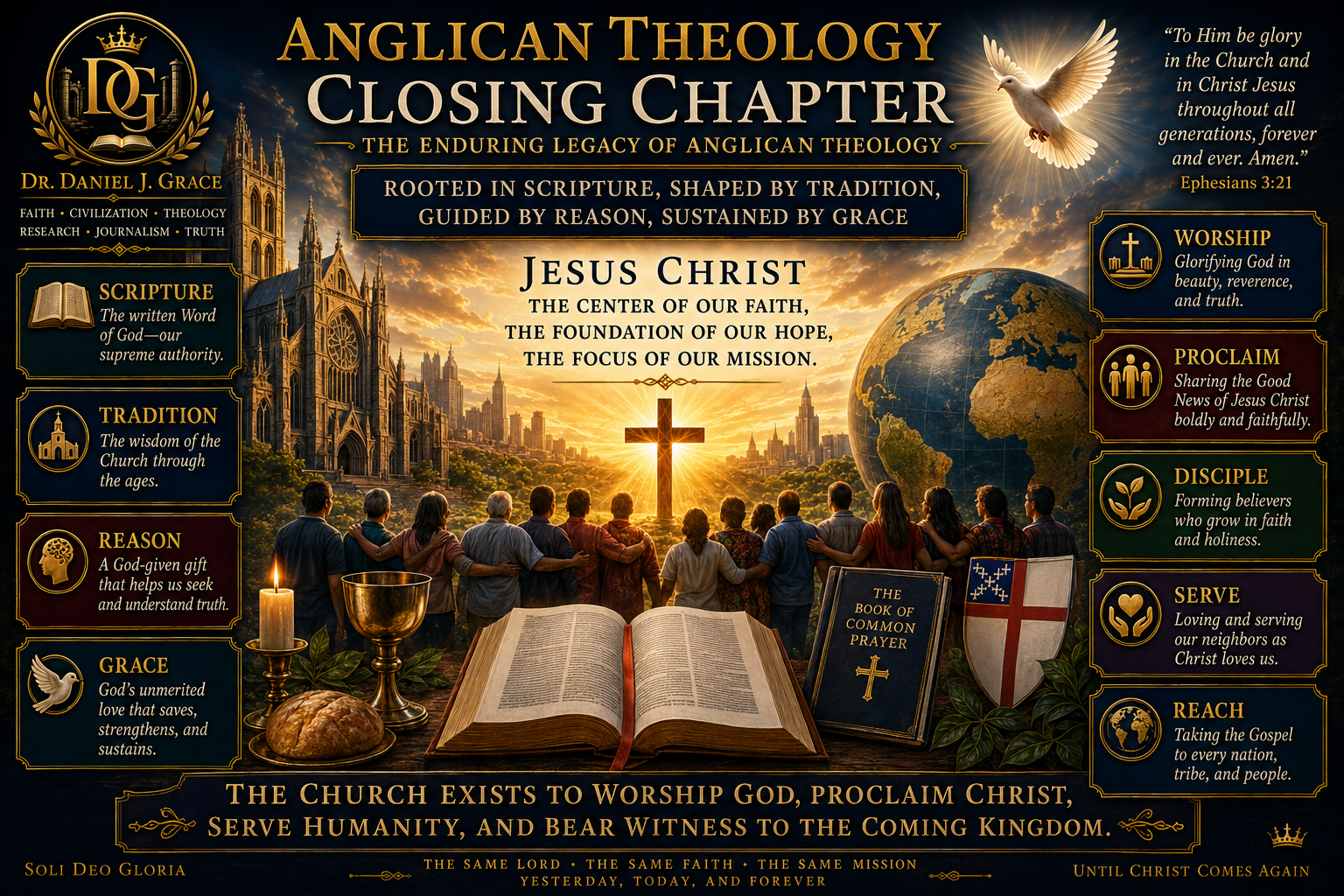
Rooted in Scripture, Shaped by Tradition, Guided by Reason, Sustained by Grace
Conclusion
The Enduring Legacy of Anglican Theology
Introduction
Every theological journey eventually reaches a point of reflection.
Having explored the history, beliefs, worship, spirituality, mission, sacraments, salvation, and global influence of Anglicanism, we arrive at the final conclusion of this study.
Yet in one sense, theology never truly ends.
Theology is not merely an academic discipline.
It is the lifelong pursuit of knowing God more deeply.
Throughout the centuries, Anglicanism has sought to preserve this vision. It has attempted to remain faithful to the Gospel while engaging thoughtfully with changing cultures, new questions, and emerging challenges.
The Anglican tradition has never claimed perfection.
Rather, it has sought faithfulness.
Its strength lies not in novelty but in continuity—continuity with Scripture, continuity with the historic Church, and continuity with the Gospel of Jesus Christ.
A Church of Balance
One of Anglicanism’s most remarkable characteristics is its commitment to balance.
Throughout this series we have repeatedly encountered three guiding principles:
Scripture
Tradition
Reason
These foundations help Anglicans navigate difficult questions while remaining anchored in historic Christianity.
Scripture remains the supreme authority.
Tradition provides the wisdom of previous generations.
Reason enables believers to think carefully and faithfully.
Together these principles form a framework that has served Anglicanism for centuries.
The Centrality of Jesus Christ
Every chapter of this series ultimately points to one person:
Jesus Christ.
The Church exists because of Him.
The sacraments proclaim Him.
The Scriptures reveal Him.
Mission serves Him.
Worship glorifies Him.
Theology itself finds its purpose in understanding His saving work.
Without Christ, Anglicanism becomes merely another institution.
With Christ, it becomes a living witness to God’s grace.
The future of the Church therefore depends not upon human strength but upon faithful obedience to Christ.
The Beauty of Anglican Worship
One of Anglicanism’s greatest gifts to Christianity is its worship.
Through:
The Book of Common Prayer
Liturgical seasons
Scripture readings
Sacramental life
Sacred music
Anglicans have sought to worship God reverently and faithfully.
This worship connects believers with generations of Christians who have prayed the same prayers, confessed the same faith, and proclaimed the same Gospel.
In a rapidly changing world, Anglican worship provides continuity, stability, and spiritual depth.
Faith and the Modern World
The twenty-first century presents enormous challenges.
Modern Christians face:
Secularization
Technological change
Moral confusion
Political division
Religious indifference
Yet these challenges also present opportunities.
The Gospel remains relevant because the human condition remains unchanged.
People continue searching for:
Meaning
Hope
Purpose
Forgiveness
Truth
The Anglican tradition possesses resources capable of addressing these needs with wisdom and compassion.
The Global Church
Perhaps one of the most exciting developments in modern Anglicanism is its global character.
What began as an English church has become a worldwide communion.
Today Anglicans worship in:
Africa
Asia
Europe
North America
South America
Australia
Oceania
This diversity reflects the universal nature of Christianity itself.
Voices from every continent and culture will increasingly shape the future of Anglicanism.
This global reality offers tremendous hope.
The Mission Continues
The mission of the Church has never changed.
Christ’s command remains:
“Go therefore and make disciples of all nations.”
The Church is called to:
Worship God
Proclaim Christ
Teach Scripture
Serve humanity
Make disciples
These responsibilities belong to every generation.
The future Church must remain faithful to this calling.
Methods may change.
Technology may advance.
Cultures may evolve.
But the mission remains the same.
A Living Tradition
Anglicanism is sometimes described as a historic tradition.
This is true.
But it is more than a historical inheritance.
It is a living tradition.
Every generation receives the faith and passes it forward.
The challenge is always the same:
How can Christians remain faithful to the gospel while speaking meaningfully to their own time?
The Anglican tradition has sought to answer that question for centuries.
Its story continues today.
Final Reflections
As this Anglican theology series concludes, several themes emerge clearly:
Scripture remains foundational.
Jesus Christ remains central.
Worship remains essential.
Mission remains urgent.
The Church remains necessary.
Hope remains alive.
These themes unite the many dimensions of Anglican theology.
They remind believers that Christianity is not merely a set of doctrines but a way of life centred upon God.
A Word to Future Readers
Whether you are:
Anglican
Catholic
Orthodox
Protestant
Student
Researcher
Curious seeker
The study of theology ultimately invites a more profound question:
Who is Jesus Christ?
The answer to that question shapes everything else.
The Anglican tradition points consistently toward Him.
Not toward itself.
Not toward its institutions.
But toward Christ.
For He remains:
The Alpha and the Omega
The Beginning and the End
The Lord of the Church
The Savior of the World
Final Conclusion
Anglican theology is best understood not as a system seeking innovation, but as a tradition seeking faithfulness.
Rooted in Scripture.
Shaped by the wisdom of the Church.
Guided by reason.
Nourished by worship.
Strengthened by the sacraments.
Empowered by the Holy Spirit.
Its purpose has always been to lead believers to a deeper knowledge of God and fuller participation in His mission.
The future may bring new challenges.
But the foundation remains secure.
For the Church is built not upon human achievement but upon Jesus Christ Himself.
And because Christ remains faithful, His Church may move forward with confidence, hope, and joy.
Final Benediction
May the God of grace guide His Church in truth.
May the Lord Jesus Christ remain the center of our faith and hope.
May the Holy Spirit strengthen believers for worship, witness, and service.
And may the Anglican Communion continue to proclaim the Gospel faithfully until Christ comes again.
Amen.
“Rooted in Scripture, shaped by tradition, guided by reason, sustained by grace, and centered on Jesus Christ.”
End of the Anglican Theology Series
Dr Daniel J. Grace
Faith • Civilization • Theology
Research • Journalism • Truth
🌐 danieljamesgrace.com
© 2026 Dr Daniel J. Grace. All Rights Reserved.
No part of this article may be reproduced, distributed, transmitted, or published in any form or by any means without prior written permission from the author, except for brief quotations used in academic citation, review, or research purposes.
Leave a Reply