
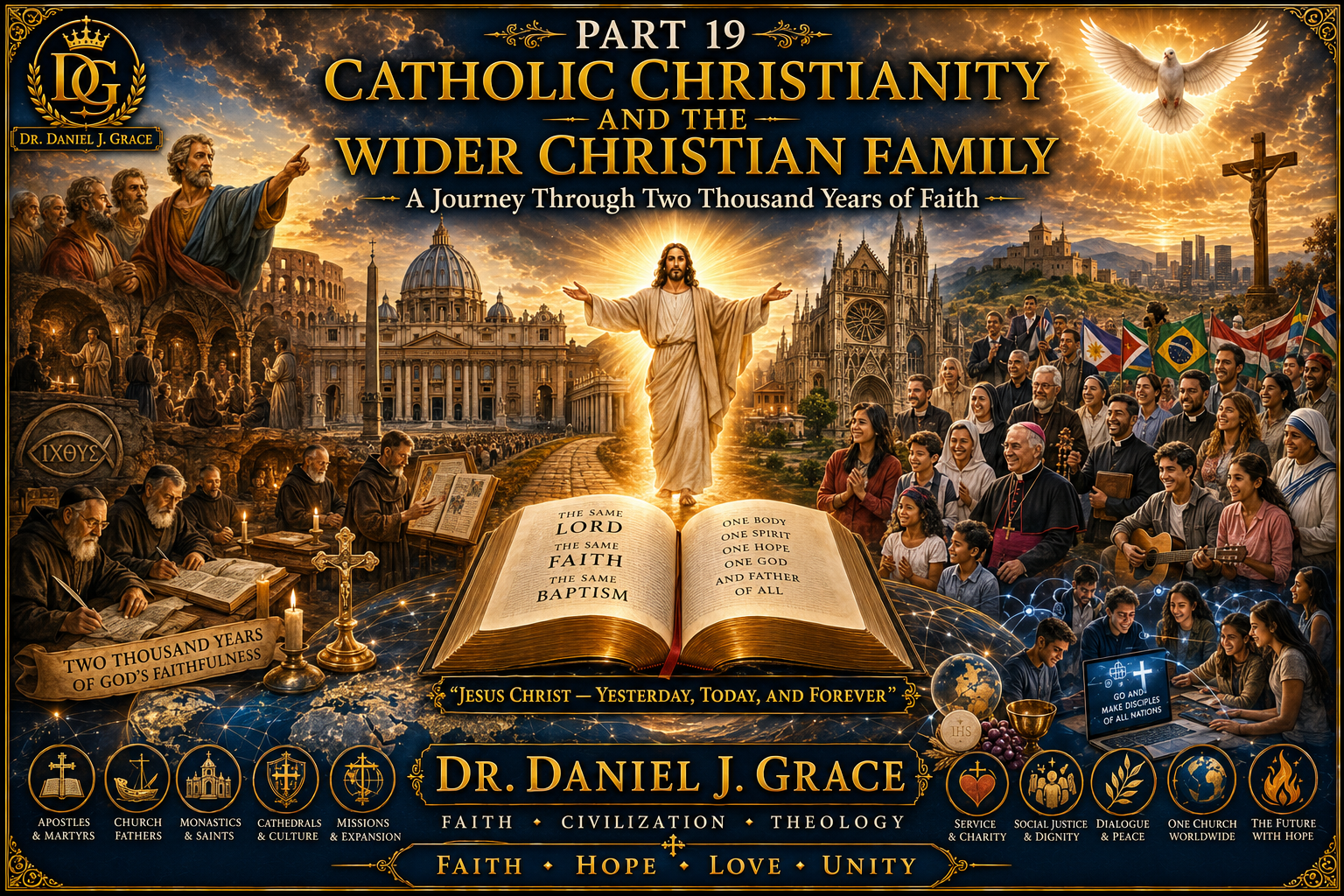
Catholic Christianity and the Wider Christian Family
Introduction
The story of Catholic Christianity is one of the most remarkable journeys in human history.
Beginning with a small group of disciples gathered around Jesus Christ in first-century Judea, Christianity grew into a worldwide faith that today spans every continent, language, culture, and nation. Through centuries of triumph and hardship, persecution and growth, reform and renewal, the Catholic Church has remained one of the most influential institutions in world history.
This book has explored that journey.
We have examined the origins of the Church, the development of doctrine, the growth of the papacy, the role of the sacraments, the witness of the saints, the influence of monasticism, the rise of mediaeval Christian civilisation, global missionary expansion, the challenges of the Reformation, the renewal of the Counter-Reformation, the significance of Vatican I and Vatican II, and the opportunities and challenges facing Catholic Christianity today.
The purpose of this study has not been to promote division or denominational rivalry. Rather, it has been to understand Catholic Christianity fairly, historically, and thoughtfully.
As we conclude this journey, we should reflect on Catholic Christianity’s contributions to the Christian world, the lessons its history offers, and how Catholics and other Christians might work together in the future.
Christianity Before Denominations
One of the most important historical realities is that the earliest Christians did not think in terms of modern denominations.
The apostles did not describe themselves as the following:
Catholic
Orthodox
Protestant
Anglican
Baptist
Methodist
They understood themselves simply as followers of Jesus Christ.
The first Christians shared the following:
One Lord
One faith
One baptism
One Gospel
Although disagreements existed, believers saw themselves as members of a single Christian community.
Remembering this reality helps place later divisions into historical perspective.
The Catholic Understanding of the Church
Catholics believe that the Church founded by Christ continues in the Catholic Church.
This conviction is rooted in:
Apostolic succession
The historic episcopate
The sacraments
Church tradition
For Catholics, the Church is not merely an organisation but a living spiritual body through which Christ continues His work in the world.
This belief has shaped Catholic identity for nearly two thousand years.
The Wider Christian Family
At the same time, Christianity today includes many traditions.
The wider Christian family includes the following:
Catholic Christians
Orthodox Christians
Anglican Christians
Lutheran Christians
Reformed Christians
Baptist Christians
Methodist Christians
Pentecostal Christians
Evangelical Christians
Although differences remain, all share belief in Jesus Christ as Lord and Saviour.
This shared foundation remains profoundly important.
What Catholics and Other Christians Share
Christians often focus on their disagreements.
Yet there is much that unites them.
Most Christians affirm the following:
The Trinity
One God in three persons.
The Divinity of Christ
Jesus is both fully God and fully human.
The Resurrection
Christ rose from the dead.
The Authority of Scripture
The Bible is God’s Word.
Salvation Through Christ
Jesus is the source of salvation.
The Final Hope
Christ will return and establish His Kingdom.
These shared beliefs are significant.
They form the foundation of Christian faith.
Learning from One Another
Throughout history, different Christian traditions have emphasised various aspects of the faith.
Catholics have often emphasised the following aspects of the faith:
Sacraments
Continuity
Tradition
Unity
Protestants have often emphasised the following points:
Scripture
Personal faith
Evangelism
Biblical preaching
Orthodox Christians have often emphasised the following points:
Worship
Mystery
Spiritual transformation
Each tradition has something valuable to contribute.
Humility allows Christians to learn from one another.
The Importance of Christian Unity
One of Jesus’ prayers was that His followers would be one.
Christian division remains one of the greatest challenges facing the Church.
Throughout history, disagreements have sometimes led to:
Conflict
Suspicion
Misunderstanding
Separation
Modern Christians increasingly recognise the importance of pursuing unity while remaining true to their convictions.
Unity does not require uniformity.
But it does require charity.
The Legacy of Catholic Christianity
Few traditions have influenced world history as deeply as Catholic Christianity.
Its contributions include:
Education
The development of universities.
Healthcare
Hospitals and medical care.
Charity
Service to the poor and vulnerable.
Art
Masterpieces of architecture, painting, and music.
Theology
Rich intellectual traditions.
Mission
Global evangelisation efforts.
Social Teaching
Advocacy for human dignity and justice.
These contributions remain part of humanity’s shared heritage.
Saints as Witnesses
One of Catholic Christianity’s greatest treasures is its saints.
Across centuries, men and women have demonstrated extraordinary faithfulness.
Figures such as:
Francis of Assisi
Teresa of Ávila
Augustine
Thomas Aquinas
Mother Teresa
continue inspiring believers today.
The saints remind Christians that faith is not merely intellectual.
Faith is lived.
Lessons from Catholic History
The history of Catholicism teaches many important lessons.
Faith Must Be Lived
Belief alone is not enough.
Faith should shape daily life.
Institutions Require Renewal
Every generation must seek reform and renewal.
Education Matters
Knowledge strengthens faith.
Worship Matters
Human beings need beauty, prayer, and community.
Service Matters
Love of God should lead to love of neighbour.
The Reality of Human Weakness
A balanced view of history recognises that the Church has not always perfectly reflected its ideals.
The church has experienced the following:
Failures
Scandals
Corruption
Conflict
These realities should not be ignored.
Yet they also remind us that Christianity ultimately rests upon Christ rather than human perfection.
The Church’s history is both a story of divine grace and human weakness.
The Church in the Modern World
The twenty-first century presents new challenges.
These include:
Secularization
Technological change
Ethical complexity
Globalization
The Church must continue addressing these issues thoughtfully and faithfully.
At the same time, new opportunities exist.
Digital communication allows the Gospel to reach people in ways previous generations could never imagine.
The Digital Age and Faith
Modern technology creates both opportunities and dangers.
It can:
Connect people
Educate believers
Spread the Gospel
But it can also:
Isolate individuals
Encourage distraction
Spread misinformation
Christians must learn how to use technology wisely.
The challenge is not merely technological.
It is spiritual.
The Future of Catholic Christianity
Predicting the future is difficult.
Yet several trends are clear.
The Church is becoming increasingly the following:
Global
Diverse
Multicultural
Africa and Asia will likely play growing roles in Catholic life.
Lay leadership will continue expanding.
Mission and evangelisation will remain a central priority.
Hope for the Future
Despite challenges, Christianity continues growing in many regions.
Millions continue finding hope in Christ.
New ministries emerge.
New churches are planted.
New generations embrace faith.
The future remains open, but there are many reasons for hope.
Beyond Labels
One important lesson from Christian history is that denominational labels, while significant, are not the ultimate reality.
The central question is not
“Am I Catholic?”
“Am I Protestant?”
“Am I Orthodox?”
The deeper question is
“Am I following Jesus Christ?”
Christian identity begins with Christ.
All other identities are secondary.
The Heart of Christianity
Throughout this book, many themes have appeared.
Yet at the heart of Christianity stands a simple message:
God loves humanity.
Jesus Christ entered history.
Christ died for sinners.
Christ rose from the dead.
Salvation is offered through Him.
Believers are called to live lives of faith, hope, and love.
This message remains the centre of the Christian faith.
Faith, Hope, and Love
The Apostle Paul wrote that three virtues endure:
Faith
Hope
Love
Catholic Christianity has spent centuries seeking to cultivate these virtues.
At its best, the Church points believers to the following:
Faith in God.
Hope in Christ.
Love for others.
These remain the marks of authentic Christianity.
A Final Reflection
The story of Catholic Christianity is ultimately the story of people who have sought to follow Christ across twenty centuries.
Some were apostles.
Some were martyrs.
Some were monks.
Some were missionaries.
Some were scholars.
Some were ordinary believers whose names history never recorded.
Together they helped build one of the most influential spiritual traditions the world has ever known.
Their legacy continues today.
Final Conclusion
Catholic Christianity is far more than a collection of doctrines, institutions, or historical events.
It is a living faith tradition that has shaped lives, cultures, and civilisations for nearly two thousand years.
Its story includes remarkable achievements and serious failures, profound wisdom and ongoing debates, as well as extraordinary saints and imperfect human beings.
Yet through every century, one message has remained constant:
Jesus Christ is Lord.
For Catholics, Protestants, Orthodox Christians, and all who call upon the name of Christ, that confession remains the foundation of faith.
May the study of Christian history inspire greater understanding.
May it encourage humility rather than pride.
May it promote unity rather than hostility.
And may it lead readers not merely to learn about Christianity but to encounter the One who stands at its centre.
Jesus Christ—yesterday, today, and forever.
End of Series
Catholic Christianity
Dr Daniel J. Grace
Faith • Civilization • Theology
Research • Journalism • Truth
© 2026 Dr Daniel J. Grace. All Rights Reserved.
No part of this article may be reproduced, distributed, transmitted, or published in any form or by any means without prior written permission from the author, except for brief quotations used in academic citation, review, or research purposes.
Leave a Reply