
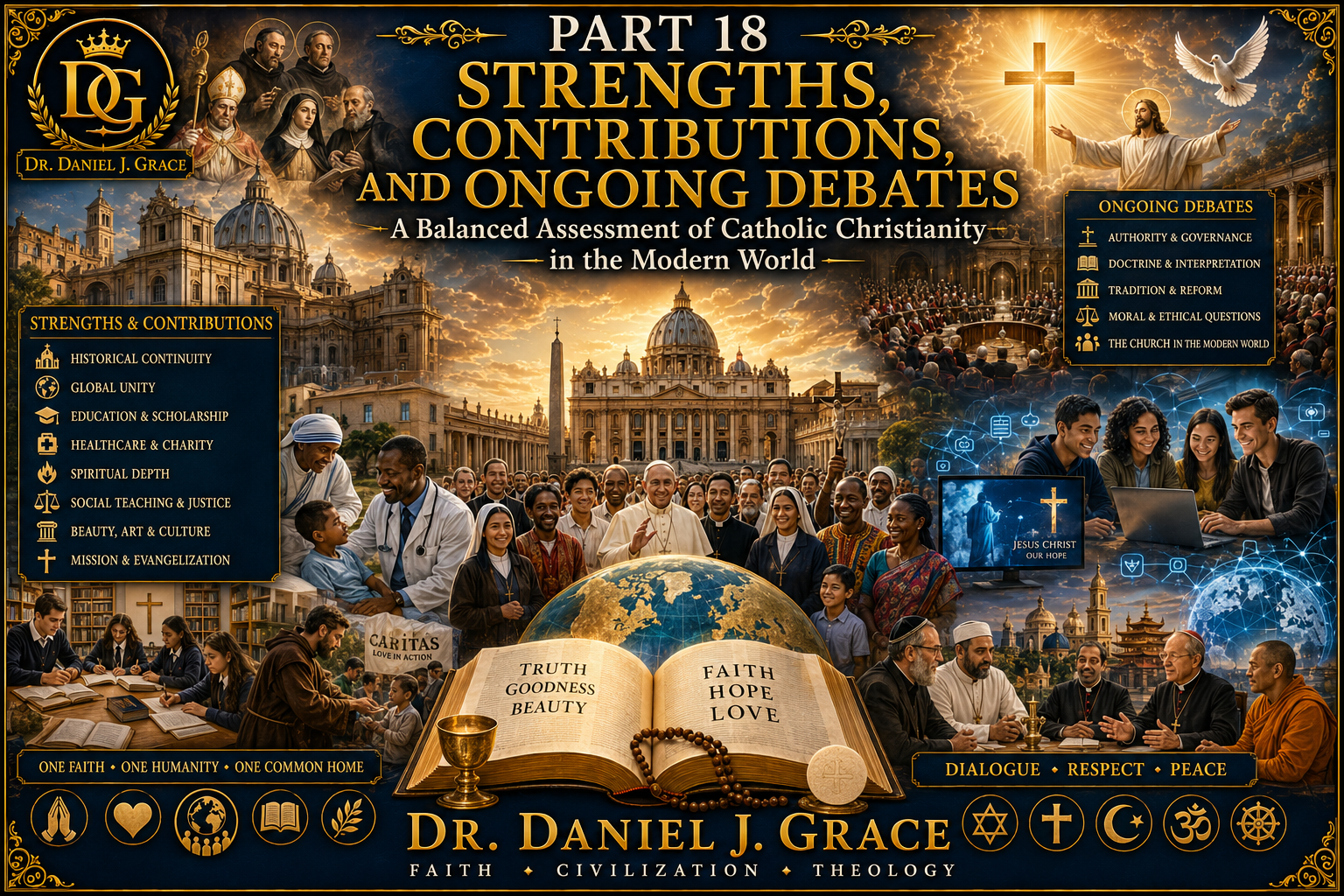
A Balanced Assessment of Catholic Christianity in the Modern World
Introduction
Catholic Christianity is one of the oldest, largest, and most influential religious traditions in human history. For nearly two thousand years, the Catholic Church has shaped civilisations, influenced cultures, inspired countless individuals, and made significant contributions to education, healthcare, social welfare, philosophy, art, architecture, and theology.
Yet Catholicism has also faced criticism, controversy, and internal challenges. Questions concerning authority, reform, doctrine, historical actions, and modern social issues continue to generate discussion both inside and outside the Church.
A balanced assessment requires honesty.
It should acknowledge Catholicism’s remarkable achievements and address legitimate criticisms and ongoing debates.
This final chapter seeks to evaluate Catholic Christianity fairly and thoughtfully, examining its strengths, contributions, challenges, and continuing role in the wider Christian family and global society.
Understanding Catholic Christianity Fairly
Before examining strengths and challenges, an important principle should be established.
No religious tradition should be judged solely by:
Its best representatives
Its worst representatives
Historical failures alone
Modern controversies alone
Instead, traditions should be assessed by considering the following:
Their core teachings
Their historical development
Their practical impact
Their spiritual fruit
Catholic Christianity deserves the same balanced approach.
The Historical Significance of Catholicism
Few institutions have exercised greater influence over world history than the Catholic Church.
For nearly twenty centuries, Catholicism has shaped:
Governments
Education
Ethics
Art
Literature
Science
Law
Social institutions
Whether one agrees with Catholic theology or not, its historical significance is undeniable.
Strength 1: Historical Continuity
One of Catholicism’s greatest strengths is its sense of continuity.
Catholics believe their faith remains connected to the apostolic Church founded by Jesus Christ.
This continuity is expressed through:
Apostolic succession
Creeds
Sacraments
Worship
Church structure
For many believers, this historical connection provides stability and identity.
Apostolic Succession
Catholics maintain that bishops stand within an unbroken line reaching back to the apostles.
This belief reinforces the Church’s understanding of authority and continuity.
Many Christians find this connection deeply meaningful.
Strength 2: Global Unity
Catholicism is often described as universal.
The word “catholic” itself means universal.
Today Catholics worship in the following:
Thousands of languages
Hundreds of cultures
Nearly every nation
Despite enormous diversity, shared beliefs and sacramental life create a remarkable sense of unity.
A Worldwide Community
A Catholic from:
Nigeria
Brazil
Australia
Philippines
Italy
can participate in the same Mass and share the same essential faith.
Many institutions lack such global reach.
Strength 3: Rich Intellectual Tradition
Catholicism has produced one of the world’s most extensive intellectual traditions.
Important figures include:
Augustine
Anselm
Aquinas
Bonaventure
Newman
These thinkers contributed significantly to philosophy and theology.
Faith and Reason
Catholic thought generally rejects the idea that faith and reason are enemies.
Instead, both are viewed as complementary.
This perspective has encouraged intellectual inquiry throughout history.
Universities and Learning
Many of the world’s earliest universities emerged within Catholic contexts.
Examples include:
Bologna
Paris
Oxford
Salamanca
These institutions helped shape modern higher education.
Strength 4: Contributions to Education
Education remains one of Catholicism’s most significant contributions.
Catholic schools educate millions worldwide.
Catholic universities continue influencing scholarship and research.
The Church views education as both a social and spiritual responsibility.
Strength 5: Healthcare and Charity
The Catholic Church operates one of the largest charitable networks in the world.
Catholic institutions provide:
Hospitals
Clinics
Orphanages
Refugee support
Disaster relief
These ministries serve people regardless of religious background.
Service to the Poor
Throughout history, Catholic social teaching has emphasised care for the vulnerable.
The Church consistently advocates for the following:
Human dignity
Social justice
Compassion
These concerns remain central to Catholic identity.
Strength 6: The Sacramental Vision
Catholic Christianity emphasises a sacramental understanding of reality.
This perspective sees God’s grace working through physical realities.
Examples include:
Water
Bread
Wine
Oil
The sacramental worldview encourages believers to see creation as meaningful and sacred.
Strength 7: Spiritual Depth
Catholic spirituality has produced extraordinary saints and mystics.
Figures such as:
Francis of Assisi
Teresa of Ávila
John of the Cross
Thérèse of Lisieux
continue inspiring Christians worldwide.
Their writings provide profound spiritual wisdom.
Strength 8: Beauty in Worship
Catholicism has contributed immensely to art and culture.
Examples include:
Cathedrals
Sacred music
Painting
Sculpture
Literature
Beauty has long been viewed as a pathway toward God.
The Power of Sacred Art
Great cathedrals and works of art continue inspiring millions.
These achievements demonstrate how faith can enrich culture.
Strength 9: Social Teaching
Modern Catholic social teaching addresses many contemporary concerns.
Themes include:
Human rights
Justice
Peace
Poverty
Environment
These teachings have influenced discussions far beyond Catholic circles.
Strength 10: Global Mission
Catholic missionaries have carried Christianity throughout the world.
They established:
Schools
Churches
Hospitals
Universities
Mission remains a defining characteristic of Catholic life.
Challenges and Criticisms
A balanced assessment must also acknowledge challenges.
No institution operating for two thousand years avoids mistakes.
Catholic history includes failures alongside achievements.
Historical Controversies
Certain historical events remain controversial.
Examples include:
Religious conflicts
Political alliances
Some aspects of colonial history
Periods of intolerance
Historians continue debating these issues.
Understanding them requires careful historical context.
Clerical Abuse Crisis
One of the most painful modern challenges involves clergy abuse scandals.
These events caused immense suffering.
They damaged trust and credibility.
The Church has implemented numerous reforms, but the wounds remain significant.
Addressing abuse continues to be an urgent priority.
The Need for Accountability
The abuse crisis highlighted the importance of the following:
Transparency
Accountability
Protection of vulnerable people
Many Catholics view ongoing reform as essential.
Debates About Authority
Questions concerning authority continue generating discussion.
Some critics argue that the Church is too centralised.
Others believe strong authority helps preserve unity.
These debates remain active.
Papal Authority
The role of the Pope remains one of Catholicism’s defining features.
Supporters view the papacy as a source of unity.
Critics sometimes question its scope.
This discussion extends across Christian traditions.
Debates Concerning Reform
Many Catholics support continued renewal and reform.
Questions often involve:
Governance
Participation
Ministry
Pastoral practice
Different perspectives exist within the Church.
Secularization
One of the greatest challenges facing Catholicism today is secularisation.
Many societies have become increasingly detached from religious belief.
This trend affects:
Worship attendance
Vocations
Religious education
The Church continues seeking effective responses.
Cultural Change
Rapid cultural change presents both opportunities and challenges.
The Church must communicate ancient truths within modern contexts.
This task requires wisdom and discernment.
The Challenge of Individualism
Modern societies often emphasise personal autonomy.
Catholic teaching, however, also stresses the following:
Community
Responsibility
Moral obligation
Balancing these values can be difficult.
Generational Differences
Younger generations frequently approach faith differently than previous generations.
Many seek:
Authenticity
Community
Meaning
Purpose
The Church continues adapting its methods of engagement.
Questions About Modern Ethics
Modern technological and scientific developments raise new ethical questions.
Examples include:
Artificial intelligence
Genetics
Biotechnology
Medical ethics
Catholic thinkers continue exploring these issues.
Internal Diversity
Catholicism contains significant diversity.
Different Catholics may emphasise the following aspects of their faith:
Tradition
Renewal
Social justice
Evangelization
Contemplation
This diversity can enrich the Church but may also create tension.
Strength Through Diversity
Despite differences, Catholicism’s diversity often reflects its global nature.
The Church includes people from vastly different cultural backgrounds.
Maintaining unity amid diversity remains both a challenge and a strength.
Catholicism and Other Christians
Relations between Catholics and other Christians have improved significantly.
Dialogue now occurs regularly with:
Orthodox Churches
Anglican Churches
Protestant communities
These efforts promote greater understanding.
Shared Christian Foundations
Catholics share many beliefs with other Christians, including:
The Trinity
The divinity of Christ
The Resurrection
Salvation through Christ
These common foundations remain important.
The Ecumenical Movement
Modern ecumenical efforts seek greater cooperation.
While significant differences remain, mutual respect has increased.
Many Christians now work together in the following areas:
Education
Humanitarian aid
Social advocacy
Catholicism and Interfaith Dialogue
The Church also engages with other religions.
Dialogue with:
Judaism
Islam
Hinduism
Buddhism
has become increasingly important.
These conversations promote understanding and peace.
Catholicism in the Digital Age
The digital revolution has transformed religious life.
Online resources now provide:
Education
Worship support
Evangelization
Community
The Church is increasingly using technology to fulfil its mission.
Opportunities for the Future
Several opportunities lie ahead.
Growth in Africa
Catholicism continues expanding rapidly.
Growth in Asia
Many communities remain vibrant and missionary-minded.
Digital Evangelization
Technology enables global outreach.
Lay Leadership
Lay Catholics increasingly contribute to Church life.
Global Collaboration
International cooperation continues expanding.
Reasons for Hope
Despite challenges, many reasons for hope exist.
The church possesses the following:
Deep spiritual resources
Global reach
Strong institutions
Dedicated believers
These strengths provide a foundation for future ministry.
What Catholicism Offers the Modern World
Catholic Christianity continues offering important contributions.
A Sense of Meaning
Faith provides purpose and hope.
Moral Reflection
Catholic ethics respond to contemporary issues.
Community
Parishes foster belonging.
Service
Catholic institutions assist millions.
Spiritual Wisdom
Centuries of experience inform Christian life.
Lessons from Catholic History
The history of Catholicism teaches valuable lessons.
Faith Endures
The Church has survived countless challenges.
Reform Is Necessary
Renewal remains essential.
Unity Matters
Christian division carries costs.
Service Matters
Faith should express itself through action.
Hope Matters
Difficult circumstances do not eliminate God’s faithfulness.
A Balanced Conclusion
Any fair assessment of Catholic Christianity must recognise both its strengths and weaknesses.
The Church has contributed enormously to:
Education
Healthcare
Charity
Art
Culture
Theology
At the same time, Catholics acknowledge historical failures and contemporary challenges.
Both realities belong to the story.
Catholic Christianity and the Wider Christian Family
Catholicism remains one of several major Christian traditions.
Its relationship with Orthodox, Protestant, Anglican, and Evangelical communities continues evolving.
Despite differences, all Christians share a common commitment to Jesus Christ.
This shared foundation remains significant.
Final Reflections
Catholic Christianity cannot be reduced to a single institution, doctrine, controversy, or historical event.
It is a living tradition shaped by:
Saints and scholars
Missionaries and martyrs
Worship and service
Faith and reason
For nearly two thousand years, Catholics have sought to follow Christ within changing historical circumstances.
The story includes triumphs and failures, wisdom and mistakes, renewal and struggle.
Yet throughout these centuries, the central message has remained remarkably consistent:
God loves humanity, Christ offers salvation, and believers are called to live lives of faith, hope, and love.
Conclusion to the Entire Series
This series has explored:
Introduction to Catholic Christianity
The Early Church and Rome
The Development of the Papacy
Saint Peter and Catholic Tradition
Ecumenical Councils
Catholic Doctrine and Tradition
The Seven Sacraments
The Eucharist
Mary in Catholic Christianity
The Saints and Christian Witness
Monasticism and Spiritual Renewal
Medieval Catholicism
Mission and Global Expansion
The Protestant Reformation
The Counter-Reformation
Vatican I and Vatican II
Catholic Christianity Today
Strengths, Contributions, and Ongoing Debates
Together, these chapters reveal a tradition that has profoundly shaped Christianity and world history.
Whether one approaches Catholicism as a believer, student, historian, or curious observer, its story remains one of the most influential and fascinating chapters in the history of human civilisation.
Dr Daniel J. Grace
Faith • Civilization • Theology
Research • Journalism • Truth
© 2026 Dr Daniel J. Grace. All Rights Reserved.
No part of this article may be reproduced, distributed, transmitted, or published in any form or by any means without prior written permission from the author, except for brief quotations used in academic citation, review, or research purposes.
Leave a Reply