
The Spread of Catholic Christianity Worldwide
Introduction
From its humble beginnings in first-century Judea, Christianity grew into one of the most influential and widespread religions in human history. What began with a small group of disciples gathered around Jesus Christ eventually spread across continents, cultures, languages, and civilisations.
The Catholic Church played a central role in this global expansion.
Missionaries travelled across deserts, mountains, oceans, jungles, and empires carrying the Christian message. They established churches, schools, hospitals, monasteries, universities, and charitable institutions. Through their efforts, Catholic Christianity became a truly global faith.
Yet the story of Catholic missions is complex.
It includes extraordinary examples of courage, sacrifice, service, and cultural engagement.
It also includes mistakes, misunderstandings, and controversies connected to colonialism and political power.
A balanced understanding of Catholic missions requires us to recognise both achievements and failures.
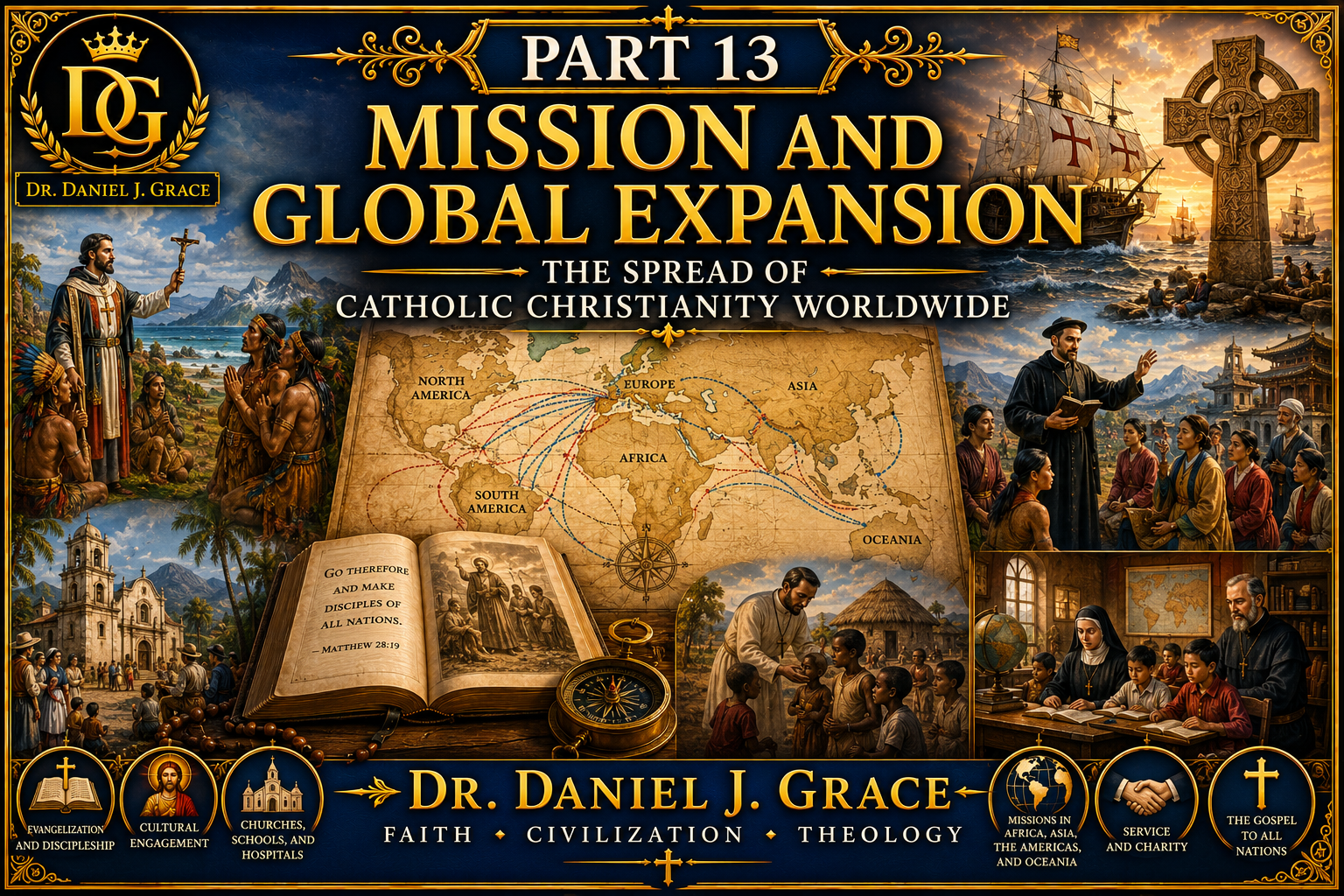
This chapter explores the global expansion of Catholic Christianity from the apostolic era to the modern world, examining how the Gospel spread across Europe, Africa, Asia, the Americas, and Oceania.
The Missionary Command of Christ
Catholic missionary activity begins with Jesus Himself.
Following His resurrection, Jesus instructed His disciples:
“Go therefore and make disciples of all nations.”
This command became known as the Great Commission.
Mission lies at the heart of Christianity.
The Church exists not merely for itself but to proclaim the Gospel to the world.
From the beginning, Christians understood that they should share their faith.
The Apostolic Age
The first missionaries were the apostles.
They carried the message of Christ throughout the Roman Empire.
Peter, Paul, John, Thomas, and others established Christian communities across vast regions.
The Book of Acts records many of these missionary efforts.
Christianity quickly expanded beyond its Jewish origins.
Saint Paul: The First Great Missionary
No missionary influenced early Christianity more than Saint Paul.
Following his conversion, Paul travelled thousands of kilometres.
His missionary journeys took him to:
Asia Minor
Greece
Macedonia
Rome
Paul established churches, trained leaders, and wrote letters that became part of the New Testament.
His ministry demonstrated Christianity’s universal message.
Christianity and the Roman Empire
The Roman Empire unintentionally helped Christianity spread.
Several factors contributed:
Roads
Roman roads allowed easier travel.
Common Language
Greek served as a shared language.
Urban Networks
Major cities became centres of missionary activity.
Relative Stability
Political order facilitated movement.
These conditions helped Christianity expand rapidly.
Christianity Beyond Rome
Even during the early centuries, Christianity spread beyond Roman borders.
Communities emerged in:
Persia
Armenia
Ethiopia
India
This reminds us that Christianity was already becoming global long before mediaeval Europe.
Christianity in Ethiopia
Ethiopia possesses one of the oldest Christian traditions in the world.
Christianity became established there during the fourth century.
The Ethiopian Church developed a rich spiritual and cultural heritage.
Its history demonstrates that Christianity was never exclusively European.
Christianity in Armenia
Armenia became the first nation to adopt Christianity as its official religion.
This occurred around AD 301.
Armenian Christianity developed unique traditions while remaining connected to the broader Christian world.
The Conversion of Europe
Following the fall of Rome, missionaries continued spreading Christianity throughout Europe.
Many Germanic tribes eventually embraced Christianity.
Missionary work reached:
Ireland
England
Germany
Scandinavia
Eastern Europe
This process took centuries.
Saint Patrick and Ireland
Saint Patrick remains one of Christianity’s most famous missionaries.
Originally brought to Ireland as a slave, Patrick later returned as a missionary.
His efforts transformed Irish society.
Ireland became a major centre of Christian learning and missionary work.
Irish Missionaries
Irish monks played a remarkable role in the evangelisation of Europe.
They established monasteries throughout Europe.
These communities preserved learning and spread Christianity.
Irish missionaries helped shape mediaeval Christian civilisation.
Saint Boniface and Germany
Saint Boniface became known as the Apostle of Germany.
His missionary efforts helped establish Christianity across German territories.
Boniface combined evangelisation with church organisation and education.
Christianity in Scandinavia
The conversion of Scandinavia occurred gradually.
Missionaries worked among:
Vikings
Danish kingdoms
Norwegian rulers
Swedish communities
Over time Christianity became deeply rooted in the region.
Eastern Europe
Christianity also expanded eastward.
Missionaries reached:
Poland
Hungary
Bohemia
Russia
These conversions significantly shaped European history.
Saints Cyril and Methodius
Among the most influential missionaries were Cyril and Methodius.
They evangelised the Slavic peoples and developed a written alphabet to support translation.
Their work demonstrated the importance of adapting Christianity to local cultures.
The Importance of Language
Missionaries quickly recognised that language is important.
People understand the Gospel most effectively in their language.
Throughout history, missionaries have translated the following:
Scripture
Liturgy
Catechisms
Translation became one of the Church’s most powerful missionary tools.
Monasteries and Mission
Monasteries served as centres of missionary activity.
Monks established communities that combined:
Prayer
Education
Charity
Evangelization
These institutions often became foundations for Christian expansion.
The Age of Exploration
The fifteenth and sixteenth centuries marked a new phase in global history.
European exploration connected previously isolated regions.
New sea routes opened access to the following:
Africa
Asia
The Americas
Oceania
The Catholic Church became deeply involved in these developments.
Mission and Colonial Expansion
Catholic missions often accompanied European exploration.
This relationship remains one of the most debated aspects of Church history.
Missionaries sometimes benefited from colonial structures.
At other times they defended indigenous peoples against exploitation.
The reality was complex and varied by region.
Catholic Missions in the Americas
Following Columbus’s voyages, Catholic missionaries travelled throughout the Americas.
Their goals included:
Evangelization
Education
Social assistance
Missionaries established churches, schools, and hospitals across vast territories.
Defending Indigenous Peoples
Some missionaries became strong defenders of indigenous populations.
One notable example was Bartolomé de las Casas.
He was critical of abuses committed against native peoples.
His advocacy helped raise moral questions concerning colonial practices.
Challenges in the Americas
Missionary efforts often faced serious difficulties.
These included:
Cultural misunderstandings
Political conflicts
Forced assimilation
Colonial exploitation
A balanced assessment must acknowledge both missionary dedication and historical failures.
Catholicism in Latin America
Despite challenges, Catholic Christianity became deeply rooted throughout Latin America.
Today, countries include the following:
Mexico
Brazil
Colombia
Argentina
Peru
Peru has some of the largest Catholic populations in the world.
Latin American Catholicism developed distinctive spiritual and cultural expressions.
Our Lady of Guadalupe
One of the most important events in Latin American Catholic history involves Our Lady of Guadalupe.
The devotion became a powerful symbol of Christian faith and cultural identity.
Guadalupe remains highly significant throughout the Americas.
Catholic Missions in Asia
Asia presented unique opportunities and challenges.
Missionaries encountered ancient civilisations with rich philosophical and religious traditions.
Success required sensitivity and adaptation.
Saint Francis Xavier
Saint Francis Xavier ranks among Christianity’s greatest missionaries.
He travelled extensively throughout Asia.
His ministry included work in:
India
Japan
Southeast Asia
His missionary zeal inspired generations of Catholics.
Christianity in India
Christianity has ancient roots in India.
Tradition associates its beginnings with Saint Thomas the Apostle.
Later Catholic missionaries strengthened and expanded Christian communities.
India remains home to millions of Christians today.
Christianity in Japan
Catholic missionaries achieved notable success in Japan during the sixteenth century.
However, severe persecution later emerged.
Many Christians suffered martyrdom.
The courage of Japanese believers remains an important chapter in Christian history.
Matteo Ricci and China
One of the most remarkable missionaries was Matteo Ricci.
Ricci sought to engage Chinese culture respectfully.
He learned the language.
He studied Chinese philosophy.
He built relationships with scholars.
His approach demonstrated the importance of cultural understanding in missionary work.
Inculturation
Catholic missions increasingly recognised the importance of inculturation.
Inculturation means expressing Christianity within local cultural contexts.
Rather than imposing foreign customs, missionaries sought ways to communicate the Gospel through local traditions where possible.
This principle remains important today.
Catholic Missions in Africa
Christianity has ancient African roots.
North Africa produced major Christian thinkers such as Augustine.
Ethiopia maintained a long Christian tradition.
Modern Catholic missions expanded Christianity across many additional regions.
Education and Healthcare
Catholic missionaries frequently established the following:
Schools
Hospitals
Clinics
Orphanages
These institutions often became important community resources.
Education and healthcare remain significant aspects of Catholic mission work.
African Catholic Growth
The Catholic Church has experienced remarkable growth in Africa.
Many African nations now possess vibrant Christian communities.
Africa represents one of the most dynamic regions of global Christianity.
Catholic Missions in Oceania
Missionaries also travelled throughout Oceania.
They reached:
Australia
New Zealand
Pacific Islands
These missions often required extraordinary perseverance due to geographic isolation.
Catholicism in Australia
Catholic Christianity became an important part of Australian society.
Irish immigration contributed significantly to its growth.
Catholic institutions helped shape:
Education
Healthcare
Social services
The Church continues playing a major role in Australian life.
Religious Orders and Mission
Various religious orders contributed to missionary expansion.
These included:
Jesuits
Education and intellectual engagement.
Franciscans
Simplicity and service.
Dominicans
Preaching and teaching.
Benedictines
Monastic witness.
Salesians
Youth ministry.
Each order contributed uniquely to the Church’s global mission.
The Jesuits
The Society of Jesus became one of the most influential missionary organisations in history.
Jesuits established schools and universities worldwide.
Their commitment to education remains highly respected.
Missionaries as Linguists
Many missionaries became scholars of language.
They developed:
Dictionaries
Grammars
Written alphabets
Their work often preserved local languages and cultural knowledge.
Missionaries and Science
Some missionaries contributed significantly to scientific knowledge.
They studied:
Geography
Astronomy
Botany
Anthropology
Missionary work sometimes expanded understanding of the wider world.
Modern Missionary Activity
Contemporary Catholic missions differ significantly from earlier models.
Today’s emphasis focuses on the following:
Dialogue
Service
Partnership
Respect for cultures
Mission is understood as both proclamation and practical service.
Vatican II and Mission
The Second Vatican Council emphasised the Church’s missionary nature.
The Council encouraged the following:
Cultural respect
Religious dialogue
Evangelization
Global cooperation
Its teachings continue shaping modern missionary practice.
Mission and Social Justice
Modern Catholic missions often address social issues such as the following:
Poverty
Education
Healthcare
Human rights
The Gospel is understood as involving both spiritual and practical concern for human dignity.
Challenges Facing Mission Today
Missionary activity faces several challenges.
These include:
Secularization
Religious pluralism
Political restrictions
Cultural misunderstandings
Missionaries must navigate increasingly complex environments.
Christianity as a Global Faith
One of the most significant developments in modern Christianity is its global character.
The Church has shifted its centre of gravity away from Europe.
Catholic populations are growing rapidly in the following regions:
Africa
Asia
Latin America
The future of Catholicism will increasingly reflect this global diversity.
Lessons from Mission History
Mission history offers important lessons.
Courage Matters
Many missionaries sacrificed greatly.
Culture Matters
Respect for local cultures is essential.
Service Matters
Education and healthcare demonstrate Christian love.
Humility Matters
The Church must learn from past mistakes.
The gospel is universal.
Christianity transcends ethnic and national boundaries.
A Balanced Assessment
Catholic missions achieved remarkable successes.
Millions encountered Christianity through missionary efforts.
Schools, hospitals, and charitable institutions improved countless lives.
At the same time, colonial systems and cultural insensitivity entangled some missionary activities.
A balanced historical perspective recognises both of these realities.
The Continuing Mission of the Church
Mission remains central to Catholic identity.
Every Christian is called to witness through:
Faith
Service
Compassion
Evangelization
The Church’s mission continues wherever believers seek to share Christ’s love with the world.
Conclusion
The history of Catholic missions is one of the most remarkable stories in human history.
From the apostles of the first century to modern missionaries serving across continents, countless individuals have devoted their lives to spreading the Gospel.
Their efforts helped transform Christianity from a small movement in Judea into a truly global faith.
Through missionary work, Catholic Christianity reached Europe, Africa, Asia, the Americas, and Oceania, shaping cultures, establishing institutions, and influencing billions of lives.
The story includes both extraordinary achievements and important lessons about humility, cultural respect, and justice.
Ultimately, Catholic missions reflect the Church’s conviction that the message of Jesus Christ is intended for all peoples and all nations.
In Part 14 — The Protestant Reformation: Challenges Faced by the Catholic Church, we will examine one of the most dramatic turning points in Christian history and its lasting impact on Catholicism and the wider Christian world.
Dr Daniel J. Grace
Faith • Civilization • Theology
Research • Journalism • Truth
© 2026 Dr Daniel J. Grace. All Rights Reserved.
No part of this article may be reproduced, distributed, transmitted, or published in any form or by any means without prior written permission from the author, except for brief quotations used in academic citation, review, or research purposes.
Leave a Reply