
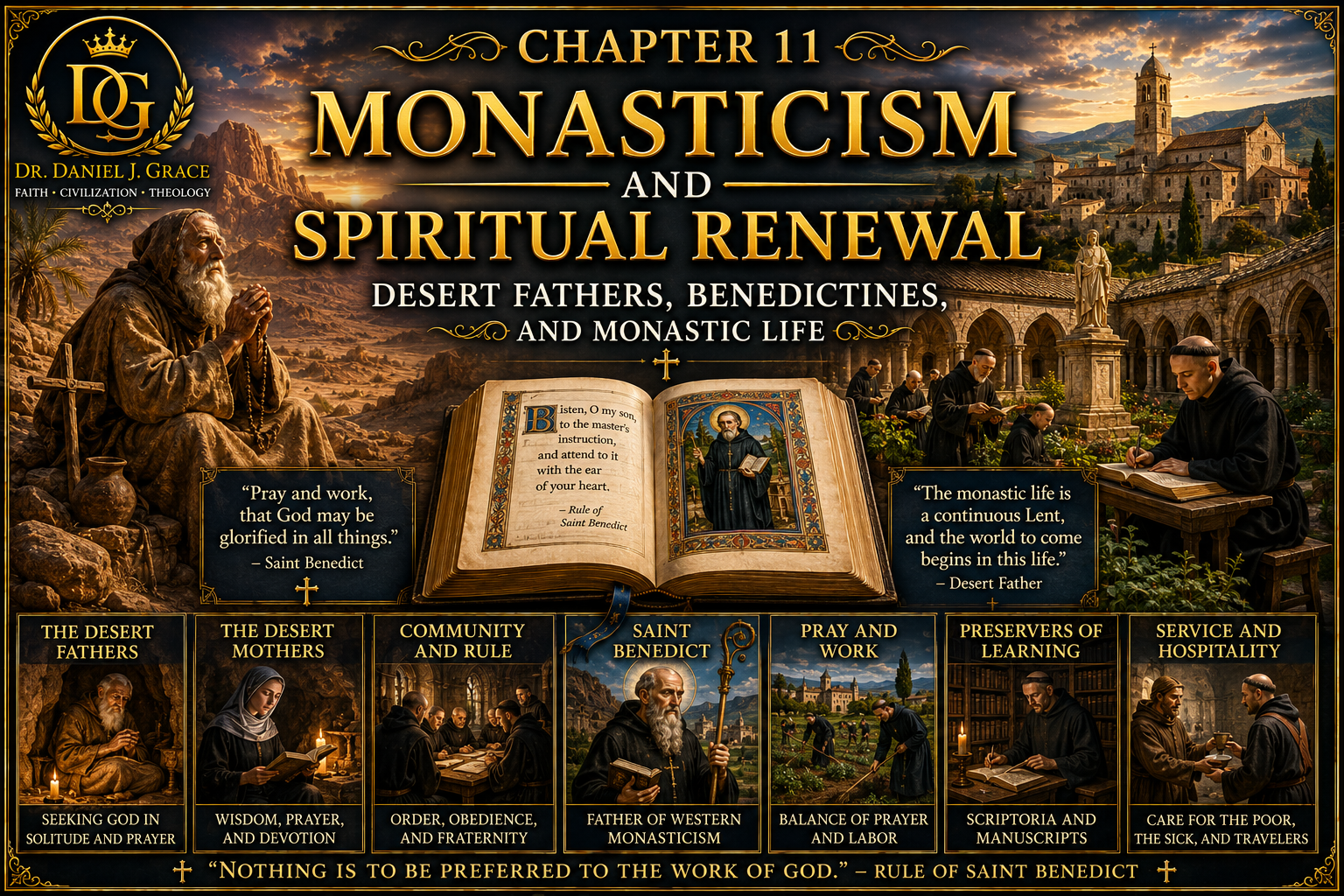
Desert Fathers, Benedictines, and Monastic Life
Introduction
Few movements have shaped Christian history as profoundly as monasticism. While kings built empires and armies fought wars, monks and nuns quietly transformed the spiritual, intellectual, and cultural foundations of Christian civilisation.
For nearly two thousand years, monasteries have served as centres of prayer, learning, charity, education, and spiritual renewal. Within their walls, Scriptures were copied, theological works were written, the poor were fed, travellers were sheltered, and generations of Christians learnt how to pursue holiness.
Monasticism did not emerge from wealth or political power. It began in deserts.
The first monks left cities and towns behind in search of God. They desired a more profound relationship with Christ and sought solitude, prayer, and simplicity. What began as a movement of spiritual withdrawal eventually became one of the most influential forces in Christian history.
Catholic Christianity regards monasticism not merely as a historical institution but as a continuing witness to the importance of prayer, discipline, and devotion. Monastic communities remind the Church that human beings are created not only for work and success but ultimately for communion with God.
This chapter explores the origins of monasticism, the lives of the Desert Fathers and Mothers, the rise of Benedictine monasticism, the role of monasteries in preserving civilisation, and the continuing significance of monastic spirituality today.
The World Before Monasticism
To understand monasticism, it is important to understand the world in which it developed.
During the first three centuries of Christianity, believers frequently faced persecution.
Faith often required courage.
Martyrdom was a real possibility.
Many Christians demonstrated extraordinary commitment through suffering and sacrifice.
However, after Christianity became legal under Emperor Constantine in the fourth century, circumstances changed dramatically.
The Church gained freedom.
Christianity spread rapidly.
Political influence increased.
While these developments brought many benefits, some believers worried that Christian commitment might become less radical.
Many sought a way to maintain spiritual intensity.
Monasticism emerged as one response to this challenge.
The Search for Holiness
Early monks were motivated by a desire for holiness.
They wanted:
Simplicity
Prayer
Self-discipline
Freedom from distractions
Deeper communion with God
They believed that withdrawing from worldly concerns could help them focus entirely on spiritual growth.
Their goal was not to reject creation but to seek God more fully.
The Egyptian Desert
The birthplace of Christian monasticism was Egypt.
The deserts of Egypt became home to countless men and women seeking solitude and prayer.
The harsh environment symbolised a struggle for the spirit.
Just as Israel encountered God in the wilderness, many Christians believed the desert offered a place of spiritual encounter.
Thousands travelled into these barren regions.
Their influence soon spread throughout the Christian world.
Saint Anthony the Great
No figure is more important in the origins of monasticism than Saint Anthony the Great.
Born around AD 251, Anthony came from a wealthy Christian family.
After hearing Christ’s words:
“Sell what you possess and give to the poor,”
He took them literally.
Anthony distributed his wealth and withdrew into the desert.
There he devoted himself to prayer, fasting, and spiritual discipline.
Anthony’s Influence
Anthony’s life attracted enormous attention.
Although he sought solitude, others came seeking guidance.
Many wished to imitate his example.
His reputation spread throughout the Roman Empire.
The biography of Anthony, written by Athanasius, became one of the most influential Christian texts of the ancient world.
Countless future monks drew inspiration from his example.
Spiritual Warfare
The Desert Fathers often described the Christian life as spiritual warfare.
They believed that believers faced temptations that included:
Pride
Anger
Lust
Greed
Fear
Despair
The desert became a place where these struggles could be confronted honestly.
Many sayings of the Desert Fathers focus on self-control, humility, and perseverance.
Their wisdom continues to influence Christian spirituality today.
The Desert Fathers
The Desert Fathers were not a formal organisation.
They were individual spiritual teachers who lived in deserts throughout Egypt, Palestine, and Syria.
They became known for their wisdom and holiness.
Visitors travelled great distances seeking their advice.
The sayings of the Desert Fathers reveal remarkable spiritual insight.
Many of their teachings remain relevant today.
Wisdom of the Desert
The Desert Fathers frequently emphasised the following:
Silence
Silence creates space for listening to God.
Humility
Humility protects believers from pride.
Prayer
Prayer sustains spiritual life.
Simplicity
Freedom from excess allows greater focus on God.
Patience
Spiritual growth takes time.
These principles became foundational to later monastic traditions.
The Desert Mothers
Women also played a significant role in early monasticism.
Known as the Desert Mothers, they pursued lives of prayer and devotion.
Figures such as Amma Syncletica became respected spiritual teachers.
Their writings and sayings reveal profound wisdom and demonstrate the important role women played in early Christian spirituality.
From Solitary Life to Community
Initially many monks lived alone.
Over time, however, communal forms of monasticism emerged.
Living together offered several advantages:
Mutual support
Shared prayer
Accountability
Organization
Community life became increasingly important as monasticism developed.
Saint Pachomius
Saint Pachomius helped establish communal monasticism.
Rather than living entirely alone, monks lived together under common rules.
They shared:
Prayer
Work
Meals
Resources
This model became highly influential.
Many future monastic communities followed similar patterns.
Monastic Rules
As communities grew, structure became necessary.
Monastic rules provided guidance on the following:
Prayer
Work
Worship
Discipline
Community life
These rules helped create stability and order.
The most famous monastic rule would later emerge through Saint Benedict.
The Spread of Monasticism
Monasticism quickly spread beyond Egypt.
Communities appeared throughout:
Palestine
Syria
Asia Minor
North Africa
Europe
Different regions developed distinct traditions.
Despite variations, all shared a commitment to prayer, discipline, and spiritual growth.
Saint Basil the Great
In the Eastern Church, Saint Basil became a major architect of monastic life.
His rule emphasised:
Community
Charity
Worship
Service
Eastern Orthodox monasticism continues to reflect Basil’s influence.
Monasticism Reaches the West
As Christianity expanded throughout Europe, monastic ideals travelled westward.
Various forms of monastic life emerged.
Eventually one figure would provide the foundation for Western monasticism.
That figure was Saint Benedict.
Saint Benedict of Nursia
Saint Benedict was born around AD 480.
He lived during a period of political instability following the collapse of the Western Roman Empire.
Seeking God, Benedict withdrew from society.
Eventually he established monastic communities and wrote a rule that became enormously influential.
The Rule of Saint Benedict
The Rule of Saint Benedict remains one of the most important documents in Christian history.
It provided practical guidance for monastic life.
Its principles emphasised the following:
Prayer
Work
Balance
Stability
Obedience
Community
The rule avoided extreme practices.
Instead, Benedict promoted moderation and wisdom.
Pray and Work
The Benedictine motto is often summarised as
Ora et Labora
“Pray and Work.”
This phrase reflects Benedict’s conviction that prayer and daily labour belong together.
Work itself can become an act of worship.
This balanced approach contributed significantly to the success of Benedictine monasticism.
Daily Life in a Monastery
Monastic life follows a structured rhythm.
Days are organised around prayer.
Monks gather several times daily for communal worship.
They also engage in:
Reading
Study
Agriculture
Teaching
Service
The routine seeks to cultivate spiritual discipline and attentiveness to God.
The Liturgy of the Hours
A central feature of monastic life is the Liturgy of the Hours.
This practice involves praying at various times throughout the day.
Traditionally, these include the following:
Matins
Lauds
Prime
Terce
Sext
None
Vespers
Compline
Through these prayers, the day becomes sanctified by continual remembrance of God.
Monasteries and Learning
Monasteries became major centres of education.
During periods of political instability, monks preserved learning.
They copied manuscripts by hand.
They studied:
Scripture
Theology
Philosophy
History
Literature
Without monastic efforts, many ancient texts would have been lost forever.
Scriptoria
Many monasteries maintained scriptoria.
These were rooms dedicated to copying manuscripts.
Monks carefully reproduced books by hand.
The work required patience and skill.
These efforts preserved both Christian and classical writings.
The impact on Western civilisation was enormous.
Monasteries and Agriculture
Monks also transformed agriculture.
They introduced improved farming techniques.
Monasteries often became models of efficient land management.
Agricultural innovation contributed to economic development across mediaeval Europe.
Hospitality and Charity
Monasteries frequently served travellers, pilgrims, and the poor.
Hospitality became a central monastic value.
Guests were treated with dignity and respect.
Monasteries often provided:
Food
Shelter
Medical care
Education
Their charitable work strengthened local communities.
Missionary Monks
Many monks became missionaries.
They carried Christianity to new regions.
Examples include:
Saint Patrick in Ireland
Saint Columba in Scotland
Saint Boniface in Germany
Their efforts helped spread Christianity throughout Europe.
Irish Monasticism
Ireland developed a unique monastic tradition.
Monasteries became major centres of learning and missionary work.
Irish monks preserved scholarship during difficult periods and later carried Christianity across Europe.
Their influence remains significant.
Cluniac Reform
By the tenth century, some monasteries experienced decline.
The Cluniac Reform sought renewal.
Monasteries emphasised:
Worship
Discipline
Independence from political interference
The reform strengthened monastic life and influenced broader Church renewal.
The Cistercians
The Cistercian movement emerged as another reform effort.
Its members sought greater simplicity.
They emphasised:
Manual labor
Simplicity
Prayer
Self-sufficiency
The Cistercians became one of the most influential mediaeval religious movements.
Saint Bernard of Clairvaux
Saint Bernard became the most famous Cistercian leader.
His writings profoundly influenced mediaeval spirituality.
Bernard emphasised:
Love of God
Humility
Contemplation
His leadership helped expand the Cistercian movement throughout Europe.
Monasticism and Scholarship
Many great theologians emerged from monastic backgrounds.
Monasteries fostered intellectual development.
Monks contributed to:
Theology
Biblical interpretation
Philosophy
Science
History
The relationship between faith and learning became a defining feature of Christian civilisation.
Monasticism and Culture
Monasteries influenced:
Art
Architecture
Music
Literature
Some of the world’s most beautiful churches and manuscripts originated within monastic communities.
Their cultural legacy remains visible today.
Challenges Facing Monasticism
Monastic life was not always ideal.
Communities sometimes struggled with:
Wealth
Corruption
Political influence
Declining discipline
Periods of reform repeatedly emerged to address these challenges.
Renewal became a recurring theme in monastic history.
Monasticism in the Modern World
The modern era has brought significant changes.
Industrialisation, urbanisation, and secularisation have dramatically changed society.
Monastic communities became smaller in many regions.
Yet monasticism continues.
Monks and nuns remain active throughout the world.
Contemporary Monastic Life
Modern monasteries continue to emphasise the following:
Prayer
Hospitality
Community
Study
Service
Many welcome visitors seeking spiritual guidance.
Retreat centres provide opportunities for reflection in an increasingly busy society.
What Monasticism Teaches Today
Modern Christians can learn much from monastic traditions.
Silence
Modern life is noisy.
Silence remains spiritually valuable.
Simplicity
Consumer culture encourages excess.
Monastic simplicity offers a different vision.
Prayer
Regular prayer sustains faith.
Community
Spiritual growth often occurs in relationships.
Balance
Work and worship belong together.
Monastic Wisdom and Technology
The digital age presents unique challenges.
Constant connectivity often produces distraction.
Monastic practices encourage:
Focus
Reflection
Presence
Discipline
Many people consider monastic wisdom surprisingly relevant in the modern world.
The Continuing Legacy of Saint Benedict
Saint Benedict was declared the patron saint of Europe.
His influence extends far beyond monasteries.
His principles of balance, prayer, work, and community continue shaping Christian thought.
Many regard Benedict as one of the architects of Western civilisation.
Monasticism and Christian Renewal
Throughout history, monastic movements repeatedly renewed the Church.
When Christianity became comfortable or complacent, monastic communities often called believers back to prayer and holiness.
Their witness continues reminding Christians that spiritual depth matters.
Lessons from the Monastic Tradition
Monasticism teaches:
God deserves priority.
Prayer transforms life.
Simplicity brings freedom.
Community matters.
Holiness requires discipline.
Service reflects Christ.
These lessons remain timeless.
Conclusion
Monasticism began in the deserts of Egypt but grew into one of the most influential movements in Christian history.
From the Desert Fathers and Mothers to Benedictines, Cistercians, missionaries, scholars, and modern monks, monastic communities have shaped spirituality, education, culture, and civilisation.
Their legacy extends far beyond monastery walls.
They preserved learning, served the poor, spread Christianity, and demonstrated the enduring importance of prayer and holiness.
Most importantly, monasticism reminds Christians that life’s highest purpose is not success, wealth, or power, but communion with God.
In Part 12 — Mediaeval Catholicism: Cathedrals, Universities, and Christian Civilisation, we will explore how the Catholic Church helped shape mediaeval society, education, architecture, law, and culture, having a lasting effect on the development of the Western world.

Dr Daniel J. Grace
Faith • Civilization • Theology
Research • Journalism • Truth
© 2026 Dr Daniel J. Grace. All Rights Reserved.
No part of this article may be reproduced, distributed, transmitted, or published in any form or by any means without prior written permission from the author, except for brief quotations used in academic citation, review, or research purposes.
Leave a Reply