The Centre of Catholic Worship
Introduction
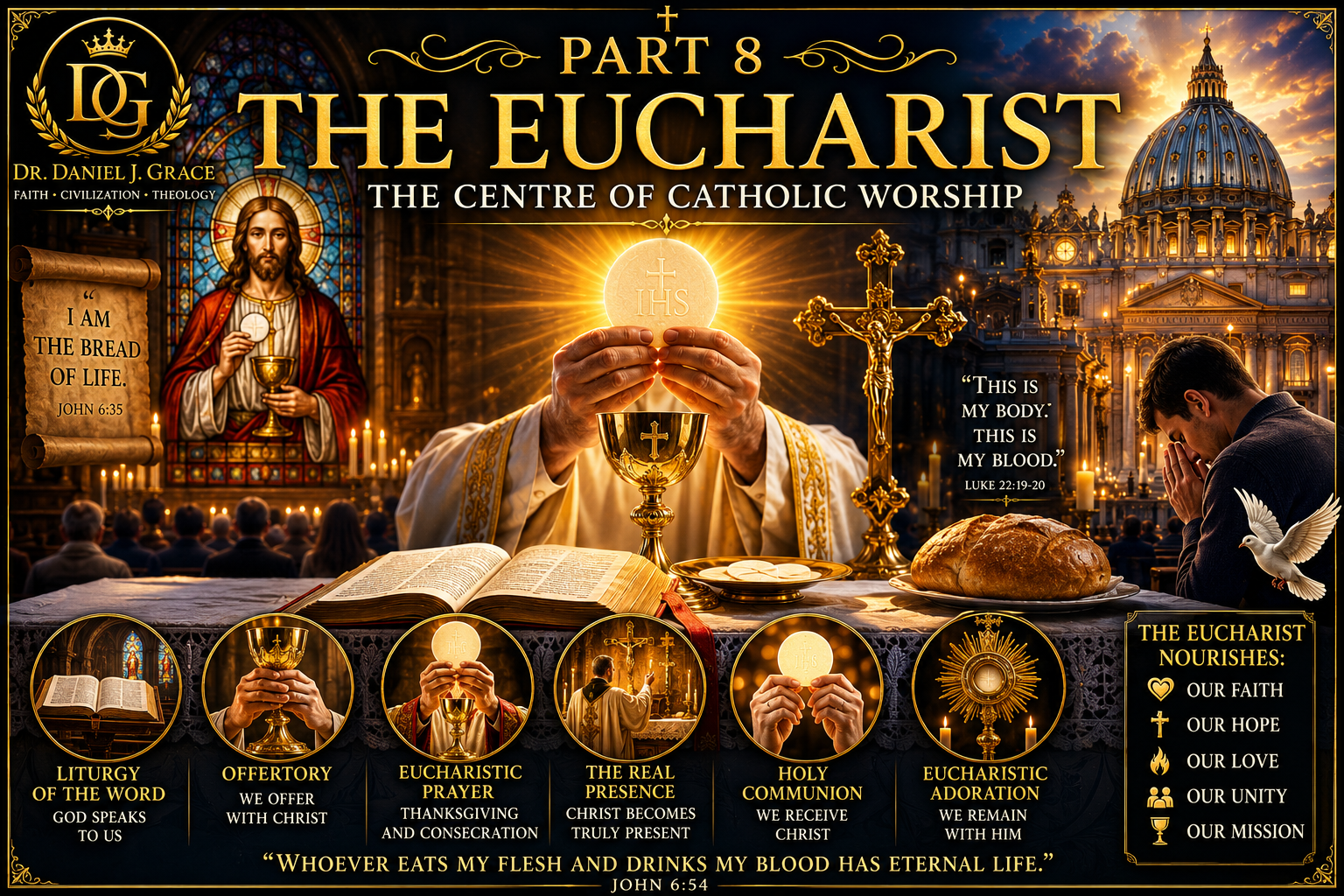
Among all the teachings and practices of Catholic Christianity, none is more central than the Eucharist. Catholics describe the Eucharist as the following:
“The source and summit of the Christian life.”
This statement, affirmed by the Second Vatican Council, expresses the unique place the Eucharist occupies in Catholic faith, worship, spirituality, and community life.
Every week, and often every day, millions of Catholics gather throughout the world to celebrate the Mass. Whether in a magnificent cathedral in Rome, a village church in Africa, a chapel in Asia, or a small parish in Australia, the same sacrament is celebrated.
For Catholics, the Eucharist is not merely a symbol, memorial, or religious ritual.
It is an encounter with the living Christ.
The Eucharist stands at the centre of Catholic worship because Catholics believe that Jesus Christ is truly present in the sacrament. Through the Eucharist, believers are nourished spiritually, united with Christ, strengthened for discipleship, and joined together as one body.
The history, theology, and spirituality of the Eucharist reach back to the earliest days of Christianity and continue to shape Catholic life in the modern world.
The Meaning of the Word Eucharist
The word ‘Eucharist’ comes from the Greek word ‘eucharistia’, meaning the following:
“Thanksgiving.”
The term reflects gratitude for God’s saving work through Jesus Christ.
From the earliest centuries, Christians used this word to describe the sacred meal instituted by Jesus.
Thanksgiving remains at the heart of Catholic worship.
Every celebration of the Eucharist is an act of gratitude for:
Creation
Redemption
Salvation
God’s mercy
Christ’s sacrifice
The gift of eternal life
The Biblical Foundations of the Eucharist
The roots of the Eucharist are deeply biblical.
The sacrament is not a later invention.
Its foundations are found in both the Old and New Testaments.
Several biblical events help illuminate its meaning.
The Passover Background
One of the most important foundations is the Jewish Passover.
The Passover commemorated God’s deliverance of Israel from slavery in Egypt.
Families gathered for a sacred meal.
A lamb was sacrificed.
Special prayers were offered.
The event remembered God’s saving action.
For centuries, the Passover has shaped Jewish identity.
Jesus celebrated Passover with His disciples.
Catholics believe the Eucharist both fulfils and transforms the meaning of Passover.
The Manna in the Wilderness
Another important biblical image is manna.
After leaving Egypt, Israel wandered in the wilderness.
God provided miraculous bread from heaven.
The manna sustained God’s people during their journey.
In the Gospel of John, Jesus refers to this event when teaching about Himself as the Bread of Life.
The manna points forward to a greater spiritual nourishment found in Christ.
The Feeding of the Five Thousand
The miracle of the loaves and fishes also prepares for Eucharistic teaching.
Jesus fed thousands using a small amount of food.
The miracle revealed His compassion and divine power.
More importantly, it prepared listeners for His later teaching regarding the Bread of Life.
The Bread of Life Discourse
John, chapter 6, contains one of the most important passages concerning the Eucharist.
Jesus declares:
“I am the bread of life.”
He continues:
“Whoever eats my flesh and drinks my blood has eternal life.”
These statements shocked many listeners.
Some found them difficult to accept.
Others abandoned Him because of these teachings.
Yet Jesus did not withdraw His words.
Catholics regard this chapter as foundational for understanding the Eucharist.
The Last Supper
The central Eucharistic event occurred during the Last Supper.
On the night before His crucifixion, Jesus gathered with His disciples.
Taking bread, He said:
“This is my body.”
Taking the cup, He said:
“This is my blood.”
He then instructed his followers:
“Do this in remembrance of me.”
These words became the foundation of Christian Eucharistic worship.
The Church has obeyed this command ever since.
The Eucharist in the Early Church
The earliest Christians celebrated the Eucharist regularly.
The Book of Acts describes believers gathering to
“Break bread.”
Early Christian writings confirm this practice.
The Eucharist quickly became the centre of Christian worship.
Even during persecution, believers risked their lives to celebrate it.
The importance of the Eucharist cannot be overstated.
For the early Church, it was essential.
The Witness of the Church Fathers
Early Christian leaders consistently emphasised the Eucharist.
Ignatius of Antioch, writing around AD 107, described the Eucharist in highly realistic language.
Justin Martyr, Irenaeus, Augustine, and many others affirmed the importance of Eucharistic worship.
These writings demonstrate that belief in Christ’s presence in the Eucharist emerged very early in Christian history.
The Real Presence of Christ
The Catholic Church teaches that Christ is truly present in the Eucharist.
This teaching is known as the doctrine of the Real Presence.
Catholics believe that Jesus is present:
Truly
Really
Substantially
The Eucharist is not merely a symbol.
It is not merely a reminder.
It is Christ Himself present sacramentally.
Understanding Transubstantiation
To explain this mystery, Catholic theology developed the term ‘
Transubstantiation
This teaching was formally articulated during the Middle Ages.
The church teaches:
The substance of bread becomes Christ’s Body.
The substance of wine becomes Christ’s Blood.
The outward appearances remain unchanged.
The mystery cannot be fully explained scientifically because it concerns spiritual reality rather than physical chemistry.
Transubstantiation seeks to protect the Church’s belief that Christ becomes truly present.
Why the Real Presence Matters
The doctrine of the Real Presence affects every aspect of Catholic worship.
If Christ is truly present:
Worship becomes profoundly sacred.
Reverence becomes essential.
Communion becomes an encounter with Christ.
The Mass becomes the heart of Christian life.
The Eucharist is not merely about remembering Christ.
It is about meeting Him.
The Mass
The Eucharist is celebrated within the Mass.
The Mass developed from the worship of the early Church and remains the central act of Catholic worship.
Millions of Catholics participate every week.
Structure of the Mass
The Mass contains two major sections.
The Liturgy of the Word
The Liturgy of the Word section includes:
Scripture readings
Psalms
Gospel proclamation
Homily (sermon)
Prayers
The Liturgy of the Eucharist
This includes:
Presentation of gifts
Eucharistic Prayer
Consecration
Communion
Together they form one act of worship.
The Eucharistic Prayer
The Eucharistic Prayer is at the centre of the Mass.
The priest offers prayers of thanksgiving and consecration.
The Church remembers Christ’s saving work.
The words of institution are spoken:
“This is my body.”
“This is my blood.”
Catholics believe the Eucharist is the moment of consecration.
Holy Communion
Following consecration, believers receive Communion.
Catholics approach the altar to receive Christ sacramentally.
Communion symbolises unity with Christ and with the Church.
The act expresses faith, worship, and participation in God’s grace.
Spiritual Effects of the Eucharist
Catholic teaching identifies several spiritual effects.
The Eucharist:
Deepens union with Christ.
Strengthens charity.
Forgives venial sins.
Increases grace.
Promotes unity.
Nourishes spiritual life.
These effects help believers grow in holiness.
The Eucharist and Christian Unity
The Eucharist is both a sign and source of unity.
Saint Paul wrote:
“Because there is one bread, we who are many are one body.”
The sacrament expresses the unity of believers.
Catholics therefore view Eucharistic sharing as closely connected to full ecclesial communion.
Eucharistic Adoration
Because Catholics believe Christ remains present in the consecrated Eucharist, many churches reserve the sacrament in a tabernacle.
This practice gave rise to Eucharistic adoration.
Believers spend time in prayer before the Blessed Sacrament.
Adoration encourages the following:
Worship
Reflection
Silence
Intimacy with Christ
Many saints developed deep Eucharistic devotion through this practice.
The Feast of Corpus Christi
The Church celebrates a special feast called Corpus Christi.
The feast honours Christ’s presence in the Eucharist.
Public processions often accompany the celebration.
The event emphasises gratitude for the sacrament and a witness to faith.
Eucharistic Miracles
Throughout history reports of Eucharistic miracles have emerged.
Some involve unusual phenomena associated with consecrated hosts.
The Church investigates such claims carefully.
While miracles may strengthen faith for some believers, Catholic doctrine does not depend upon them.
Faith rests upon Christ’s words and the Church’s teaching.
The Eucharist and the Saints
Many saints expressed profound devotion to the Eucharist.
Examples include:
Saint Francis of Assisi
Saint Thomas Aquinas
Saint Teresa of Avila
Saint John Vianney
Saint Padre Pio
Saint Teresa of Calcutta
Their writings frequently emphasise the Eucharist’s centrality in spiritual life.
Saint Thomas Aquinas and the Eucharist
Among theologians, Thomas Aquinas made a particularly important contribution.
His writings helped explain Eucharistic theology.
He also composed beautiful hymns still used in Catholic worship.
His work remains influential today.
The Eucharist and Sacrifice
Catholics understand the Mass as connected to Christ’s sacrifice on the Cross.
The Church does not teach that Christ is sacrificed repeatedly.
Rather, the one sacrifice of Calvary becomes sacramentally present.
The Eucharist allows believers to participate in Christ’s saving work.
Protestant Perspectives
Christian traditions differ regarding the Eucharist.
Some Protestant churches view Communion primarily as a memorial.
Others affirm a real spiritual presence.
Anglican, Lutheran, Orthodox, and Catholic understandings often share more similarities than many realise.
The Eucharist remains one of the most significant areas of theological discussion among Christians.
Orthodox Christianity and the Eucharist
Eastern Orthodox Christians also believe strongly in Christ’s real presence.
Although theological language may differ, both traditions regard the Eucharist as central to Christian worship.
This shared belief forms an important point of agreement.
Challenges in Modern Society
Modern life presents challenges.
Many people live with:
Busyness
Individualism
Digital distraction
Secularism
The Eucharist offers a different vision.
It calls believers to the following:
Worship
Community
Gratitude
Reverence
Communion with God
In a fragmented world, the Eucharist invites people into more profound relationship with Christ.
The Eucharist and Social Responsibility
Catholic teaching emphasises that Eucharistic worship should influence daily life.
Receiving communion should lead to the following:
Compassion
Justice
Charity
Service
Authentic worship transforms behaviour.
The Eucharist calls believers to love others as Christ loved them.
Pope Francis and the Eucharist
Modern Catholic leaders continue to emphasise the need for Eucharistic renewal.
Pope Francis frequently describes the Eucharist as the following:
Spiritual nourishment
Medicine for the weak
A source of mercy
A call to mission
His teachings reflect the Church’s continuing commitment to Eucharistic faith.
Why Catholics Call the Eucharist the Source and Summit
The Eucharist is called the source because Christian life flows from it.
It is called the summit because Christian life leads toward it.
Every aspect of Catholic spirituality ultimately connects to the Eucharist.
Prayer, service, doctrine, and mission all find their centre here.
Lessons for Christians Today
The Eucharist teaches several important lessons:
Gratitude
Life is a gift from God.
Community
Faith is lived together.
Sacrifice
Love involves self-giving.
Worship
God deserves reverence.
Presence
Christ remains with His people.
Conclusion
The Eucharist stands at the heart of Catholic Christianity.
Rooted in Scripture, established by Christ at the Last Supper, celebrated by the early Church, and cherished throughout history, it remains the centre of Catholic worship and devotion.
Catholics believe that through the Eucharist they encounter the living Christ, receive spiritual nourishment, and participate in the mystery of salvation.
For nearly two thousand years, the Eucharist has shaped Christian identity, united believers, inspired saints, and sustained the Church through every age.
It remains, in the words of Catholic teaching, truly the source and summit of the Christian life.
In Part 9, we will explore Mary in Catholic Christianity: The Virgin Mary, Devotion, and Doctrine, examining one of the most distinctive and often misunderstood aspects of the Catholic faith.
Dr Daniel J. Grace
Faith • Civilization • Theology
Research • Journalism • Truth
© 2026 Dr Daniel J. Grace. All Rights Reserved.
No part of this article may be reproduced, distributed, transmitted, or published in any form or by any means without prior written permission from the author, except for brief quotations used in academic citation, review, or research purposes.
Leave a Reply