Their Meaning and Role in Catholic Life
Introduction
Among the most distinctive features of Catholic Christianity is its sacramental life. For Catholics, Christianity is not merely a set of beliefs to accept or moral principles to follow. It is a living relationship with God experienced through the grace of Jesus Christ and nourished through the life of the Church.
At the heart of this spiritual life stand the Seven Sacraments.
Catholics believe that the sacraments are visible signs instituted by Christ to communicate invisible grace. Through ordinary elements such as water, bread, wine, oil, words, and human actions, God works in extraordinary ways.
The sacraments accompany believers throughout life’s journey. They welcome individuals into the Christian family, strengthen faith, provide healing, guide vocation, and sustain believers until the end of earthly life.
For nearly two thousand years, the sacraments have formed the spiritual foundation of Catholic worship and devotion. They connect modern Catholics with the faith and practice of the earliest Christians and remain central to Catholic identity around the world.
This chapter explores the meaning, history, theology, and significance of the Seven Sacraments and their continuing role in Catholic life.
What Is a Sacrament?
The word ‘sacrament’ comes from the Latin word sacramentum, which originally referred to a sacred pledge or oath.
In Christian theology, a sacrament is the following:
An outward and visible sign of an inward and spiritual grace.
Catholics believe that God uses physical realities to communicate spiritual blessings.
This principle reflects a central Christian belief:
God entered the physical world through the Incarnation.
Jesus Christ was not merely a spiritual idea.
He became fully human.
Because God works through creation, physical signs can become instruments of divine grace.
Water, bread, wine, oil, touch, and spoken words can all become means through which God acts.
Why Seven Sacraments?
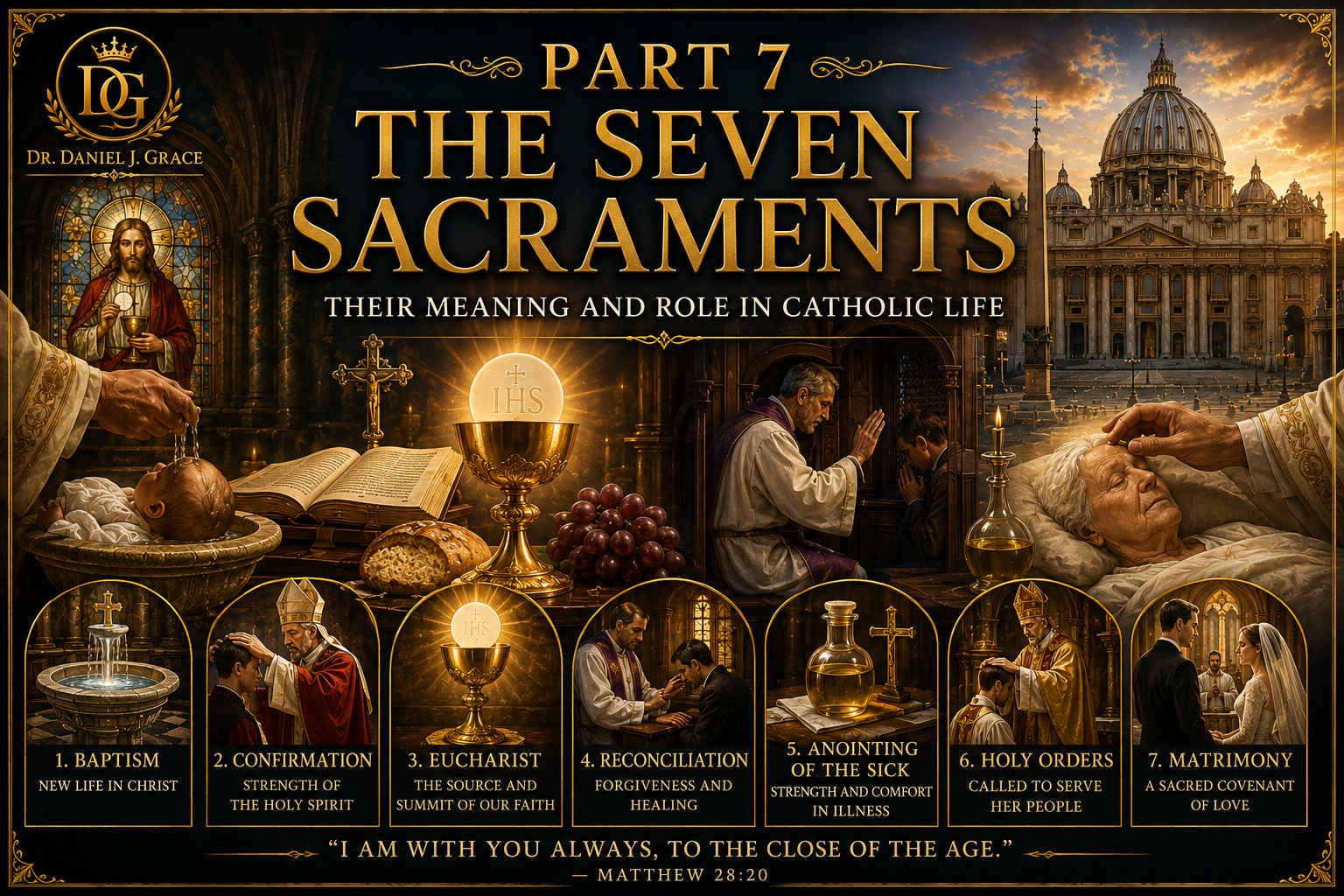
Catholic Christianity recognises seven sacraments:
Baptism
Confirmation
Eucharist
Reconciliation (Confession)
Anointing of the Sick
Holy Orders
Matrimony
These sacraments developed from the life and ministry of Christ and the practice of the apostolic Church.
The number seven symbolises completeness in biblical tradition.
Together the sacraments accompany believers through every stage of life.
Sacraments as Encounters with Christ
Catholics believe the sacraments are not merely symbolic ceremonies.
They are encounters with Christ Himself.
The Church teaches that Jesus continues His ministry through the sacraments.
When a person is baptised, Christ acts.
When sins are forgiven, Christ acts.
When the Eucharist is celebrated, Christ acts.
The sacramental life therefore connects believers directly with the saving work of Jesus.
The Sacraments of Initiation
The first three sacraments are known as the Sacraments of Initiation.
These are:
Baptism
Confirmation
Eucharist
Together they bring believers into full participation in the life of the Church.
Baptism
Baptism is the first sacrament.
It is often called the doorway to the Christian life.
Jesus commanded His followers:
“Go therefore and make disciples of all nations, baptizing them…”
From the earliest days of Christianity, baptism marked entry into the Christian community.
Meaning of Baptism
Catholics believe in baptism:
Washes away sin.
Brings new spiritual life.
Unites believers with Christ.
Incorporates individuals into the Church.
Marks the beginning of discipleship.
Water symbolises cleansing, renewal, and rebirth.
Just as physical birth introduces a person into earthly life, baptism introduces a believer into spiritual life.
Infant Baptism
Catholics commonly baptise infants.
This practice reflects the belief that God’s grace is a gift rather than a reward earned through personal achievement.
Parents and sponsors commit themselves to raising the child in the Christian faith.
The child later confirms this faith through confirmation.
Baptism and Christian Unity
Most Christian traditions recognise baptism.
Even where theological differences exist, baptism often serves as a powerful sign of unity among Christians.
Confirmation
Confirmation strengthens and completes baptismal grace.
The roots of confirmation can be found in the New Testament when apostles prayed for believers to receive the Holy Spirit.
The Meaning of Confirmation
Confirmation deepens a believer’s relationship with Christ.
The sacrament emphasises the following:
Spiritual maturity
Witness
Mission
The gifts of the Holy Spirit
During Confirmation, a bishop typically anoints the candidate with sacred oil called chrism.
This anointing symbolises empowerment by the Holy Spirit.
Gifts of the Holy Spirit
Catholic tradition speaks of seven gifts of the Spirit:
Wisdom
Understanding
Counsel
Fortitude
Knowledge
Piety
Fear of the Lord
These gifts help believers grow in holiness and serve God faithfully.
The Eucharist
The Eucharist occupies a unique place in Catholic life.
The Catholic Church describes it as the following:
“The source and summit of the Christian life.”
No sacrament is more central to Catholic worship.
The Origins of the Eucharist
The Eucharist originates in the Last Supper.
On the night before His crucifixion, Jesus took bread and wine and declared:
“This is my body.”
“This is my blood.”
He instructed His disciples:
“Do this in remembrance of me.”
The Church has celebrated the Eucharist ever since.
Catholic Understanding of the Eucharist
Catholics believe that Christ is truly present in the Eucharist.
This belief distinguishes Catholic Christianity from many Protestant traditions.
The Church teaches that through God’s action:
Bread becomes Christ’s Body.
Wine becomes Christ’s Blood.
The outward appearance remains unchanged.
Yet Christ becomes truly present sacramentally.
This teaching is known as ‘transubstantiation’.
Why the Eucharist Matters
The Eucharist:
Nourishes spiritual life.
Unites believers with Christ.
Strengthens the Church.
Recalls Christ’s sacrifice.
Anticipates eternal communion with God.
For Catholics, participation in the Eucharist is the heart of Christian worship.
The Mass
The Eucharist is celebrated within the Mass.
The Mass consists of two major parts:
Liturgy of the Word
Scripture readings and preaching.
Liturgy of the Eucharist
Consecration and communion.
Every Mass recalls Christ’s saving work and invites believers into deeper communion with Him.
The Sacraments of Healing
Human beings experience weakness, suffering, and sin.
Catholic Christianity therefore includes two sacraments specifically associated with healing:
Reconciliation
Anointing of the Sick
Reconciliation (Confession)
Reconciliation is often called ‘confession’ or ‘penance’.
It addresses humanity’s need for forgiveness and restoration.
Biblical Foundations
After His resurrection, Jesus told His apostles:
“Whose sins you forgive are forgiven them.”
Catholics see this passage as establishing the ministry of reconciliation within the Church.
The Process of Confession
The sacrament usually involves:
Examination of conscience
Confession of sins
Expression of repentance
Absolution by the priest
Penance
The goal is not punishment but reconciliation with God and the Church.
Spiritual Benefits
Catholics believe confession brings the following:
Forgiveness
Peace
Spiritual healing
Renewed relationship with God
Many believers describe the sacrament as one of the most powerful experiences of grace.
Anointing of the Sick
Anointing of the Sick provides spiritual support during illness, weakness, or old age.
Its roots are found in the New Testament, particularly in the Letter of James.
Meaning of the Sacrament
The sacrament offers the following:
Strength
Comfort
Healing
Forgiveness
Hope
A priest anoints the individual with blessed oil and prays for God’s grace.
Not Only for the Dying
Many people mistakenly associate this sacrament only with death.
In reality, it may be received whenever serious illness or significant weakness is present.
Its purpose is to strengthen believers during times of suffering.
The Sacraments of Service
Two sacraments focus particularly on service:
Holy Orders
Matrimony
These sacraments are directed toward the good of others and the building up of the Church.
Holy Orders
Holy Orders is the sacrament through which men are ordained for ministry within the Church.
It continues the apostolic ministry established by Christ.
Three Degrees of Holy Orders
Deacon
Service, charity, and ministry.
Priest
Pastoral leadership and sacramental ministry.
Bishop
The fullness of sacramental leadership and apostolic succession is essential.
Apostolic Succession
Catholics believe bishops stand within an unbroken line tracing back to the apostles.
This continuity helps preserve the Church’s connection to its apostolic origins.
The Mission of Ordained Ministry
Ordained ministers are called to:
Preach the Gospel
Celebrate the sacraments
Shepherd God’s people
Serve the Church
Their authority is intended as service rather than privilege.
Matrimony
Marriage is one of the most important sacraments in Catholic life.
It reflects God’s design for love, family, and human community.
Biblical Foundations
Marriage appears throughout Scripture.
Jesus affirmed the sacredness of marriage and elevated it as a sign of God’s covenantal love.
Catholics view marriage as a lifelong union between a man and a woman ordered towards:
Mutual love
Faithfulness
Family life
Openness to children
Marriage as a Sacrament
Catholic marriage is more than a legal contract.
It is a covenant.
The relationship between husband and wife symbolises Christ’s love for the Church.
Marriage therefore possesses both personal and spiritual significance.
Family and the Domestic Church
Catholics often refer to the family as the “domestic church”.
The home becomes a place where faith is lived and transmitted.
Parents play a vital role in teaching children:
Prayer
Scripture
Christian values
Love of God
Family life remains central to Catholic spirituality.
Sacraments and Grace
A key Catholic belief is that sacraments communicate grace.
Grace is God’s free gift.
It cannot be earned.
It transforms lives.
Through grace believers grow in holiness and become more conformed to Christ.
The sacraments serve as ordinary means through which God shares this grace.
Sacraments and Community
The sacraments are not purely private experiences.
They connect believers to the wider Church.
Through baptism Christians join the community.
Through Eucharist they worship together.
Through marriage and ordination they serve others.
The sacramental life strengthens both personal faith and communal unity.
Historical Development
The theology of the sacraments developed gradually.
The early Church celebrated baptism and the Eucharist from the beginning.
Over time theologians reflected more deeply upon sacramental practice.
The mediaeval Church eventually clarified the number and nature of the seven sacraments.
The Council of Trent provided further teaching in response to Reformation debates.
Sacraments and the Protestant Reformation
The Protestant Reformation produced significant disagreements concerning the sacraments.
Many reformers reduced the number of sacraments.
Others rejected certain Catholic teachings regarding Eucharistic presence or sacramental grace.
These differences remain among Christian traditions today.
Despite disagreements, most Christians continue practising baptism and communion.
Modern Challenges
Contemporary society presents new challenges:
Secularization
Declining church attendance
Changing views of marriage
Individualism
Technological distractions
The sacramental life offers a countercultural vision centred on worship, community, and spiritual formation.
Strengths of the Sacramental Vision
The Catholic sacramental worldview offers several strengths.
Embodied Faith
Faith involves both body and soul.
Continuity
Connection with ancient Christian practice.
Community
Participation within the Church.
Grace
Confidence in God’s active presence.
Worship
Regular encounters with Christ.
Common Criticisms
Critics sometimes argue the following:
Sacraments can become ritualistic.
External actions may overshadow inner faith.
Certain teachings are difficult to understand.
Catholics respond that sacraments require genuine faith and personal conversion.
The outward signs are intended to deepen inward transformation.
Lessons for Modern Christians
The sacraments remind believers that the following are true:
God works through ordinary life.
Faith involves both spiritual and physical realities.
Worship matters.
Community matters.
Grace remains available.
In a fragmented world, the sacraments provide rhythm, meaning, and connection to God.
Conclusion
The Seven Sacraments stand at the heart of Catholic Christianity.
Through Baptism, Confirmation, Eucharist, Reconciliation, Anointing of the Sick, Holy Orders, and Matrimony, Catholics encounter God’s grace throughout every stage of life.
The sacraments connect believers to Christ, strengthen the Church, and provide a tangible expression of God’s presence in the world.
For nearly two thousand years they have nourished Christian faith and shaped Catholic spirituality across cultures and continentsacrament that Catholicspter, we will explore The Eucharist: The Centre of Catholic Worship, examining in greater depth the sacrament Catholics regard as the source and summit of the Christian life.
Dr Daniel J. Grace
Faith • Civilization • Theology
Research • Journalism • Truth
© 2026 Dr Daniel J. Grace. All Rights Reserved.
No part of this article may be reproduced, distributed, transmitted, or published in any form or by any means without prior written permission from the author, except for brief quotations used in academic citation, review, or research purposes.
Leave a Reply