How the Early Church Defined Christian Doctrine
Introduction
The first centuries of Christianity were a period of remarkable growth, but they were also a period of significant theological controversy. As the Church expanded throughout the Roman Empire, Christians faced difficult questions concerning the identity of Jesus Christ, the nature of God, the role of the Holy Spirit, and the meaning of salvation.
The apostles had proclaimed the Gospel, and the Scriptures had begun to circulate among Christian communities. Yet misunderstandings, competing interpretations, and false teachings emerged. Church leaders needed a way to preserve apostolic truth while maintaining unity among believers spread across vast geographical regions.
The answer came through what became known as the Ecumenical Councils.
These councils brought bishops and church leaders together to examine theological disputes, defend orthodox doctrine, and provide guidance for the universal Church.
For Catholic Christianity, the Ecumenical Councils are among the most important events in Christian history. They helped define doctrines that continue to shape Christian belief today.
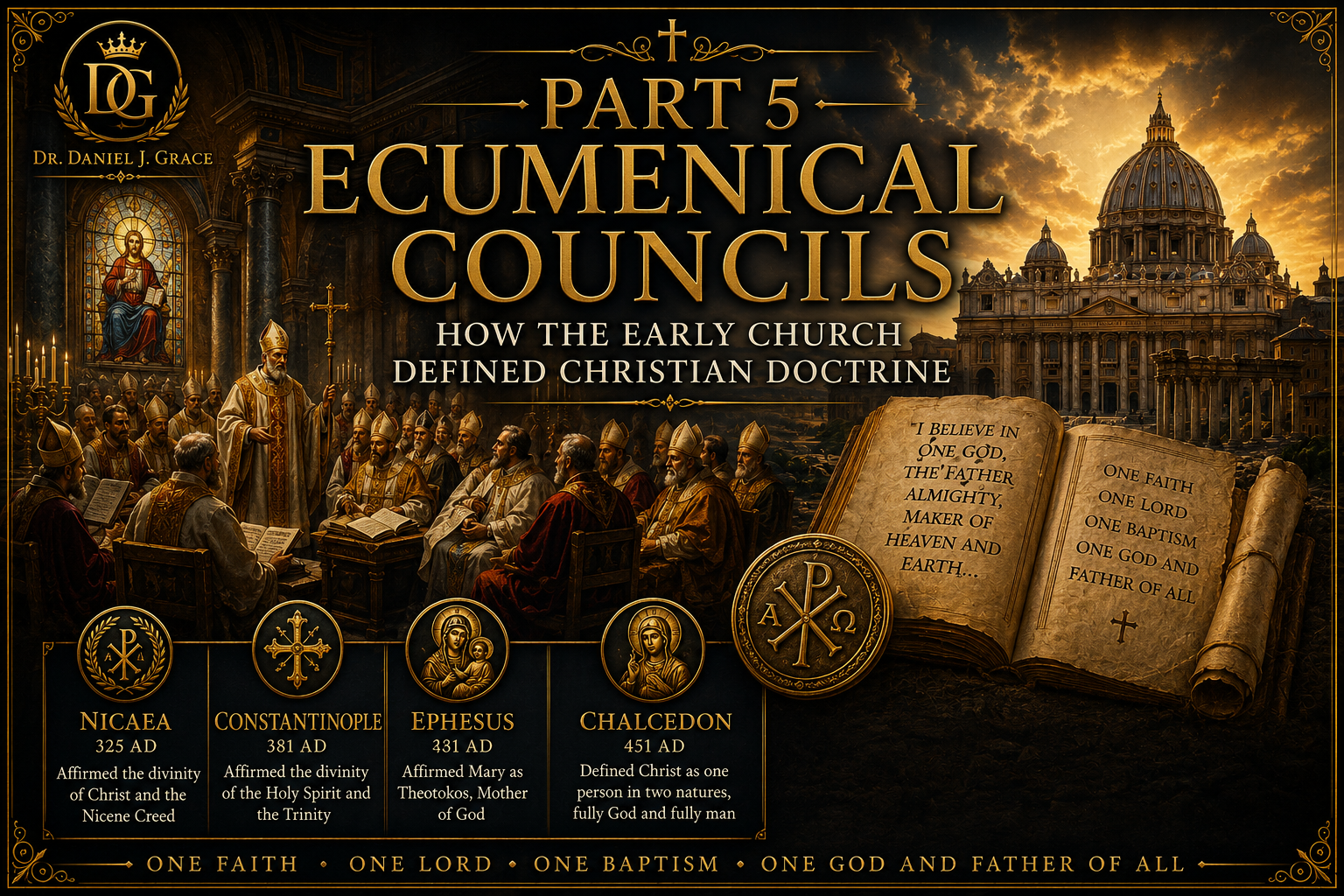
This chapter explores the origins, purpose, major decisions, and lasting significance of the early Ecumenical Councils, particularly Nicaea, Constantinople, Ephesus, and Chalcedon.
Why Councils Were Necessary
The early Church inherited a faith centred on Jesus Christ.
However, questions quickly emerged.
Was Jesus fully God?
Was Jesus fully human?
How should Christians understand the Trinity?
What authority belonged to bishops?
How should Scripture be interpreted?
How could unity be preserved among diverse churches?
Without clear answers, Christianity risked fragmentation.
Different teachers proposed different interpretations.
Some teachings threatened the very heart of the Gospel.
The Church therefore gathered bishops together to seek clarity and unity.
Councils provided opportunities for prayer, discussion, debate, and collective decision-making.
Their goal was not to create new doctrines but to clarify and defend the apostolic faith.
What Is an Ecumenical Council?
The word “ecumenical” comes from a Greek term meaning “the whole inhabited world”.
An ecumenical council involved representatives from the wider Christian Church rather than a single local region.
The bishops gathered to discuss matters affecting the entire Church.
Their decisions carried significant authority.
Catholics believe that the Holy Spirit guided the Church during these councils.
This does not mean every participant was perfect.
Rather, Catholics believe God preserved essential Christian truth through these gatherings.
The Context of the Fourth Century
The fourth century marked a major turning point.
Before AD 313, Christians frequently faced persecution.
After Emperor Constantine legalised Christianity through the Edict of Milan, believers could gather openly.
This new freedom allowed church leaders to meet on a larger scale.
At the same time, theological controversies became increasingly visible.
The Church now had the opportunity—and the necessity—to address them publicly.
The most significant controversy involved a priest named Arius.
The Arian Controversy
Arius was a priest from Alexandria in Egypt.
He taught that Jesus Christ was not eternal in the same sense as God the Father.
According to Arius:
The Son was created.
The Son was exalted above creation.
The Son was divine in a limited sense.
The Son was not fully equal to the Father.
His teaching spread rapidly.
Many found it persuasive.
Others regarded it as a serious threat to Christian faith.
The controversy divided churches throughout the empire.
To resolve the dispute, Emperor Constantine called a council.
The First Council of Nicaea (AD 325)
The Council of Nicaea is perhaps the most famous council in Christian history.
Approximately three hundred bishops gathered in the city of Nicaea.
Their task was to address the teachings of Arius and clarify the Church’s understanding of Christ.
The Central Question
The key issue was simple but profound:
Who is Jesus Christ?
Was He merely a created being?
Or was He truly God?
The answer would shape the future of Christianity.
The Decision of Nicaea
The bishops rejected Arianism.
They affirmed that Jesus Christ is fully divine.
The council declared that the Son is the following:
“Begotten, not made, being of one substance with the Father.”
The Greek term ‘homoousios’ became central.
It means “of the same essence” or “same substance”.
The council taught that Christ is fully God, not merely similar to God.
This decision protected the Christian belief that salvation comes through God Himself entering human history.
The Nicene Creed
One of Nicaea’s greatest legacies is the Nicene Creed.
The creed summarised essential Christian belief.
It became a standard confession of faith.
Even today, Catholics recite a form of the Nicene Creed during Mass.
Many Protestant and Orthodox churches also affirm it.
The creed remains one of Christianity’s most important doctrinal statements.
The Importance of Nicaea
Nicaea accomplished several things.
First, it defended Christ’s full divinity.
Second, it provided theological clarity.
Third, it demonstrated the Church’s commitment to doctrinal unity.
Finally, it established a model for future councils.
The issues addressed at Nicaea continue to influence Christian theology today.
Challenges After Nicaea
Although Nicaea made an important decision, controversy did not disappear.
Many leaders continued supporting Arian ideas.
Political alliances complicated matters.
Different emperors favoured different theological positions.
For decades, debates continued.
The Church needed further clarification.
This led to another major council.
The First Council of Constantinople (AD 381)
The Council of Constantinople expanded upon Nicaea.
It addressed ongoing disputes concerning the Trinity.
It also clarified the Church’s understanding of the Holy Spirit.
The Holy Spirit Question
Some groups accepted Christ’s divinity but denied the full divinity of the Holy Spirit.
The council rejected these teachings.
The bishops affirmed that the Holy Spirit is fully divine.
The Spirit is not merely a force or influence.
The Spirit is God.
The Doctrine of the Trinity
Constantinople strengthened the Church’s teaching concerning the Trinity.
Christianity teaches the following:
One God
Three Persons
Father, Son, and Holy Spirit
The three Persons are distinct yet united in one divine essence.
This doctrine remains central to Catholic Christianity.
The Expanded Creed
The council expanded the Nicene Creed.
The version commonly used today is often called the Nicene-Constantinopolitan Creed.
It includes a fuller statement concerning the Holy Spirit.
The creed became a foundational expression of orthodox Christian belief.
Why the Trinity Matters
The doctrine of the Trinity is not merely abstract theology.
It shapes Christian worship and understanding.
Christians pray to the Father.
Through the Son.
In the power of the Holy Spirit.
The Trinity reveals God’s relational nature.
The doctrine influences everything from worship to salvation.
For this reason, the Church considered the issue essential.
New Controversies Concerning Christ
Even after Nicaea and Constantinople, debates continued.
Christians agreed that Jesus was divine.
But questions remained.
How did Christ’s divinity relate to His humanity?
How should the two be understood together?
Different teachers proposed different answers.
Some emphasised Christ’s divinity so strongly that His humanity seemed diminished.
Others emphasised His humanity in ways that threatened His divine identity.
These debates led to another council.
The Council of Ephesus (AD 431)
The Council of Ephesus focused largely on the teachings of Nestorius.
Nestorius was associated with Constantinople.
He objected to calling Mary Theotokos, meaning “God-bearer” or “Mother of God”.
He preferred language that distinguished Christ’s humanity and divinity more sharply.
The Question of Mary
The debate was not really about Mary alone.
It was about Jesus.
If Jesus is truly God and truly human, how should Christians speak about His birth?
The Church concluded that Mary could properly be called Theotokos because the person she bore was Jesus Christ, who is fully God and fully human.
The title protected orthodox teaching concerning Christ’s identity.
The Decision of Ephesus
The council affirmed the following:
Jesus is one person.
Jesus possesses both divine and human realities.
Mary may be called Mother of God because the child she bore is truly God incarnate.
The decision became highly influential within Catholic Christianity.
Why Ephesus Was Important
Ephesus reinforced the Church’s commitment to the unity of Christ’s person.
The council sought to avoid dividing Jesus into separate identities.
Christian salvation depends upon the reality that the one who died and rose again was both truly God and truly human.
This principle became increasingly important in later theology.
The Council of Chalcedon (AD 451)
The next major controversy concerned how Christ’s divine and human natures relate to one another.
Some theologians emphasised unity so strongly that Christ’s humanity seemed absorbed into divinity.
Others risked separating the two.
The Church sought a balanced solution.
The Chalcedonian Definition
The Council of Chalcedon produced one of Christianity’s most important doctrinal statements.
The bishops declared that Jesus Christ is the following:
Fully God
Fully human
One person
Two natures
The two natures exist:
“Without confusion, without change, without division, and without separation.”
This formulation became a cornerstone of Christian theology.
Why Chalcedon Matters
Chalcedon protected both Christ’s divinity and humanity.
If Christ is not fully God, salvation is threatened.
If Christ is not fully human, redemption is incomplete.
The council preserved both truths simultaneously.
Its influence remains enormous.
Catholics, Orthodox Christians, and many Protestants continue to affirm its essential teaching.
The Role of Rome in the Councils
The bishops of Rome played important roles in these councils.
One particularly significant figure was Pope Leo I.
His theological letter, known as the Tome of Leo, strongly influenced Chalcedon.
Many bishops regarded Leo’s teaching as faithfully expressing apostolic doctrine.
This contributed to the growing influence of the papacy within the Church.
Other Early Councils
The Church continued holding councils after Chalcedon.
Additional councils addressed:
Christological controversies
Church discipline
Worship practices
Relations between Church and state
Among the most important later councils were the following:
Constantinople II (553)
Constantinople III (680–681)
Nicaea II (787)
Each contributed to the development of Christian doctrine and practice.
The Council of Nicaea II
Nicaea II addressed the controversy over religious images.
Some Christians opposed icons entirely.
Others defended their use.
The council distinguished between worship due to God alone and honour shown to sacred images.
The decision continues to influence Catholic and Orthodox practice today.
Councils and Church Unity
The councils sought unity rather than division.
Their purpose was to preserve apostolic faith.
Unfortunately, some controversies eventually contributed to divisions.
Certain groups rejected particular council decisions.
As a result, some Christian communities separated from the wider Church.
Nevertheless, the councils remain major landmarks in Christian history.
The Holy Spirit and Church Guidance
Catholics believe the Holy Spirit guided the Church through these councils.
This belief does not imply that every participant was flawless.
Rather, Catholics believe God protected essential truths concerning salvation and doctrine.
The councils therefore serve as important expressions of the Church’s teaching authority.
How the Councils Influence Modern Christianity
Many Christians today benefit from council decisions without realising it.
When Christians affirm:
The Trinity
Christ’s divinity
Christ’s humanity
The Nicene Creed
They are drawing upon doctrines clarified through the councils.
The theological language developed during these gatherings continues shaping Christian worship, preaching, and education.
Strengths of the Ecumenical Councils
The councils contributed several important strengths.
Clarity
They clarified essential doctrines.
Unity
They provided common standards of belief.
Continuity
They preserved apostolic teaching.
Stability
They protected the Church from theological confusion.
Education
They provided creeds and definitions that continue teaching Christians today.
Criticisms and Challenges
Some critics argue that councils became too influenced by politics.
Others question particular decisions.
Still others debate the authority of later councils.
These discussions continue among historians and theologians.
Nevertheless, few deny the enormous historical importance of the councils.
Their impact upon Christianity is undeniable.
The Councils and Catholic Identity
For Catholics, the Ecumenical Councils demonstrate several important principles.
First, truth matters.
Second, unity matters.
Third, the Church possesses responsibility for preserving apostolic faith.
The councils reveal Christianity’s commitment to careful theological reflection.
They show that doctrine develops through deeper understanding rather than through abandonment of earlier truth.
Lessons for Christians Today
Modern Christians can learn much from the councils.
Seek Truth
The bishops were willing to wrestle with difficult questions.
Value Unity
The councils aimed to preserve fellowship.
Remain Grounded in Scripture
Theological discussions consistently appealed to biblical teaching.
Depend on God
The Church sought the guidance of the Holy Spirit.
Defend Essential Beliefs
The councils remind believers that some truths are foundational.
Conclusion
The Ecumenical Councils played a decisive role in shaping Christian doctrine.
Through Nicaea, Constantinople, Ephesus, and Chalcedon, the Church clarified its understanding of the Trinity, the divinity of Christ, the humanity of Christ, and the relationship between God and humanity in Jesus.
These councils helped preserve the apostolic faith and provided theological foundations that continue influencing Christianity today.
For Catholic Christianity, the councils represent a powerful example of the Church seeking truth, unity, and fidelity to the Gospel.
Their decisions continue to echo through Christian worship, theology, and discipleship nearly two thousand years later.
In the next chapter, we will explore Catholic Doctrine and Tradition: Scripture, Tradition, and the Teaching Authority of the Church, examining how Catholic Christianity understands the sources of Christian faith and authority.
Dr Daniel J. Grace
Faith • Civilization • Theology
Research • Journalism • Truth
© 2026 Dr Daniel J. Grace. All Rights Reserved.
No part of this article may be reproduced, distributed, transmitted, or published in any form or by any means without prior written permission from the author, except for brief quotations used in academic citation, review, or research purposes.
Leave a Reply