
How the Bishop of Rome Became the Pope
Introduction
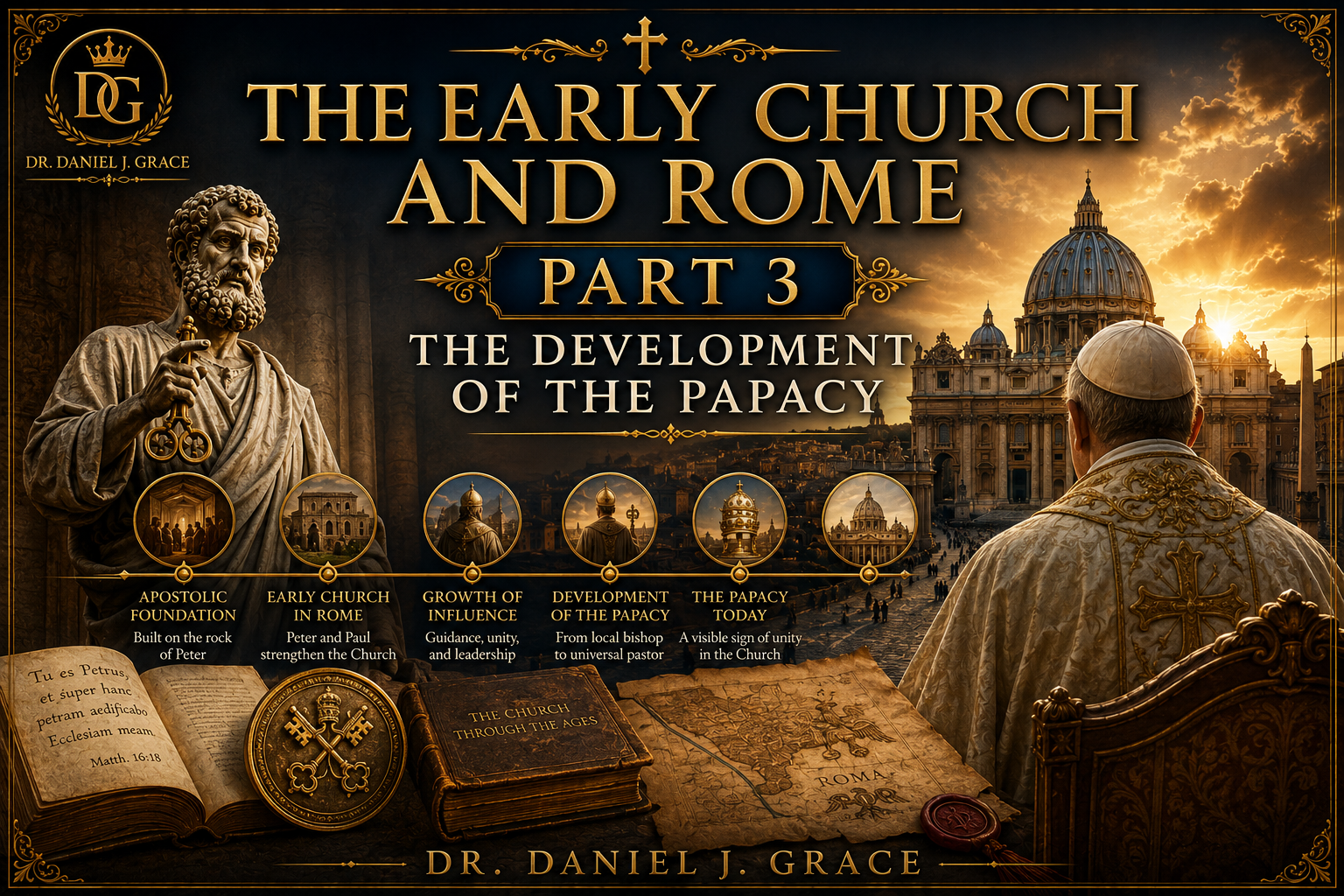
Few institutions in world history have exercised as much influence as the papacy. For nearly two thousand years, the Bishop of Rome—commonly known as the Pope—has served as one of Christianity’s most visible leaders. The papacy has guided the Catholic Church through persecution, theological controversy, political upheaval, cultural transformation, and global expansion.
To Catholics, the Pope is the successor of Saint Peter and the visible sign of unity within the Church. To many other Christians, the papacy remains a subject of theological discussion and historical debate. Regardless of one’s perspective, understanding the development of the papacy is essential for understanding Catholic Christianity.
The office of the Pope did not emerge fully formed overnight. Rather, it developed gradually through centuries of historical events, theological reflection, pastoral leadership, and changing circumstances. The story of the papacy is closely connected to the growth of the Church, the importance of Rome, and the role of Saint Peter in Christian tradition.
This chapter explores how the bishop of Rome gradually became recognised as the pope and how the papacy evolved into one of the most significant institutions in Christian history.
The New Testament Foundations
Catholics begin their understanding of the papacy with the New Testament.
Among the twelve apostles, Peter occupies a unique place.
His name appears more frequently than any other apostle.
He is often listed first among the disciples.
He frequently acts as spokesman for the group.
He is present at key moments in Jesus’ ministry.
Peter’s Confession
One of the most important passages appears in Matthew 16:13–19.
After Peter declares that Jesus is “the Christ, the Son of the living God,” Jesus responds:
“You are Peter, and on this rock I will build my church.”
Catholics regard this passage as highly significant.
They believe Jesus entrusted Peter with a special leadership role within the Church.
The passage continues with references to the “keys of the kingdom,” a phrase that has been interpreted as indicating authority and responsibility.
Throughout history, Catholic theology has viewed these verses as foundational for understanding Peter’s position and the later development of the papacy.
Peter Among the Apostles
The New Testament portrays Peter as a leading figure among the apostles.
At Pentecost
Peter delivers the first major Christian sermon following the descent of the Holy Spirit.
Thousands respond and are baptised.
In Jerusalem
Peter helps guide the early Church.
He performs miracles.
He defends Christian teaching.
He addresses disputes within the Christian community.
In Mission
Peter participates in missionary work beyond Jerusalem.
The Book of Acts records his ministry among both Jews and Gentiles.
His influence extends throughout the early Christian movement.
Catholics view these activities as evidence of Peter’s special role in the life of the Church.
Peter and Rome
Ancient Christian tradition holds that Peter eventually travelled to Rome.
Although the New Testament does not explicitly describe Peter’s arrival in Rome, early Christian writers consistently associate him with the city.
According to tradition:
• Peter ministered in Rome.
• Peter served as a leader of the Roman Church.
• Peter was martyred during the persecution under Emperor Nero.
• Peter was buried in Rome.
The Vatican today stands near the traditional site of Peter’s tomb.
Archaeological discoveries beneath Saint Peter’s Basilica have strengthened interest in the ancient tradition connecting Peter to Rome.
For Catholics, Rome’s importance is inseparable from its association with Peter.
The Church of Rome in the First Century
Even before the development of the papacy, the Church in Rome possessed significant influence.
Several factors contributed to this importance.
Rome Was the Capital
Rome governed the empire.
Political decisions made there affected millions.
As Christianity spread, the prominence of Rome naturally increased the visibility of its Christian community.
Apostolic Heritage
The Roman Church was associated not only with Peter but also with Paul.
The presence of two major apostles enhanced its prestige.
Stability
The Roman Church often provided guidance during times of uncertainty.
Other Christian communities frequently looked to Rome for advice and support.
These factors gradually elevated Rome’s position within the wider Church.
Early Evidence of Roman Leadership
By the late first century, evidence suggests that the Roman Church already exercised influence beyond its local region.
Clement of Rome
Around AD 96, Clement, a leader of the Roman Church, wrote a letter to Christians in Corinth.
The letter addressed disputes within the Corinthian church.
Significantly, Rome intervened even though it was hundreds of kilometres away.
Many historians view this letter as evidence that the Roman Church already possessed considerable moral authority.
Although the later papacy had not yet emerged, the seeds of Roman leadership were becoming visible.
Ignatius of Antioch
Another important witness comes from Ignatius of Antioch.
Writing in the early second century, Ignatius praised the Roman Church in unusually strong language.
He referred to Rome as a church that held a position of honour among Christian communities.
His writings suggest that Christians already recognised Rome as having unique significance.
While interpretations differ, Catholics see these references as early evidence supporting Rome’s special role.
The Second and Third Centuries
As Christianity expanded, theological disputes became increasingly common.
Questions emerged concerning the following:
• Doctrine
• Church discipline
• Worship practices
• Church authority
The bishops of Rome often participated in resolving these controversies.
Their influence continued to grow.
Irenaeus of Lyons
One of the most important witnesses is Irenaeus, writing around AD 180.
Irenaeus argued that apostolic teaching could be verified through the churches that the apostles founded.
Among these churches, he gave particular attention to Rome.
He described Rome as possessing special significance because of its connection to Peter and Paul.
His testimony became important in later Catholic arguments regarding papal authority.
The Meaning of Apostolic Succession
A key concept in Catholic understanding of the papacy is apostolic succession.
Catholics believe that the apostles appointed successors to continue their ministry.
These successors became bishops.
Through an unbroken line of ordination, bishops inherit responsibility for teaching, worship, and leadership.
The Bishop of Rome is viewed as the successor of Peter.
This succession provides continuity between the apostolic age and the modern Church.
The concept remains central to Catholic ecclesiology.
Persecution and the Roman Bishops
The early bishops of Rome faced severe challenges.
Many served during periods of persecution.
Some suffered martyrdom.
Others guided the Church through crises and uncertainty.
Their leadership helped preserve Christian unity and doctrine.
Far from seeking political power, many early bishops simply struggled to ensure the survival of Christian communities.
The sacrifices made by these leaders contributed to the growing respect accorded to the Roman See.
Constantine and a New Era
The conversion of Emperor Constantine transformed the Church’s position within society.
Following the Edict of Milan in AD 313:
• Christianity became legal.
• Churches could be built openly.
• Christian leaders gained greater freedom.
The Bishop of Rome now operated in a vastly different environment.
The increased visibility of Christianity also increased the visibility of Rome’s bishop.
As Christianity became more organised, questions of authority became increasingly important.
The Councils and Roman Influence
The fourth and fifth centuries witnessed major theological controversies.
Church leaders gathered at ecumenical councils to address these issues.
Among the most important councils were the following:
• Nicaea (325)
• Constantinople (381)
• Ephesus (431)
• Chalcedon (451)
The bishops of Rome played important roles in these discussions.
Their opinions were often highly regarded.
Pope Leo the Great
One of the most influential early popes was Leo I (440–461).
His theological writings significantly shaped the Council of Chalcedon.
The council famously declared the following:
“Peter has spoken through Leo.”
This statement became highly significant in Catholic interpretations of papal authority.
Leo helped strengthen the position of the Roman bishop within the wider Church.
Why Rome Became Pre-Eminent
Several factors explain Rome’s growing influence.
Apostolic Foundation
Rome was associated with Peter and Paul.
Political Importance
Rome had long been the empire’s capital.
Historical Continuity
The Roman Church maintained a consistent presence through centuries of upheaval.
Leadership During Crises
Roman bishops frequently provided stability during theological disputes.
Missionary Influence
Rome played an increasingly important role in evangelisation and church organisation.
These factors combined to elevate the Bishop of Rome above other bishops in terms of influence and recognition.
The Fall of the Western Roman Empire
In AD 476, the Western Roman Empire collapsed.
Political structures that had governed Europe for centuries disappeared.
Amid this chaos, the Church remained.
The bishops of Rome often became important civic leaders.
They negotiated with invading forces.
They organised relief efforts.
They provided stability when governments failed.
As secular authority weakened, the influence of the papacy increased.
This period significantly shaped the future role of the pope.
Gregory the Great
Among the most important early popes was Gregory I (590–604).
Gregory strengthened church administration.
He promoted missionary work.
He cared for the poor.
He helped reform church life.
Under Gregory, the papacy became a major force in both religious and social affairs.
His leadership profoundly influenced the development of mediaeval Christianity.
Many historians regard him as one of the most significant figures in papal history.
The Emergence of the Papal States
As political conditions changed, the papacy acquired territorial responsibilities.
The Papal States emerged in central Italy.
For centuries, popes exercised both spiritual and temporal authority.
This dual role brought opportunities and challenges.
While it provided independence from secular rulers, it also entangled the papacy in political conflicts.
The relationship between spiritual leadership and political power became a recurring theme throughout papal history.
Medieval Papal Authority
During the Middle Ages, papal influence reached unprecedented levels.
Popes interacted with:
• Kings
• Emperors
• Nobles
• Universities
• Religious orders
The papacy often served as a unifying force within Western Christianity.
However, this period also witnessed controversies.
Questions concerning power, wealth, and authority sometimes generated criticism.
The mediaeval papacy experienced both remarkable achievements and significant challenges.
Reform and Renewal
Throughout history, periods of reform have played a crucial role in the life of the papacy.
Church leaders repeatedly sought to address abuses and strengthen spiritual integrity.
Major reform movements emerged during:
• The Gregorian Reforms
• Monastic renewals
• The Counter-Reformation
• Modern Catholic renewal efforts
These movements demonstrate that the papacy has continually adapted to changing circumstances while seeking to preserve its mission.
The Reformation Challenge
The Protestant Reformation of the sixteenth century posed one of the greatest challenges in papal history.
Reformers questioned:
• Papal authority
• Church practices
• Certain doctrines
The resulting divisions transformed Christianity.
In response, the Catholic Church initiated significant reforms.
The Council of Trent clarified doctrine and addressed various concerns.
The papacy emerged from this period with renewed determination to strengthen Catholic identity.
Vatican I and Papal Infallibility
The First Vatican Council (1869–1870) addressed important questions regarding papal authority.
The council defined the doctrine of papal infallibility.
This teaching is often misunderstood.
Catholics believe that the Pope can make mistakes.
Rather, they believe that under very specific conditions, when formally defining doctrine concerning faith and morals for the entire Church, the Holy Spirit protects the Church from error.
Such occasions are rare.
The doctrine reflects Catholic confidence in God’s guidance of the Church.
The Modern Papacy
The modern papacy differs significantly from its mediaeval form.
The pope no longer governs extensive territories.
Instead, his primary role is spiritual leadership.
Modern popes have addressed issues such as the following:
• Human rights
• Peace
• Poverty
• Technology
• Globalization
• Environmental stewardship
• Religious freedom
Advances in communication allow popes to reach global audiences instantly.
The papacy has become one of the most recognisable religious institutions in the world.
The Pope Today
Today, the Pope serves in the following roles:
• Bishop of Rome
• Successor of Peter
• Head of the Catholic Church
• Visible sign of Catholic unity
Catholics view the pope as a shepherd responsible for guiding the Church.
His duties include:
• Teaching
• Pastoral leadership
• Appointing bishops
• Preserving doctrine
• Encouraging evangelization
While debates concerning papal authority continue among Christians, the office remains central to Catholic identity.
Different Christian Perspectives
Not all Christians view the papacy in the same way.
Catholic View
The pope is Peter’s successor and serves as the visible centre of the Church’s unity.
Orthodox View
The Bishop of Rome has historically held honour, but not universal jurisdiction.
Protestant View
Opinions vary widely.
Some respect the historical importance of the papacy while rejecting claims of universal authority.
Others strongly criticise some aspects of papal doctrine.
Understanding these perspectives helps foster respectful dialogue among Christians.
Conclusion
The development of the papacy was a gradual historical process spanning centuries.
Beginning with Peter’s leadership among the apostles, continuing through the growth of the Roman Church, and evolving through theological reflection and historical circumstances, the office of the Pope became one of Christianity’s most influential institutions.
For Catholics, the papacy represents continuity with the apostolic age and serves as a visible sign of unity within the Church.
Whether admired, debated, or criticised, the papacy has undeniably shaped Christian history, Western civilisation, and global religious life.
Understanding its development helps us better understand Catholic Christianity itself and prepares us to explore the next stage of our journey: Saint Peter and Catholic Tradition.
Dr Daniel J. Grace
Faith • Civilization • Theology
Research • Journalism • Truth
© 2026 Dr Daniel J. Grace. All Rights Reserved.
No part of this article may be reproduced, distributed, transmitted, or published in any form or by any means without prior written permission from the author, except for brief quotations used in academic citation, review, or research purposes.
Leave a Reply