
Origins, Identity, and Global Influence
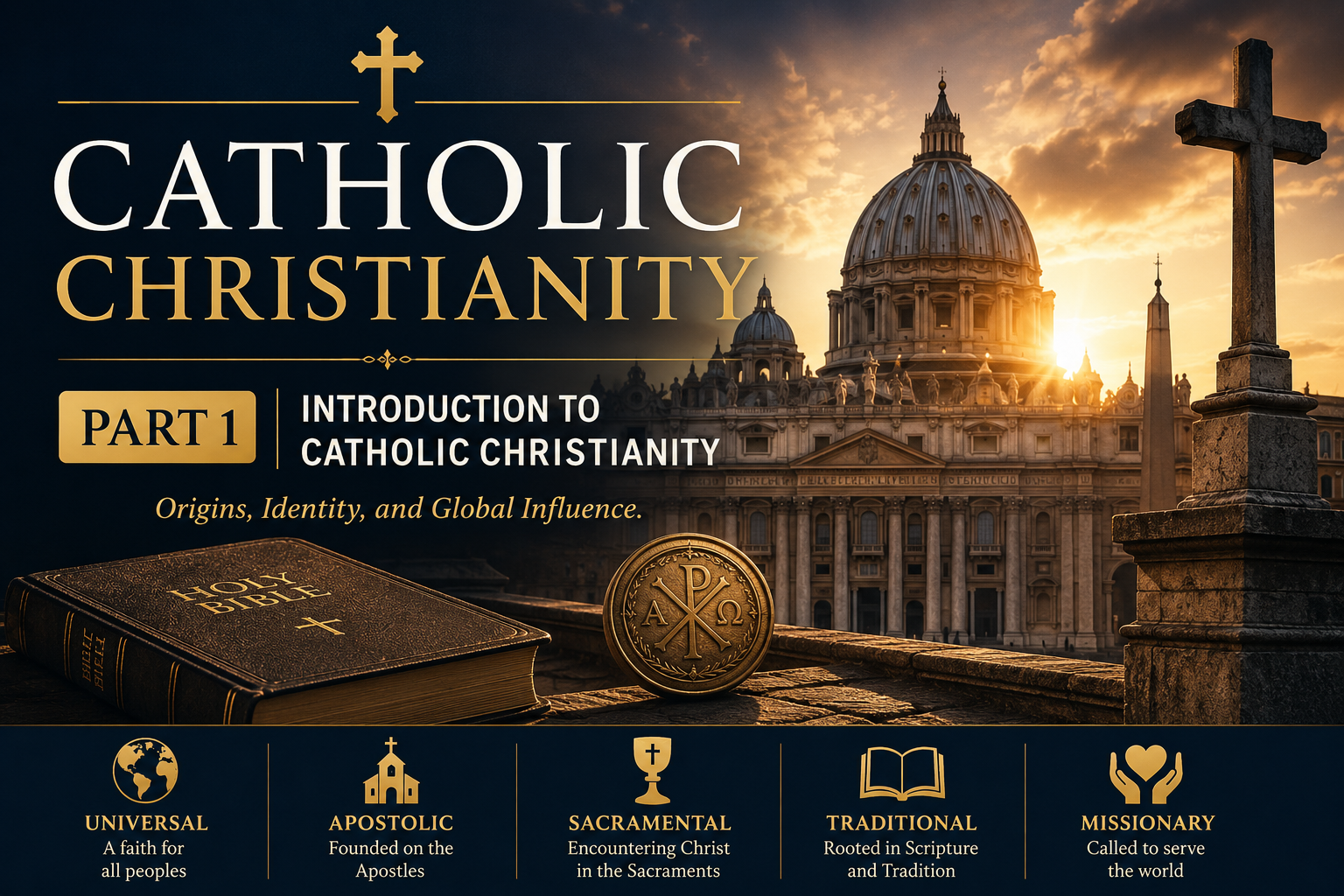
Part 1 — Introduction to Catholic Christianity
Origins, Identity, and Global Influence
Catholic Christianity is the largest branch of Christianity in the world, with more than one billion followers spread across every continent. Its history stretches back nearly two thousand years to the life, death, and resurrection of Jesus Christ and the ministry of the apostles. Throughout the centuries, Catholic Christianity has shaped theology, philosophy, education, law, art, architecture, culture, and social life in profound ways. Whether one agrees with all Catholic teachings or not, it is impossible to understand the history of Christianity—or indeed much of world history—without understanding the Catholic Church.
The word “Catholic” comes from the Greek word katholikos, which means “universal” or “according to the whole.” From the earliest centuries of Christianity, believers used this term to describe the worldwide community of Christians united in faith and worship. The Church was not intended to belong to one nation, one language, or one culture. It was understood as a universal fellowship of believers called to proclaim the Gospel to all peoples.
Today, Catholic Christianity is present in nearly every country in the world. Catholics worship in large cathedrals, small village churches, urban parishes, monasteries, schools, universities, hospitals, and mission stations. The Catholic Church speaks hundreds of languages and encompasses people from every ethnic, cultural, and social background. While united by common beliefs and sacramental life, Catholicism also reflects a remarkable diversity of local traditions and expressions.
Christianity in the First Century
To understand Catholic Christianity, one must begin with Jesus Christ. Christians believe that Jesus is the Son of God, the promised Messiah, and the Saviour of the world. His ministry in first-century Judea transformed the lives of His followers and laid the foundation for the Christian faith.
Jesus gathered disciples around Him, taught about the Kingdom of God, healed the sick, forgave sins, and called people to repentance and faith. His crucifixion under Roman authority and His resurrection from the dead became the central events of Christian belief. According to the New Testament, Jesus commissioned His disciples to proclaim the Gospel to all nations.
Following the resurrection, the apostles carried the Christian message throughout the Roman Empire. The Book of Acts records how the Gospel spread from Jerusalem to Judea, Samaria, and eventually to major cities throughout the Mediterranean world. Christian communities emerged in places such as Antioch, Ephesus, Corinth, Philippi, Alexandria, and Rome.
These early Christian communities united around faith in Christ, devotion to prayer, the teaching of the apostles, and participation in the breaking of bread. Although they faced persecution and hardship, they grew steadily and established the foundations of what would later become the worldwide Church.
The Importance of Rome
Among the many cities of the ancient world, Rome held unique significance. As the capital of the Roman Empire, Rome was the political, military, and cultural centre of the Mediterranean. The city connected vast regions through roads, trade routes, and administration.
According to ancient Christian tradition, both the Apostle Peter and the Apostle Paul ministered in Rome and suffered martyrdom there. Their witness gave Rome special importance among early Christians. Over time, the Christian community in Rome came to be regarded as a leading church because of its connection to these apostles and its prominent position within the empire.
As Christianity expanded, bishops from various regions often looked to Rome for guidance in matters of doctrine and church discipline. This development gradually contributed to the increasing influence of the bishop of Rome, who would later become known as the Pope.
The Meaning of Catholic Identity
Catholic identity is rooted in several key convictions. First, Catholics believe that the Church was founded by Jesus Christ and entrusted to the apostles. Second, Catholics understand the Church as a visible community united in faith, worship, and leadership. Third, Catholics believe that God continues to work through the Church to proclaim the Gospel and administer the sacraments.
For Catholics, Christianity is not merely an individual relationship with God, although personal faith is essential. It is also participation in a community that spans generations and cultures. The Church is viewed as the Body of Christ, a spiritual family through which believers are nourished, guided, and encouraged.
Catholic identity includes commitment to Scripture, participation in sacramental life, prayer, worship, service, and the pursuit of holiness. Catholics see themselves as members of a worldwide family united under Christ.
Scripture and Tradition
One of the distinguishing characteristics of Catholic Christianity is its understanding of Scripture and Tradition.
Catholics hold the Bible as the inspired Word of God and regard it as central to Christian faith and practice. The Scriptures are read publicly in worship, studied in theological education, and used in personal devotion throughout the world.
At the same time, Catholics believe that the Christian faith was transmitted both through written Scripture and through the living tradition of the Church. Tradition includes teachings, practices, creeds, liturgical worship, and the accumulated wisdom passed down from generation to generation.
Catholics do not see Scripture and Tradition as competitors. Rather, they view them as complementary sources through which God has preserved and communicated the Christian faith. The Church serves as the guardian and interpreter of this inheritance.
The Role of the Church
Catholic Christianity places strong emphasis on the Church as a visible and historical community. The Church is understood not simply as an organisation but as a spiritual reality established by Christ.
Catholics believe the Church exists to proclaim the Gospel, celebrate the sacraments, teach truth, care for the poor, and guide believers toward holiness. Through the centuries, the Church has developed institutions, ministries, and structures to fulfil these responsibilities.
The Church’s mission extends beyond internal worship. Catholic teaching emphasises service to society through education, healthcare, charitable work, social justice initiatives, and humanitarian assistance. Around the world, Catholic organisations operate schools, universities, hospitals, orphanages, and relief programmes.
This commitment to both spiritual and practical service reflects the Catholic conviction that faith should influence every aspect of life.
Worship and Sacramental Life
Worship occupies a central place in Catholic Christianity. Catholics gather regularly for prayer, Scripture reading, preaching, and participation in the sacraments.
The Mass is the principal act of Catholic worship. During the Mass, believers hear readings from Scripture, offer prayers, and participate in the Eucharist. Catholics regard the Eucharist as the source and summit of Christian life.
Beyond weekly worship, Catholics engage in personal prayer, devotional practices, pilgrimages, fasting, and acts of charity. Many Catholics also participate in spiritual traditions developed over centuries, including the Rosary, Eucharistic adoration, retreats, and contemplative prayer.
These practices are intended to deepen faith and foster a closer relationship with God.
Catholic Christianity and Culture
The influence of Catholic Christianity extends far beyond church buildings. Throughout history, Catholicism has inspired some of humanity’s greatest achievements in art, architecture, music, literature, and education.
Magnificent cathedrals stand as testimonies to faith and creativity. Works by artists such as Michelangelo, Raphael, and countless others reflect the impact of Catholic belief on Western civilisation. Sacred music, including Gregorian chant and classical compositions, continues to influence worship and culture.
Catholic universities and schools have contributed significantly to intellectual development. Many institutions founded by Catholics became centres of learning, scientific inquiry, and scholarship.
The Church’s cultural influence demonstrates how religious belief can shape societies and inspire creative expression.
Global Expansion
Catholic Christianity spread far beyond its Mediterranean origins. Through missionary efforts, exploration, migration, and evangelism, the Church expanded into Europe, Africa, Asia, the Americas, and Oceania.
Missionaries established churches, schools, and communities in diverse cultural settings. While missionary history includes both admirable achievements and controversial aspects, it undeniably contributed to the global character of Catholic Christianity.
Today, Africa, Asia, and Latin America are home to some of the fastest-growing Catholic populations. These regions are increasingly shaping the future of global Catholicism.
The Catholic Church has become a truly international community in which believers from different backgrounds contribute to a shared faith.
Diversity Within Unity
One of the most remarkable aspects of Catholic Christianity is its ability to maintain unity while embracing diversity.
Catholics worship in many languages and cultural styles. Various liturgical traditions exist within the broader Catholic communion. Local customs often enrich religious practice while remaining connected to the wider Church.
This balance between unity and diversity has allowed Catholic Christianity to adapt to changing circumstances and different cultural environments throughout history.
Despite differences in language, culture, and geography, Catholics around the world share common beliefs, sacraments, and spiritual heritage.
Challenges and Criticisms
Like every major religious tradition, Catholic Christianity has faced criticism and controversy. Historical debates have emerged concerning church authority, doctrine, political involvement, and responses to social issues.
The Church has experienced periods of corruption, division, reform, and renewal. Catholics themselves often acknowledge their failures and mistakes, while emphasising the need for ongoing reform and faithfulness.
Understanding Catholic Christianity requires recognising both its strengths and its challenges. A balanced approach acknowledges accomplishments and addresses areas needing improvement.
Throughout its history, the Church has continually sought renewal while preserving what it understands to be the essential truths of the Christian faith.
Why Study Catholic Christianity?
Studying Catholic Christianity is important for several reasons.
First, it helps us understand the largest Christian tradition in the world. Second, it reveals major developments in history, culture, and theology. Third, it encourages respectful dialogue among Christians from different traditions.
Many beliefs and practices found across Christianity have roots in the early centuries of Church history, a period deeply connected to Catholic development. Understanding Catholicism therefore contributes to a broader understanding of Christianity as a whole.
Whether one is Catholic, Protestant, Orthodox, or simply interested in religion and history, studying Catholic Christianity provides insightful perspectives on faith, community, tradition, and the human search for God.
Conclusion
Catholic Christianity stands as one of the most influential religious traditions in human history. From humble beginnings in the first century to its presence in virtually every nation today, the Catholic Church has played a central role in shaping Christian belief and global civilisation.
Its emphasis on Scripture, Tradition, sacramental life, worship, mission, and community continues to attract believers around the world. While facing challenges and ongoing debates, Catholic Christianity remains a vibrant and dynamic expression of the Christian faith.
As we continue this study, we will explore the historical development, beliefs, practices, institutions, and global impact of Catholic Christianity in greater depth. By doing so, we gain a clearer understanding not only of Catholicism itself but also of the broader story of Christianity throughout the centuries.
Dr Daniel J. Grace
Faith • Civilization • Theology
Research • Journalism • Truth
© 2026 Dr Daniel J. Grace. All Rights Reserved.
No part of this article may be reproduced, distributed, transmitted, or published in any form or by any means without prior written permission from the author, except for brief quotations used in academic citation, review, or research purposes.
Leave a Reply