What Eastern Orthodoxy Offers the Modern World Through Faith, Worship, and Communion with God
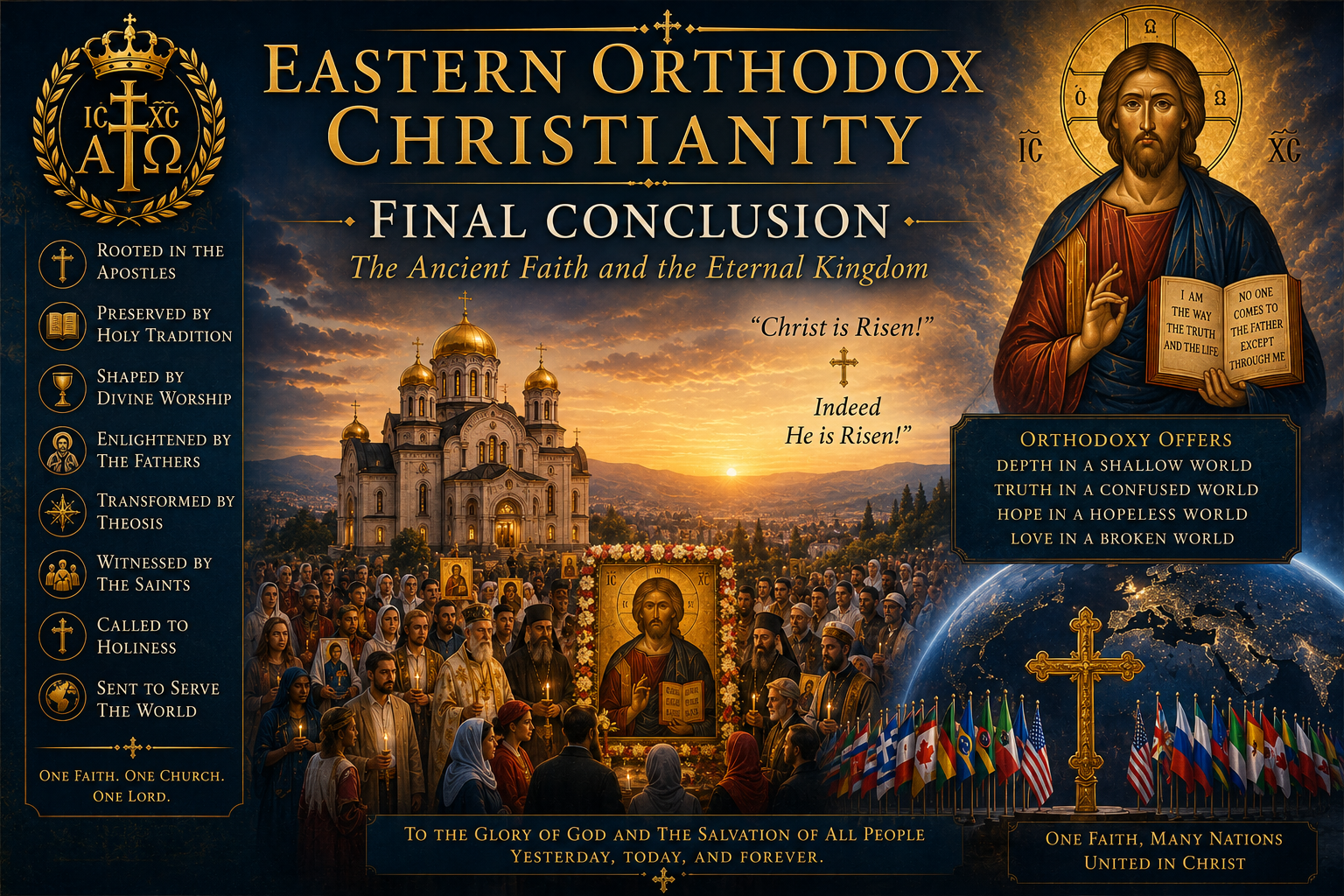
The Ancient Faith and the Eternal Kingdom
Introduction
Throughout this series, we have explored the rich history, theology, worship, spirituality, and global influence of Eastern Orthodox Christianity.
We have journeyed from the Apostolic Age to the modern world.
We have examined:
The Early Church
The Church Fathers
Holy Scripture and Tradition
The Seven Ecumenical Councils
Sacred Icons
Theosis
Byzantine Christianity
Orthodox Worship
Modern Orthodoxy
Together these themes reveal a faith that is both ancient and living.
Orthodoxy is not merely a collection of doctrines preserved from the past.
It is a living encounter with Jesus Christ.
For Orthodox Christians, Christianity is not primarily an ideology, institution, or philosophy.
It is communion with the living God.
This final chapter brings together the major themes of the series and reflects on the continuing relevance of Orthodoxy in the twenty-first century.
The Church of the Apostles
Orthodox Christians understand their faith as the continuation of the Church founded by Jesus Christ.
The Church traces its roots directly to:
Christ
The Apostles
The Early Christian Communities
Orthodoxy sees itself not as a new expression of Christianity but as the preservation of Apostolic Christianity.
This continuity remains one of Orthodoxy’s defining characteristics.
Across centuries of political upheaval, cultural change, and theological controversy, the Church has sought to preserve the faith once delivered to the saints.
A Faith Shaped by Worship
One of the most distinctive aspects of Orthodoxy is its conviction that worship shapes belief.
Orthodox theology emerges from prayer.
The Church does not merely teach doctrine.
It sings a doctrine.
It preaches doctrine.
It celebrates doctrine.
The Divine Liturgy is central to Orthodox life.
There believers encounter:
Scripture
Sacrament
Community
The presence of God
Orthodox worship reminds Christians that faith involves the whole person.
Mind and heart, body and soul, participate together in the worship of God.
The Wisdom of the Fathers
The Church Fathers remain among Orthodoxy’s greatest treasures.
Figures such as:
Athanasius
Basil the Great
Gregory Nazianzen
Gregory of Nyssa
John Chrysostom
Maximus the Confessor
continue influencing Orthodox theology today.
Their writings remind believers that Christianity possesses deep intellectual and spiritual roots.
The Fathers defended the faith during times of crisis and provided guidance that continues benefiting Christians centuries later.
Their legacy demonstrates that truth and holiness belong together.
Scripture and Tradition
Orthodoxy maintains a unique understanding of the relationship between Scripture and Holy Tradition.
The Bible occupies a central place within the life of the Church.
At the same time, Orthodoxy recognises that Scripture emerged from the worshipping community of believers.
Tradition preserves the context in which Scripture is understood.
Together Scripture and Tradition form a unified witness to Christ.
This balance provides continuity and stability in a world often marked by confusion and fragmentation.
The Beauty of Orthodoxy
Orthodox Christianity has always recognised the spiritual importance of beauty.
Icons, architecture, sacred music, incense, and liturgical worship all testify to this conviction.
Beauty is not viewed as decoration.
It is viewed as revelation.
The beauty of Orthodox worship seeks to point beyond itself toward the beauty of God’s Kingdom.
For many people, sacred beauty becomes a pathway toward faith.
Orthodoxy reminds the modern world that truth, goodness, and beauty belong together.
Theosis: Humanity’s True Destiny
Perhaps no Orthodox teaching better summarises the Christian life than theosis.
Orthodoxy teaches that salvation involves transformation.
God became human so humanity could participate in divine life.
The goal of Christianity is not merely moral improvement.
It is communion with God.
Theosis reveals the extraordinary dignity of human beings.
Every person is called to holiness.
Every person is invited into relationship with God.
Every person is created for eternal communion with the Creator.
This vision remains one of Orthodoxy’s most profound contributions to Christian thought.
The Witness of the Saints
The saints occupy a central place in Orthodox life.
They demonstrate what divine grace can accomplish.
The saints were not perfect people.
They were transformed people.
Their lives reveal:
Faithfulness
Courage
Humility
Love
Orthodox Christians honour the saints because they reflect Christ’s image.
The saints remind believers that holiness remains possible in every generation.
Orthodoxy and the Modern World
The modern world presents many challenges.
People often struggle with:
Loneliness
Anxiety
Consumerism
Spiritual confusion
Loss of meaning
Orthodoxy does not claim to possess easy answers to every problem.
However, it offers something many people are seeking:
Depth.
In a culture of distraction, Orthodoxy offers stillness.
In a culture of individualism, Orthodoxy offers community.
In a culture of uncertainty, Orthodoxy offers continuity.
Its ancient wisdom continues speaking to contemporary concerns.
A Global Church
Orthodoxy today is a truly global faith.
Orthodox communities flourish across:
Europe
Africa
Asia
Australia
North America
South America
The Church continues to grow beyond its historic centres.
New generations and new cultures continue discovering the richness of Orthodox Christianity.
This global expansion demonstrates that Orthodoxy is not merely a historical tradition.
It remains a living and dynamic faith.
The Enduring Mission of the Church
Despite changing circumstances, the mission of the Church remains unchanged.
Orthodoxy continues seeking to:
Worship God
Proclaim the Gospel
Preserve Apostolic faith
Serve humanity
Lead believers toward communion with Christ
The Church exists not for itself but for the glory of God and the salvation of the world.
This mission has guided Orthodox Christians for nearly two thousand years.
It continues guiding them today.
Why Orthodoxy Matters
Many people assume ancient traditions have little relevance in the modern world.
Orthodoxy challenges that assumption.
Its survival across centuries suggests otherwise.
The Church has endured the following:
Persecution
Empire
Schism
War
Revolution
Modernization
Yet the faith remains.
Orthodoxy matters because it addresses humanity’s deepest questions:
Who is God?
Who are we?
Why do we suffer?
What is salvation?
What is the purpose of life?
These questions remain as relevant today as they were in the first century.
Christ at the Center
At the centre of Orthodoxy stands Jesus Christ.
Everything in Orthodox life points toward Him.
The Church Fathers point toward Him.
The Scriptures reveal Him.
The sacraments unite believers with Him.
The saints imitate Him.
The liturgy worships Him.
Orthodoxy ultimately exists to lead people into relationship with Christ.
Without Christ, Orthodoxy loses its meaning.
With Christ, every aspect of Orthodox life finds its purpose.
Final Reflections
Eastern Orthodox Christianity represents one of the world’s oldest continuous Christian traditions.
Its history stretches back to the Apostles.
Its theology has shaped Christian civilisation.
Its worship continues inspiring millions of believers around the globe.
Orthodoxy offers a vision of Christianity that is
Ancient yet living
Traditional yet relevant
Intellectual yet spiritual
Beautiful yet profound
It invites believers not merely to learn about God but to know Him.
Not merely to study faith but to live it.
Not merely to seek information but transformation.
The journey of Orthodoxy is ultimately a journey toward Christ.
Final Conclusion
Eastern Orthodox Christianity stands as a witness to the enduring power of the Christian faith.
Across centuries of change, it has preserved the worship, theology, spirituality, and hope of the ancient Church.
Its message remains remarkably simple:
God loves humanity.
Christ has conquered death.
The Holy Spirit transforms lives.
The Church invites all people into communion with God.
This invitation remains open today.
As Orthodox Christians often proclaim during Pascha:
“Christ is Risen!”
And the faithful respond:
“Indeed He is Risen!”
In that proclamation lies the heart of Orthodox Christianity—hope, victory, resurrection, and eternal life in Jesus Christ.
End of Series
Dr Daniel J. Grace
Faith • Civilization • Theology
Research • Journalism • Truth
© 2026 Dr Daniel J. Grace. All Rights Reserved.
No part of this article may be reproduced, distributed, transmitted, or published in any form or by any means without prior written permission from the author, except for brief quotations used in academic citation, review, or research purposes.
Leave a Reply