
How the Orthodox Church Faces Contemporary Challenges While Preserving Apostolic Christianity
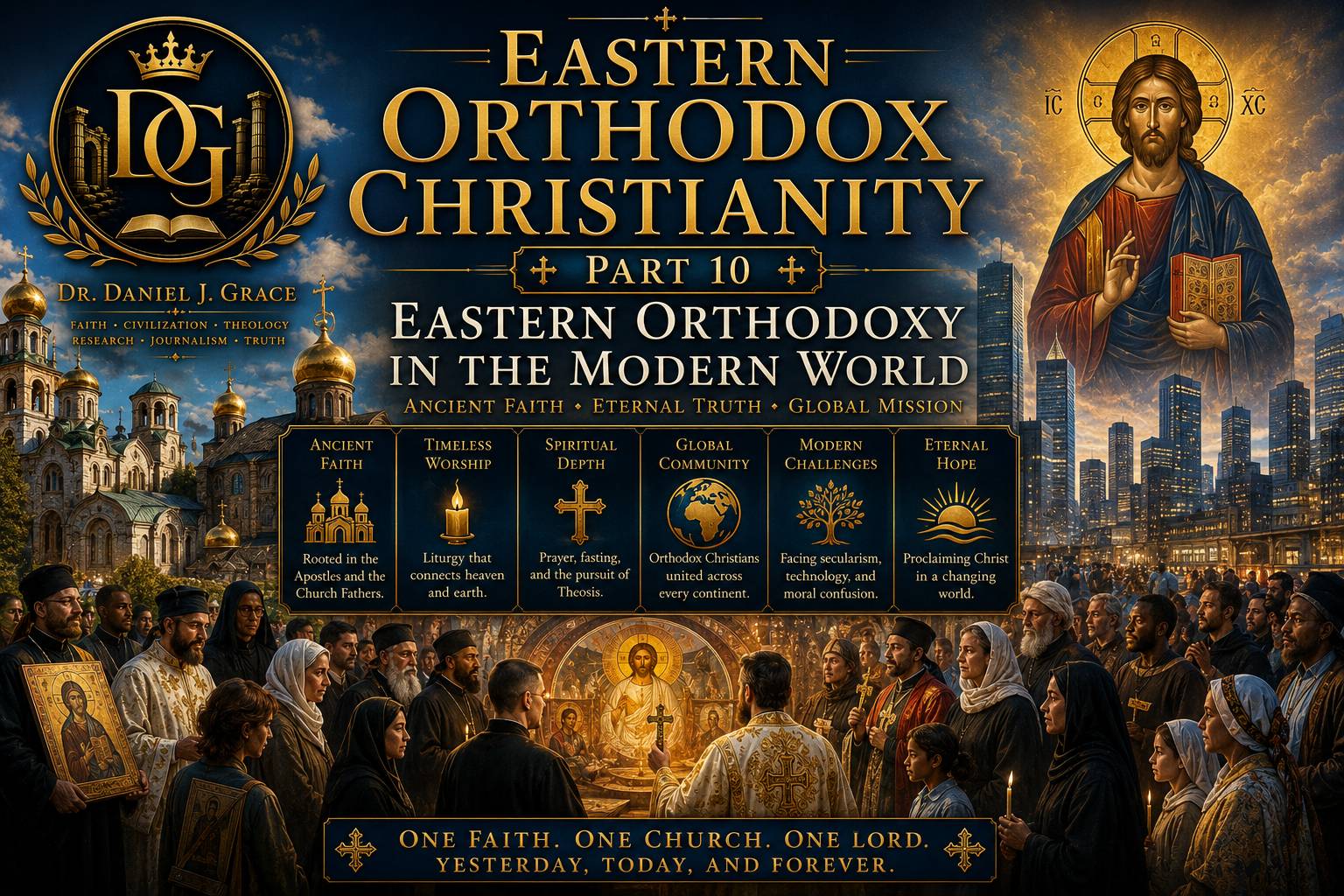
Eastern Orthodoxy in the Modern World
Ancient Faith in a Changing Age
Introduction
Eastern Orthodoxy is often described as the ancient faith.
Its liturgies preserve prayers that have been spoken for centuries.
Its theology remains rooted in the teachings of the Apostles, the Church Fathers, and the Ecumenical Councils.
Its worship continues to reflect traditions inherited from the early Church and the Byzantine world.
Yet Orthodoxy does not exist only in the past.
Today, hundreds of millions of Orthodox Christians live throughout the modern world.
They worship at:
Greece
Russia
Romania
Serbia
Georgia
Ukraine
The Middle East
Western Europe
North America
Australia
Africa
Asia
Modern Orthodox believers face many of the same challenges confronting other Christians:
Secularism
Materialism
Technological change
Social fragmentation
Religious indifference
The question facing Orthodoxy today is not whether it can survive.
It has already survived:
Roman persecution
Barbarian invasions
The fall of empires
Islamic conquest
Communist oppression
World wars
The question is how Orthodoxy can remain faithful while speaking meaningfully to contemporary society.
This chapter explores Orthodoxy’s place in the modern world and the opportunities and challenges it faces today.
Orthodoxy Beyond Traditional Borders
For centuries Orthodoxy was concentrated primarily in Eastern Europe and the Middle East.
Migration transformed this reality.
Large Orthodox communities now exist across the globe.
Orthodox churches can be found in:
Sydney
Melbourne
Brisbane
London
Paris
Berlin
New York
Toronto
Johannesburg
As Orthodoxy expands geographically, it increasingly encounters new cultures and societies.
This expansion presents both opportunities and challenges.
The Church must preserve its identity while communicating the Gospel within diverse cultural contexts.
The Growth of Orthodoxy in the West
Many people in Western countries have discovered Orthodoxy in recent decades.
Some attract:
Ancient worship
Historic continuity
Liturgical beauty
Spiritual depth
The writings of the Church Fathers
Others seek an alternative to the increasing secularisation of modern culture.
Orthodox parishes throughout North America, Europe, and Australia continue receiving converts from various Christian backgrounds.
This growth demonstrates that ancient traditions can still speak powerfully to contemporary people.
Secularism and Modern Society
One of the greatest challenges facing Orthodoxy is secularism.
Modern societies increasingly separate public life from religious belief.
Many people view faith as:
Private
Optional
Irrelevant
Orthodox Christianity offers a different vision.
It teaches that God is relevant to every aspect of life.
Faith shapes:
Family
Work
Culture
Ethics
Community
Orthodoxy challenges the assumption that religion belongs only in private spaces.
Technology and Spiritual Life
Technology has transformed human existence.
Smartphones, social media, artificial intelligence, and digital communication shape daily life.
These developments create both opportunities and risks.
Technology can:
Connect people
Spread knowledge
Support ministry
Share the Gospel
Yet it can also contribute to:
Distraction
Isolation
Superficiality
Orthodox spirituality emphasises stillness, prayer, and contemplation.
Many Orthodox leaders encourage believers to use technology wisely while preserving space for silence and communion with God.
The Challenge of Consumer Culture
Modern culture often encourages people to define themselves through consumption.
Success is measured by:
Wealth
Possessions
Status
Orthodoxy offers a different perspective.
The Church teaches that human fulfilment is found not in possessions but in communion with God.
The Orthodox emphasis on:
Simplicity
Fasting
Charity
provides a countercultural witness in consumer societies.
Family and Community
The Orthodox Church continues emphasising the importance of family life.
Family serves as a primary context for:
Faith formation
Prayer
Moral development
At the same time, Orthodoxy recognises that modern families face significant pressures.
Economic demands, social change, and cultural shifts create new challenges.
Orthodox communities seek to support families through worship, education, and fellowship.
Orthodoxy and Young People
Many churches throughout the world struggle to engage younger generations.
Orthodoxy faces this challenge as well.
Young people often encounter:
Secular ideologies
Religious skepticism
Digital distractions
Yet many young adults are also searching for:
Meaning
Authenticity
Community
Spiritual depth
Orthodox Christianity possesses resources that can address these needs.
Its ancient traditions often appeal to those seeking something deeper than contemporary consumer culture.
The Revival of Monasticism
One remarkable development in modern Orthodoxy has been renewed interest in monasticism.
Monasteries continue attracting:
Pilgrims
Seekers
Young adults
People often visit monasteries seeking:
Silence
Prayer
Spiritual guidance
Monastic communities remind modern society that life can be centred upon God rather than constant activity.
Orthodoxy and Social Responsibility
Orthodox Christianity teaches that faith must be expressed through love.
The church supports efforts addressing:
Poverty
Hunger
Homelessness
Human suffering
Orthodox charities operate throughout the world.
These ministries reflect Christ’s command to love one’s neighbour.
Orthodoxy seeks to combine spiritual transformation with practical compassion.
Global Orthodoxy
Modern Orthodoxy is increasingly global.
The centre of gravity is no longer confined to a single region.
Orthodox communities now thrive on multiple continents.
This diversity enriches the Church.
Different cultures contribute unique gifts while sharing the same faith.
The global character of Orthodoxy reflects the universal mission of Christianity.
Orthodoxy in Africa
One of the most exciting developments has been the growth of Orthodoxy in Africa.
Orthodox communities have expanded significantly in several African nations.
Missionary work, education, and local leadership have contributed to this growth.
African Orthodoxy demonstrates that the ancient faith can flourish in new cultural contexts.
Its growth represents an important aspect of Orthodoxy’s future.
Ecumenical Relations
Orthodoxy participates in dialogue with other Christian traditions.
These conversations often involve:
Roman Catholics
Anglicans
Protestants
Oriental Orthodox Churches
The goal is not a compromise of doctrine.
Rather, it is greater understanding and cooperation where possible.
Orthodox Christians continue praying for Christian unity while remaining faithful to their theological convictions.
Preserving Tradition
One of Orthodoxy’s greatest strengths is continuity.
The church has preserved:
Ancient worship
Apostolic teaching
Patristic theology
This continuity provides stability in a rapidly changing world.
Many people find a connection to historic Christianity in Orthodoxy.
Preserving tradition remains a central priority.
Challenges Within Orthodoxy
Orthodoxy also faces internal challenges.
These include:
Jurisdictional divisions
National tensions
Cultural differences
The Church continually seeks ways to strengthen unity while respecting legitimate diversity.
Such challenges remind believers that the Church consists of imperfect human beings seeking to follow Christ.
The Witness of the Saints
Modern Orthodoxy continues producing saints.
Recent examples include:
Saint Nektarios
Saint Paisios
Saint Porphyrios
These figures demonstrate that holiness remains possible today.
Their lives inspire believers throughout the world.
Modern saints remind the Church that spiritual transformation is not confined to the past.
Orthodoxy and Mission
Mission remains central to the life of the Church.
Christ commanded His followers:
“Go therefore and make disciples of all nations.”
An orthodox mission involves:
Evangelism
Education
Charity
Witness through worship
The Church seeks not merely to preserve itself but to share the Gospel with the world.
The Search for Meaning
Modern society often experiences a crisis of meaning.
Many people struggle with:
Loneliness
Anxiety
Spiritual emptiness
Orthodoxy offers a vision centred upon communion with God.
Its emphasis on prayer, worship, and community speaks to profound human needs.
The Church reminds people that life possesses eternal significance.
Why Orthodoxy Continues to Matter
Some assume ancient traditions cannot speak to contemporary realities.
Orthodoxy demonstrates otherwise.
Its teachings address enduring human questions:
Who am I?
Why am I here?
What is truth?
How can I know God?
Because these questions remain relevant, Orthodoxy remains relevant.
The ancient faith continues offering wisdom for modern life.
The Future of Orthodoxy
The future of Orthodoxy will involve both continuity and adaptation.
The church will continue preserving the following:
Apostolic faith
Liturgical worship
Spiritual tradition
At the same time, it must engage new generations and new cultures.
The challenge is not choosing between tradition and mission.
The challenge is remaining faithful while sharing the Gospel effectively.
Orthodoxy’s history suggests it is capable of meeting this challenge.
Conclusion
Eastern Orthodoxy enters the modern world carrying a rich spiritual heritage.
Rooted in the Apostles, shaped by the Fathers, strengthened through centuries of worship and prayer, the Church continues proclaiming the Gospel in an age of rapid change.
Orthodoxy offers stability in uncertainty, depth in superficiality, and hope in a fragmented world.
Its ancient traditions remain remarkably relevant because they address humanity’s deepest needs.
As Orthodox Christians move into the future, they do so guided by the same faith that sustained believers through persecution, empire, and transformation.
The mission remains unchanged:
To worship Christ, proclaim the Gospel, and lead humanity toward communion with God.
Final Series Conclusion (Coming Next)
The Ancient Faith and the Eternal Kingdom: What Eastern Orthodoxy Offers the Modern World
Dr Daniel J. Grace
Faith • Civilization • Theology
Research • Journalism • Truth
© 2026 Dr Daniel J. Grace. All Rights Reserved.
No part of this article may be reproduced, distributed, transmitted, or published in any form or by any means without prior written permission from the author, except for brief quotations used in academic citation, review, or research purposes.
Leave a Reply