“Understanding How the Bible and Holy Tradition Together Preserve the Apostolic Faith”
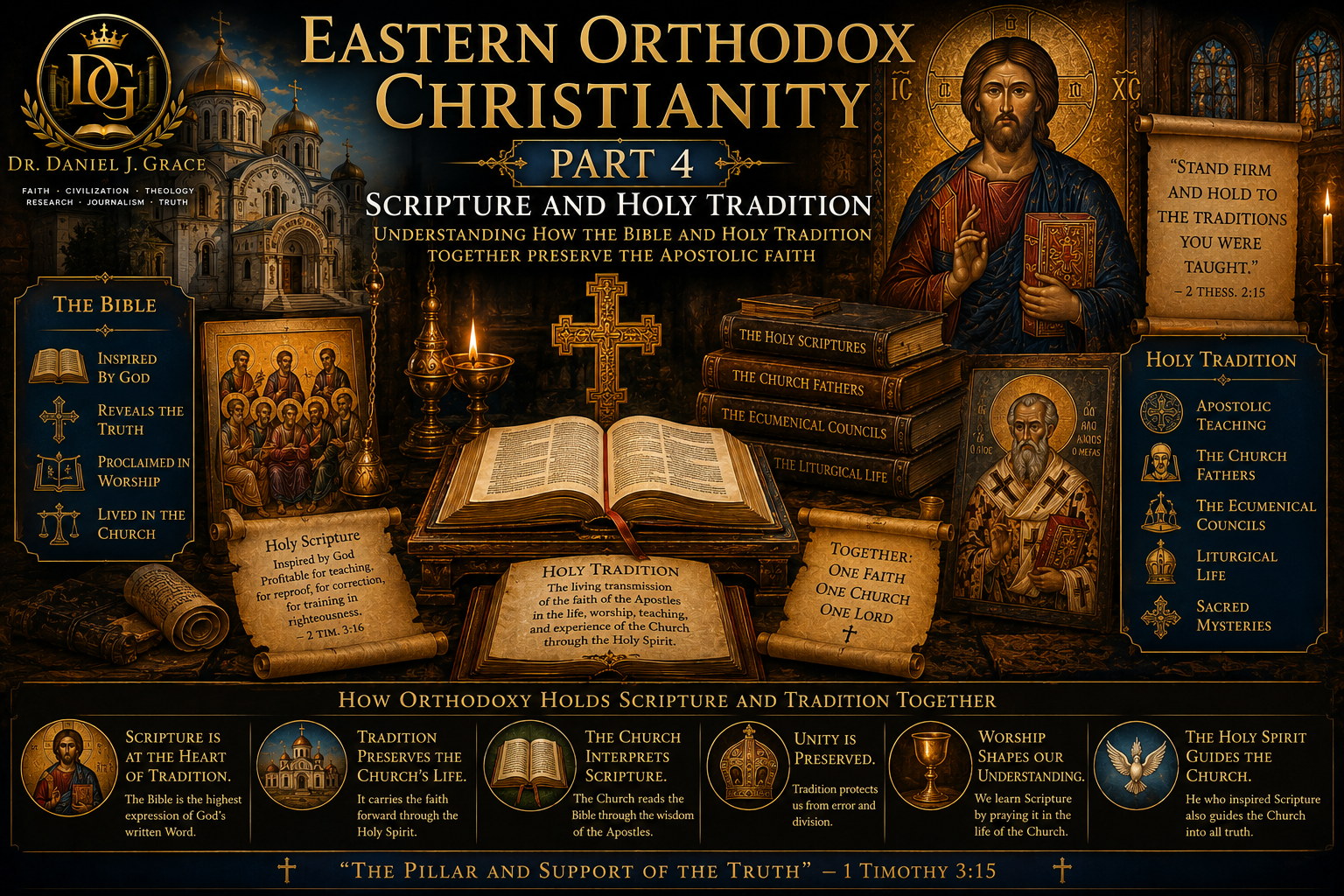
Scripture and Holy Tradition
How Orthodoxy Understands the Bible, the Church, and the Living Faith
Introduction
One of the most important questions in Christianity concerns authority.
How do Christians know what is true?
How is the faith preserved from one generation to the next?
What role does the Bible play in Christian life?
How should believers understand the teachings handed down throughout Church history?
Eastern Orthodox Christianity answers these questions through its understanding of Scripture and Holy Tradition.
For Orthodox Christians, Scripture and Tradition are not competitors.
They are not opposing authorities.
They are not separate sources of revelation.
Rather, they are interconnected expressions of the one faith delivered by Christ to the Apostles and preserved in the Church’s life.
Orthodoxy sees the Bible as the inspired Word of God, affirming it emerged from the Church’s life and must be interpreted within its living tradition.
This chapter explores the Orthodox understanding of Scripture and Holy Tradition and why this relationship remains central to Orthodox theology.
What Is Holy Scripture?
Orthodox Christians affirm that the Bible is inspired by God.
The Scriptures reveal:
God’s character
God’s plan of salvation
The life of Christ
The work of the Holy Spirit
The hope of eternal life
The Bible occupies a central place in Orthodox worship and spirituality.
Scripture is read:
During the Divine Liturgy
In daily prayers
During feast days
In personal devotion
Orthodox Christians deeply revere Scripture as God’s written revelation.
The Church does not stand above Scripture.
The Church serves Scripture and proclaims its message.
The Bible in Orthodox Worship
Visitors to Orthodox churches are often surprised by how much Scripture appears in worship.
The Divine Liturgy contains:
Psalms
Gospel readings
Epistle readings
Biblical prayers
Scriptural references
Many Orthodox prayers are drawn directly from biblical texts.
Orthodox worship immerses believers in Scripture.
The Bible is not merely studied.
It is prayed, sung, proclaimed, and lived.
This reflects the Orthodox conviction that Scripture belongs at the heart of Christian life.
How the Bible Came Into Being
One important Orthodox belief is that the Bible emerged from the life of the Church.
The apostles preached the gospel before the New Testament existed.
Christian communities worshipped before the New Testament canon was finalised.
The church received:
Apostolic preaching
Apostolic teaching
Apostolic writings
Over time, the Church recognised the books that God inspired.
These books became the New Testament.
Orthodoxy, therefore, emphasises that Scripture and the Church developed together.
The Church did not create Scripture.
Rather, it recognised the books that were inspired by the Holy Spirit.
What Is Holy Tradition?
Holy Tradition is one of the most misunderstood concepts in Orthodoxy.
Some assume that ‘tradition’ simply means old customs.
Orthodox Christianity understands tradition much more deeply.
‘Holy tradition’ refers to the living transmission of the Christian faith.
It includes:
Scripture
The Ecumenical Councils
The Creeds
The Church Fathers
Liturgical worship
Sacramental life
Spiritual teaching
Tradition is not merely information passed down.
It is the life of the Holy Spirit within the Church.
Orthodox Christians often describe tradition as the living memory of the Church.
Scripture Within Tradition
Orthodox Christians do not place Scripture outside Tradition.
Instead, Scripture stands at the heart of Tradition.
The Bible is the highest written expression of Holy Tradition.
The same Holy Spirit who inspired the Scriptures continues guiding the Church.
For Orthodoxy:
Scripture is part of tradition.
Tradition protects Scripture.
Tradition helps interpret Scripture.
This relationship prevents both neglect of the Bible and private interpretations disconnected from historic Christianity.
Apostolic Tradition
The Apostle Paul wrote:
“Stand firm and hold to the traditions you were taught.”
Orthodox Christians understand Apostolic Tradition as the faith delivered by Christ to the Apostles.
This faith was transmitted through:
Teaching
Worship
Church life
Scripture
The Apostles handed down more than written texts.
They handed down a complete Christian way of life.
Orthodoxy seeks to preserve that inheritance.
The Role of the Church Fathers
The Fathers play a crucial role in preserving tradition.
Their writings help Christians understand:
Scripture
Theology
Worship
Spiritual growth
Orthodox Christians study the Fathers because they reveal how the early Church understood the faith.
The Fathers serve as guides rather than replacements for Scripture.
They help believers remain connected to Apostolic Christianity.
The Importance of the Ecumenical Councils
The seven Ecumenical Councils occupy a central place within Orthodox Tradition.
These councils addressed major theological controversies.
They defended:
The Trinity
The Divinity of Christ
The Humanity of Christ
Orthodox doctrine
Orthodox Christians view these councils as expressions of the Church guided by the Holy Spirit.
Their decisions remain authoritative because they preserve apostolic faith.
The Nicene Creed
One of the most important products of tradition is the Nicene Creed.
The Creed summarises the Christian belief concerning:
God the Father
Jesus Christ
The Holy Spirit
The Church
Baptism
Resurrection
Orthodox Christians recite the Creed regularly during worship.
The Creed serves as a concise statement of apostolic faith.
It unites believers across generations.
Scripture and Interpretation
A major concern for Orthodoxy involves interpretation.
The Bible can be misunderstood when isolated from the life of the Church.
Orthodox Christians believe Scripture should be interpreted:
Christologically
Ecclesially
Historically
Spiritually
The Church provides the context in which Scripture is rightly understood.
This approach seeks to avoid individual interpretations that contradict Apostolic teaching.
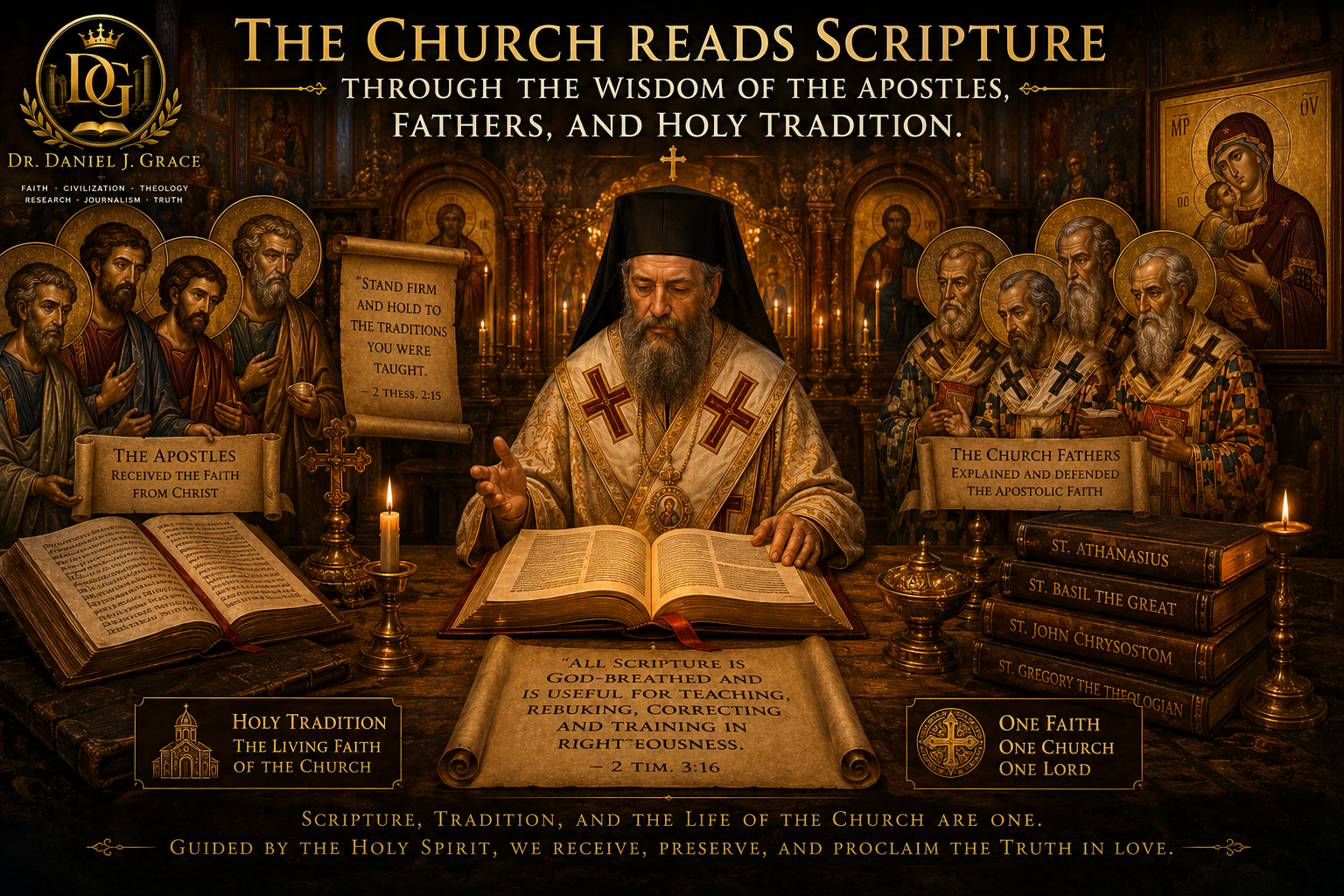
The Church as the Interpreter of Scripture
Orthodoxy teaches that Scripture belongs to the Church.
This does not mean Church leaders can invent new meanings.
Rather, the Church safeguards the faith received from the apostles.
The Church interprets Scripture through:
Worship
Councils
Fathers
Tradition
This collective wisdom protects Christian doctrine from distortion.
The Bible as a Spiritual Book
Orthodox Christianity emphasises that Scripture is not merely an academic text.
The Bible is a spiritual book intended to transform lives.
Reading Scripture requires:
Prayer
Humility
Faith
Repentance
The Fathers often warned against reading Scripture merely to gain knowledge.
True understanding comes through spiritual growth.
Orthodox Christians seek not only to understand Scripture but also to live it.
Tradition Is Not Dead
A common misunderstanding is that tradition belongs only to the past.
Orthodoxy rejects this idea.
Holy Tradition remains alive.
The Holy Spirit continues guiding the Church.
Tradition is not frozen history.
It is living continuity.
The same faith proclaimed by the apostles continues to be proclaimed today.
The Relationship Between Scripture and Worship
Orthodox worship and Scripture are deeply connected.
The liturgy:
Interprets Scripture
Proclaims Scripture
Applies Scripture
Many Orthodox Christians encounter Scripture primarily through worship.
This practice reflects the ancient Christian understanding that theology and worship belong together.
The Church learns Scripture by praying with it.
Scripture, Tradition, and Unity
One of the purposes of tradition is preserving unity.
Throughout history, Christians have faced disagreements and controversies.
Tradition provides continuity across generations.
It connects believers with:
The Apostles
The Martyrs
The Fathers
The Councils
Orthodoxy views this continuity as a gift from God.
It helps preserve the faith from distortion.
Why This Matters Today
Modern Christians often face competing interpretations of Christianity.
Many voices claim authority.
Many ideas compete for attention.
Orthodoxy responds by pointing believers back to:
Scripture
The Apostles
The Fathers
The Historic Church
This approach offers stability in a rapidly changing world.
It reminds Christians that faith is not invented by each generation.
It is received, preserved, and lived.
Conclusion
The Orthodox understanding of Scripture and Holy Tradition reflects a vision of Christianity rooted in continuity.
The Bible remains the inspired Word of God.
Holy Tradition preserves the life of the Church and helps us rightly understand Scripture.
Together they form a unified witness to Christ.
Orthodox Christians do not choose between Scripture and Tradition.
They embrace both as gifts entrusted to the Church by the Holy Spirit.
Through Scripture believers hear God’s Word.
Through tradition they remain connected to the Apostolic faith.
Together they guide Christians toward truth, holiness, and communion with God.
In the next chapter, we will explore one of the most significant events in Christian history:
The Seven Ecumenical Councils and their role in defining Orthodox doctrine and preserving Christian unity.
Dr Daniel J. Grace
Faith • Civilization • Theology
Research • Journalism • Truth
© 2026 Dr Daniel J. Grace. All Rights Reserved.
No part of this article may be reproduced, distributed, transmitted, or published in any form or by any means without prior written permission from the author, except for brief quotations used in academic citation, review, or research purposes.
Leave a Reply