“How the Great Church Fathers Preserved Apostolic Faith and Shaped Christian Theology”
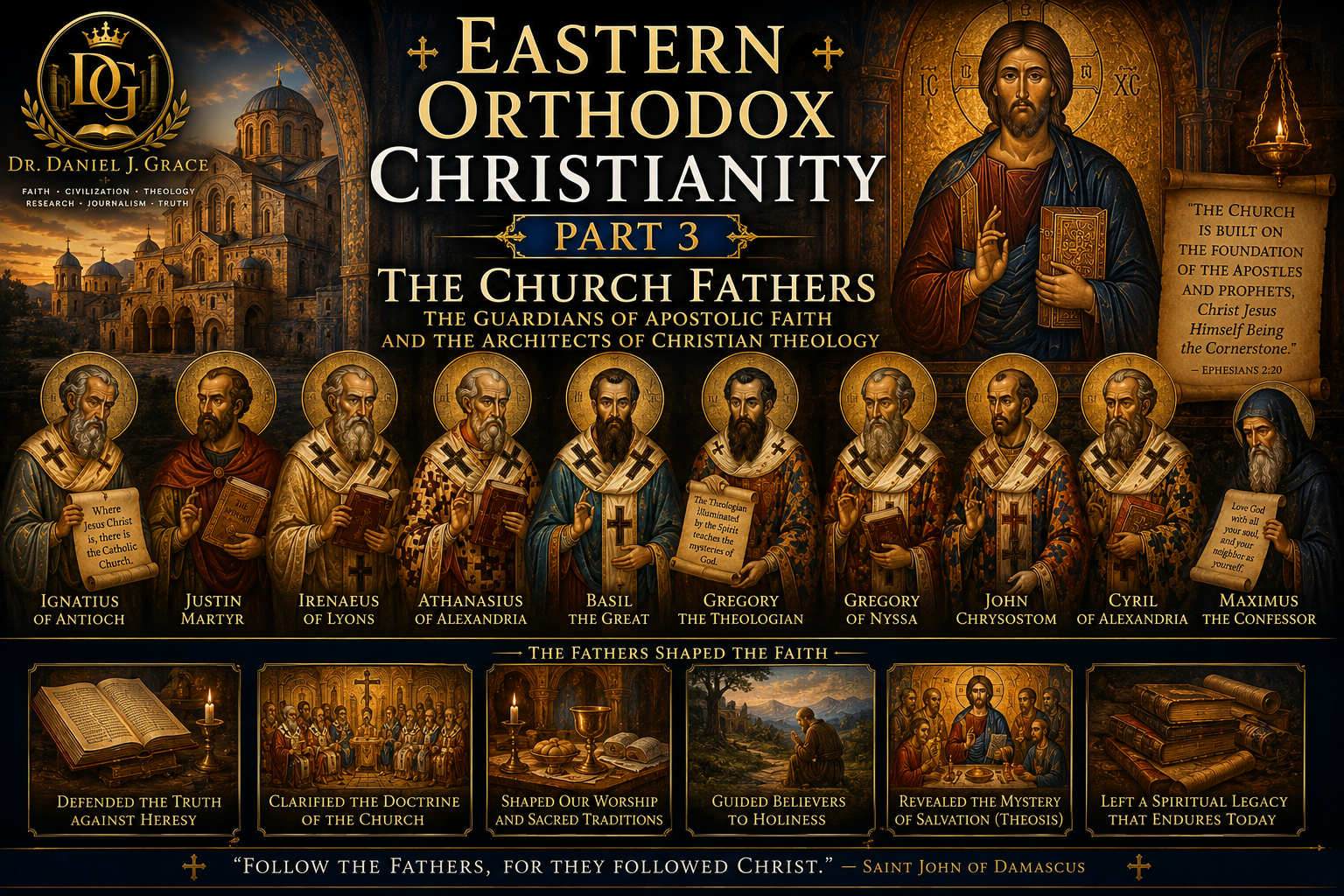
The Church Fathers
The Guardians of Apostolic Faith and the Architects of Christian Theology
Introduction
No study of Eastern Orthodox Christianity can be complete without understanding the Church Fathers.
The Fathers occupy a central place in Orthodox theology, spirituality, worship, and biblical interpretation. Their writings continue to shape how Orthodox Christians understand Scripture, the Trinity, the person of Jesus Christ, salvation, prayer, and the life of the Church.
For Orthodoxy, the Church Fathers are not simply historical figures. They are living witnesses whose teachings help preserve the faith handed down by the apostles.
Throughout the centuries, these remarkable men defended Christianity against heresy, explained difficult theological questions, guided the Church through times of crisis, and left a spiritual legacy that continues to motivate believers today.
The Church Fathers helped build the theological foundations upon which Orthodox Christianity stands.
This chapter explores who the Fathers were, why they matter, and how their teachings continue to influence the Church.
Who Were the Church Fathers?
The term “Church Fathers” refers to influential Christian leaders, theologians, bishops, monks, and teachers who helped shape the life and doctrine of the early Church.
Although they lived in different centuries and regions, they shared several characteristics:
Deep commitment to Scripture
Faithfulness to Apostolic teaching
Holiness of life
Service to the Church
Defense of orthodox doctrine
The Fathers were not considered infallible.
Orthodoxy does not believe every Father was correct about every issue.
However, when the Fathers speak together with remarkable agreement, their consensus is regarded as a trustworthy guide to Christian truth.
This principle remains important in Orthodox theology today.
Why the Fathers Matter
Orthodox Christianity places profound emphasis on continuity.
The Church seeks to preserve the faith received from Christ and the apostles.
The Fathers serve as important links in this chain of transmission.
They help answer questions such as:
How did the early Christians understand Scripture?
What did they believe about Christ?
How did they worship?
How did they pray?
How did they understand salvation?
By studying the Fathers, Christians gain insight into the faith of the early Church.
Orthodoxy therefore views the Fathers as teachers who help preserve Christian unity across generations.
The Apostolic Fathers
The earliest Fathers are often called the Apostolic Fathers because they lived close to the Apostles themselves.
Among the most important are:
Clement of Rome
Traditionally associated with Rome near the end of the first century.
Ignatius of Antioch
A bishop and martyr who wrote influential letters while travelling to his execution.
Polycarp of Smyrna
He was a disciple of the Apostle John who became one of Christianity’s most respected martyrs.
These men provide valuable insights into the beliefs and practices of the earliest Christians.
Their writings reveal a church already committed to:
Apostolic authority
Eucharistic worship
Church unity
Faithfulness to Christ
Ignatius of Antioch
Among the Apostolic Fathers, Ignatius occupies a particularly important place.
While they took him to Rome for execution around AD 107, he wrote letters to various churches.
His writings emphasise:
Unity
Obedience to bishops
The reality of Christ’s incarnation
The Eucharist
Ignatius referred to the Church as “Catholic”, meaning universal.
He also strongly defended the humanity and divinity of Christ.
Orthodox Christians continue to read his writings as powerful testimony to early Christian belief.
The Apologists
During the second century, Christianity faced criticism from pagan philosophers and Roman authorities.
A group of Christian thinkers known as the Apologists defended the faith.
Among them were:
Justin Martyr
Athenagoras
Theophilus of Antioch
These writers explained Christianity to the wider world.
They demonstrated that Christian belief was both rational and morally serious.
Their efforts helped Christianity gain credibility within the Roman Empire.
Irenaeus of Lyons
One of the most important Fathers was Irenaeus.
Living in the second century, he became famous for opposing Gnosticism.
Gnostics claimed to possess secret knowledge unavailable to ordinary believers.
Irenaeus responded by emphasising:
Apostolic teaching
Scripture
Church unity
His most famous work, Against Heresies, remains influential today.
He argued that the Apostles and the churches they founded traced authentic Christianity.
This idea contributed significantly to the Orthodox understanding of Apostolic continuity.
Athanasius and the Defense of Christ’s Divinity
The fourth century witnessed one of the greatest theological controversies in Christian history.
A priest named Arius argued that Jesus Christ was a created being rather than fully divine.
This teaching threatened the very foundations of Christianity.
The Church responded at the Council of Nicaea in AD 325.
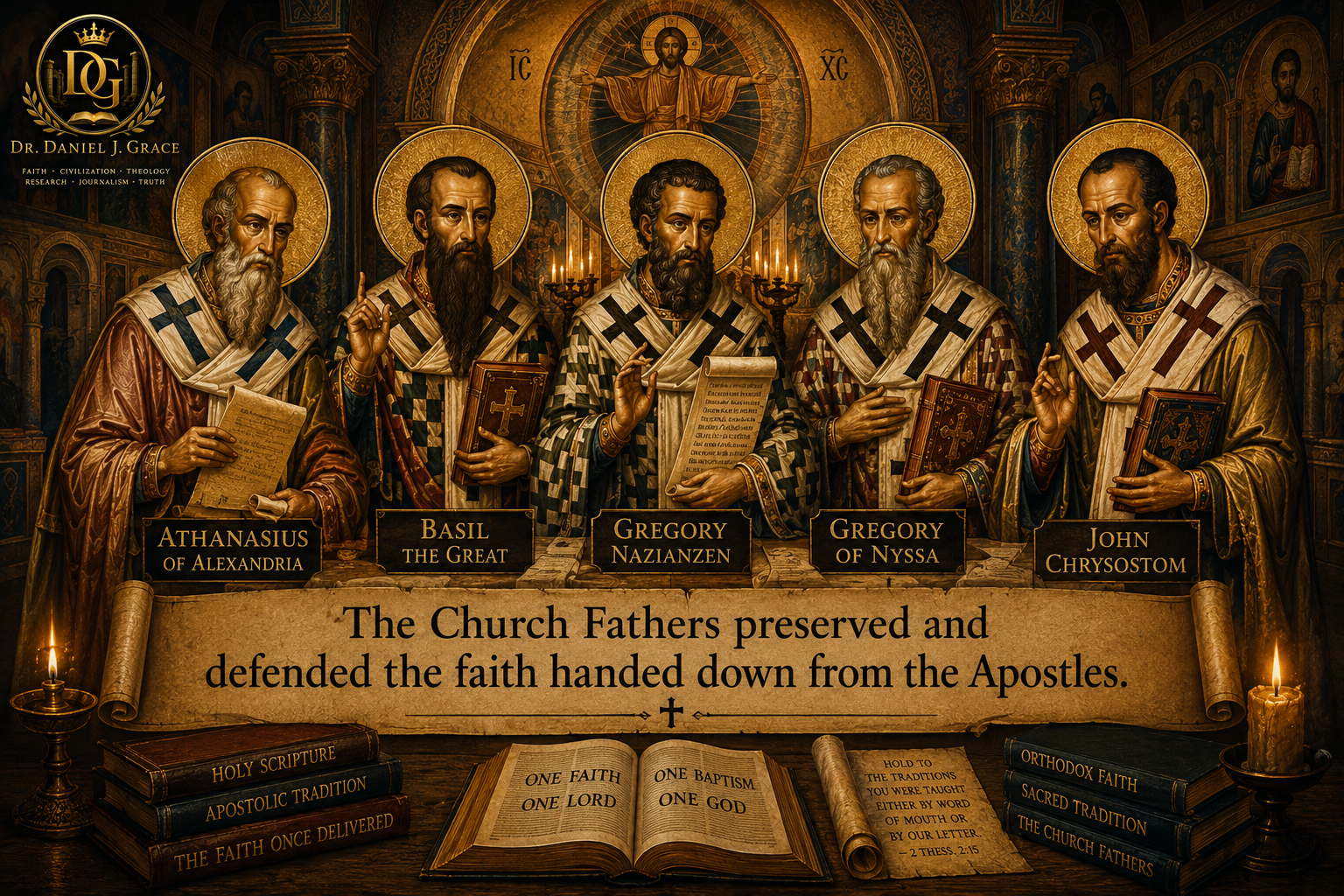
One of the strongest defenders of orthodoxy was Athanasius of Alexandria.
Athanasius insisted:
Christ is fully God.
Without Christ’s full divinity, salvation would be impossible.
His courage earned him the title:
“Athanasius Against the World.”
Orthodox Christians regard him as one of the greatest fathers in church history.
The Cappadocian Fathers
Three extraordinary theologians transformed Christian thought during the fourth century.
They are known collectively as the Cappadocian Fathers:
Basil the Great
Gregory Nazianzen
Gregory of Nyssa
These men clarified Christian teaching concerning:
The Trinity
The Holy Spirit
Human nature
Salvation
Their contributions helped establish the theological language still used by Orthodox Christians today.
The Cappadocians demonstrated how deep spiritual life and intellectual excellence can work together.
Basil the Great
Basil was a bishop, theologian, and organiser.
His contributions include:
Defense of the Trinity
Monastic reform
Care for the poor
He established hospitals and charitable institutions.
Basil believed theology should lead to practical service.
His liturgy remains widely used within Orthodox worship.
Gregory Nazianzen
Gregory became known as:
“The Theologian.”
Few Christian writers have expressed the mystery of the Trinity more beautifully.
His sermons defended the divinity of Christ and the Holy Spirit.
Orthodox Christians continue to honour him as one of the greatest theological minds in Christian history.
Gregory of Nyssa
Gregory offered profound reflections on:
Spiritual growth
Human freedom
The image of God
He emphasised the infinite nature of God.
Because God is infinite, believers never cease growing closer to Him.
This vision strongly influenced Orthodox spirituality.
John Chrysostom
John Chrysostom became one of Christianity’s greatest preachers.
His name means:
“Golden-mouthed”.
His sermons explained Scripture with remarkable clarity.
He challenged the
Corruption
Greed
Injustice
At the same time, he encouraged holiness and compassion.
His Divine Liturgy remains the most frequently celebrated liturgy in Orthodox churches worldwide.
Cyril of Alexandria
Cyril played a crucial role in defending orthodox teaching concerning Christ.
He opposed teachings that separated Christ’s humanity and divinity.
The Council of Ephesus in AD 431 supported his position.
Cyril emphasised:
Jesus Christ is one person.
Fully God.
Fully human.
This teaching remains central to Orthodox Christology.
Maximus the Confessor
Among later Fathers, Maximus occupies a special place.
Living during the seventh century, he defended orthodox doctrine despite severe persecution.
His writings explored:
Human freedom
Divine grace
Theosis
Maximus taught that salvation involves the transformation of the entire person.
His theology profoundly shaped later Orthodox spirituality.
The Fathers and Scripture
The Fathers loved Scripture.
Their writings overflow with biblical references.
Yet they approached Scripture differently from many modern readers.
They believed:
Scripture reveals Christ.
Scripture must be read within the Church.
Spiritual interpretation complements literal interpretation.
For the Fathers, the Bible was not merely a text.
It was a living encounter with God.
Orthodox biblical interpretation continues to reflect this perspective.
The Fathers and Worship
The Fathers viewed worship as essential to theology.
Many of their theological insights emerged directly from liturgical life.
Prayer shaped doctrine.
Doctrine shaped prayer.
This relationship remains central to Orthodoxy.
The famous Orthodox principle states:
“The rule of prayer is the rule of faith.”
Worship and belief belong together.
The Fathers and Holiness
The Fathers consistently taught that theology requires holiness.
Knowledge alone is insufficient.
A person may understand doctrine intellectually yet remain spiritually immature.
The Fathers emphasised:
Prayer
Repentance
Humility
Charity
True theology transforms the heart.
Orthodox spirituality continues to stress this connection.
The Fathers and Theosis
Many fathers contributed to the Orthodox doctrine of theosis.
A famous statement from Athanasius declares:
“God became man so that man might become god.”
This statement does not mean humans become divine by nature.
Rather, believers participate in God’s life through grace.
Theosis remains one of the most distinctive aspects of Orthodox theology.
The Fathers developed this teaching over centuries.
The Continuing Influence of the Fathers
The influence of the Fathers extends throughout Orthodox life.
Their writings appear in:
Sermons
Liturgies
Monastic literature
Theological education
Orthodox Christians continue reading the Fathers because they remain relevant.
Their insights address modern questions concerning:
Faith
Truth
Identity
Spiritual growth
The Fathers help connect contemporary believers with the wisdom of the ancient Church.
Why the Fathers Matter Today
Modern Christians often seek guidance amid confusion and division.
The Fathers offer stability.
They remind believers that Christianity possesses deep historical roots.
Their teachings demonstrate how faith can engage culture without compromising truth.
Their lives show that holiness and scholarship can coexist.
In an age of uncertainty, the Fathers remain trustworthy guides.
Conclusion
The Church Fathers stand among the most important figures in Christian history.
They defended orthodoxy, explained Scripture, clarified doctrine, strengthened worship, and guided believers toward holiness.
Eastern Orthodox Christianity treasures their legacy because it sees them as faithful witnesses to Apostolic truth.
Their influence continues to shape Orthodox theology, spirituality, and worship today.
Through their writings, believers encounter the wisdom of generations who sought to know Christ and faithfully proclaim His Gospel.
In the next chapter, we will explore another essential element of Orthodox Christianity:
Scripture and Holy Tradition—how Orthodoxy understands the relationship between the Bible, the Church, and the living transmission of the Christian faith.
Dr Daniel J. Grace
Faith • Civilization • Theology
Research • Journalism • Truth
🌐 danieljamesgrace.com
© 2026 Dr Daniel J. Grace. All Rights Reserved.
No part of this article may be reproduced, distributed, transmitted, or published in any form or by any means without prior written permission from the author, except for brief quotations used in academic citation, review, or research purposes.
Leave a Reply