Exploring the Ancient Faith: History, Theology, Worship, and Spirituality in Eastern Orthodox Christianity.
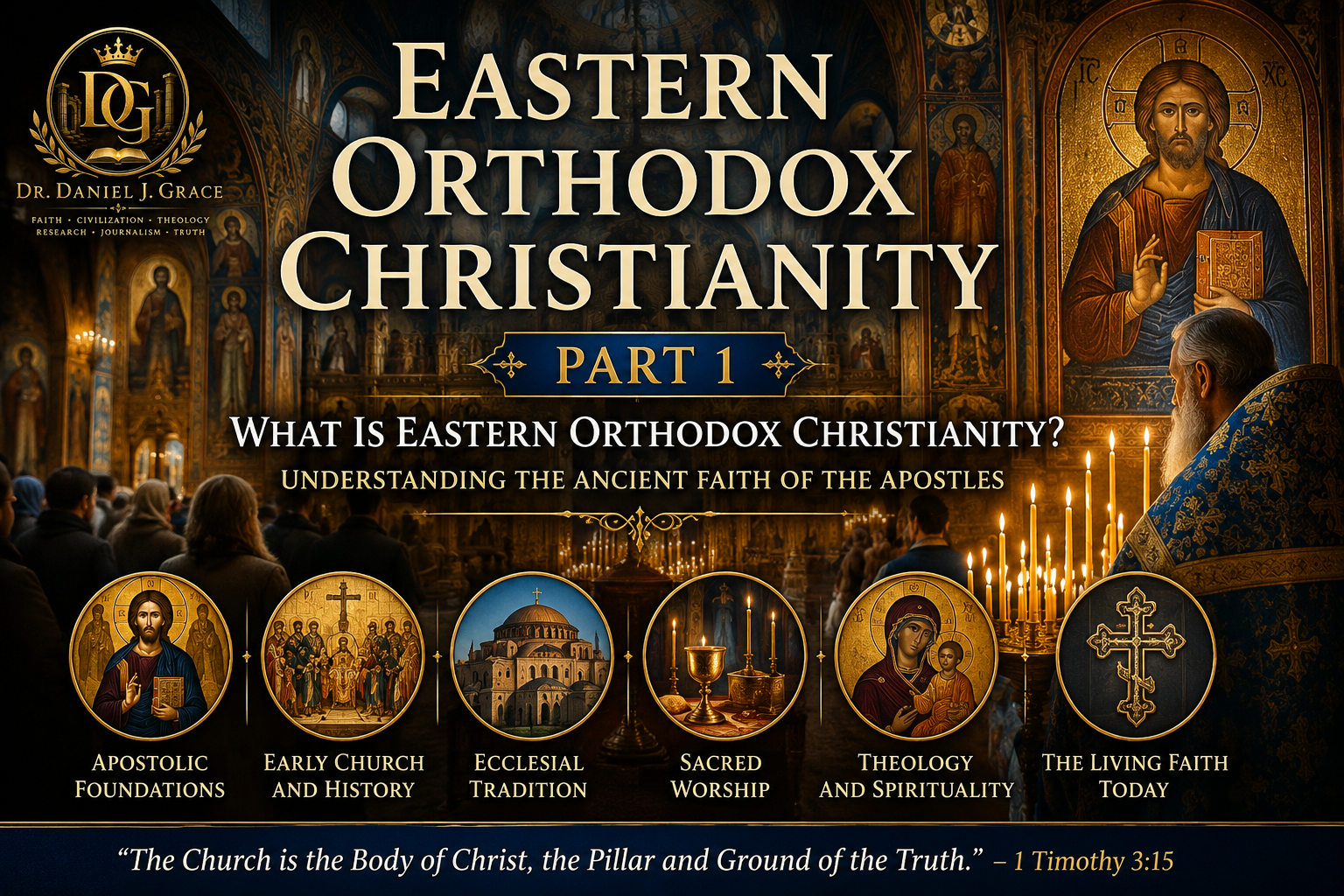
What Is Eastern Orthodox Christianity?
Understanding the Ancient Faith of the Apostles
Introduction
Eastern Orthodox Christianity is one of the oldest Christian traditions in the world. With roots stretching back to the Apostles and the earliest centuries of the Church, Orthodoxy sees itself not as a new denomination but as the continuation of the historic Christian faith preserved through the centuries.
Today, Eastern Orthodoxy includes hundreds of millions of believers worldwide and is represented by numerous churches, including the Greek Orthodox, Russian Orthodox, Serbian Orthodox, Romanian Orthodox, Bulgarian Orthodox, Georgian Orthodox, Antiochian Orthodox, and others. Despite cultural and linguistic differences, these churches share a common faith, sacramental life, and spiritual heritage.
To many Western Christians, Eastern Orthodoxy can appear mysterious. Its worship is rich with incense, icons, chanting, and ancient liturgy. Its theology often emphasises concepts that are unfamiliar to many Protestants and even some Catholics. Yet beneath these external differences lies a profound commitment to the person of Jesus Christ, the authority of Scripture, the life of prayer, and the transformation of believers through God’s grace.
This series begins by exploring the identity of Eastern Orthodox Christianity and its place within the broader story of Christian history.
The Meaning of the Word “Orthodox”
The word “orthodox” comes from two Greek words:
Orthos – correct or right
Doxa – glory, praise, worship, or belief
Together they may be understood as:
“Right Worship”
or
“Right Belief.”
Orthodox Christians believe that the Church has preserved the faith handed down by Christ to the Apostles and faithfully transmitted through generations.
For Orthodox believers, Christianity is not something invented or reinvented by each generation. It is a sacred inheritance received from those who came before.
The Apostolic Foundations of the Church
Orthodox Christianity traces its origins directly to Jesus Christ and His apostles.
The New Testament describes how Christ established His Church and commissioned His followers to preach the Gospel throughout the world.
Following Christ’s resurrection and ascension, the apostles spread Christianity throughout the Roman Empire and beyond.
Important centers of early Christianity emerged in:
Jerusalem
Antioch
Alexandria
Constantinople
Rome
These centers became known as ‘apostolic sees’ because of their connection to the Apostles.
Orthodox Christians view themselves as continuing the life of this ancient apostolic Church.
Christianity Before Denominations
One important aspect of Orthodox self-understanding is the belief that for the first thousand years of Christian history there was only one universal Church.
During this period Christians shared:
Common doctrine
Common sacraments
Common worship
Common councils
Although disagreements existed, Christians generally remained united.
The Orthodox Church sees itself as preserving the faith of this undivided Church.
This perspective shapes Orthodox theology and spirituality to this day.
The Early Church and Its Growth
Remarkable growth marked the first centuries of Christianity, despite severe persecution.
Christians faced opposition from Roman authorities, yet the faith continued to spread.
Believers gathered in homes, catacombs, and small communities.
Many suffered imprisonment or martyrdom for refusing to renounce Christ.
Despite these hardships, Christianity expanded throughout the Mediterranean world.
The courage of early Christians became one of the defining features of Church history.
Orthodox Christians continue to honour these martyrs as witnesses to the faith.
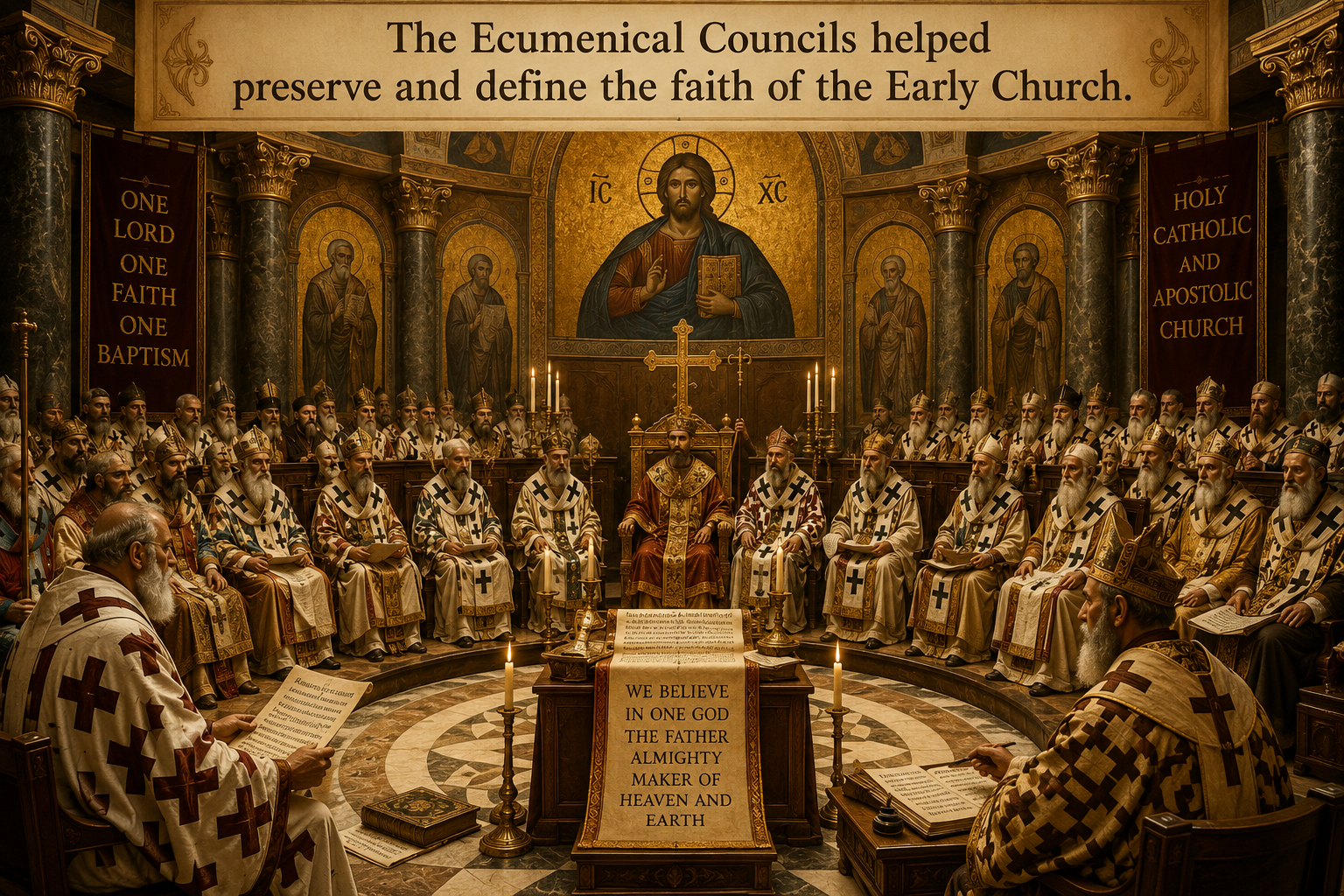
The Age of the Ecumenical Councils
As Christianity grew, theological questions emerged.
The Church responded through councils where bishops gathered to clarify doctrine.
These meetings became known as Ecumenical Councils.
The seven Ecumenical Councils played a central role in defining Christian belief.
Among their achievements were:
Defending the divinity of Christ
Clarifying the doctrine of the Trinity
Defining the relationship between Christ’s humanity and divinity
Protecting the faith against heresies
Orthodox Christians regard these councils as foundational expressions of Christian truth.
Constantinople and the Christian East
One of the most important cities in Orthodox history is Constantinople.
Originally known as Byzantium, the city became the capital of the Eastern Roman Empire under Emperor Constantine.
Constantinople eventually became the following:
A center of Christian learning
A center of worship
A center of theological development
For over one thousand years, Byzantine Christianity profoundly shaped Orthodox culture and spirituality.
Many aspects of Orthodox worship today reflect this heritage.
The Great Schism of 1054
One of the most significant events in Christian history occurred in 1054.
The Church of the East and the Church of the West gradually separated.
This event became known as the Great Schism.
Many factors contributed:
Cultural differences
Political tensions
Language barriers
Theological disputes
Questions of authority
Following the Schism, the Eastern Church became known as the Orthodox Church, while the Western Church developed into what is now known as the Roman Catholic Church.
Orthodox Christians generally view the Schism as a tragic division within Christianity.
The Orthodox View of the Church
Orthodox Christianity emphasises that the Church is more than an institution.
The church is
The Body of Christ
The People of God
The Temple of the Holy Spirit
The Church exists to unite humanity with God.
This understanding influences every aspect of Orthodox theology.
Salvation is not viewed merely as a legal transaction but as participation in the life of God.
Scripture and Tradition
Orthodox Christianity highly values Scripture.
The Bible is regarded as the inspired Word of God.
However, Orthodoxy does not separate Scripture from the life of the Church.
Instead, Scripture exists within a broader framework known as Holy Tradition.
Holy Tradition includes:
Scripture
Worship
Creeds
Ecumenical Councils
Teachings of the Church Fathers
Orthodox Christians believe these elements work together to preserve the faith.
Worship at the Heart of Orthodoxy
Orthodox Christianity is often described as a worship-centred faith.
For Orthodox believers, theology is not merely studied.
It is experienced through worship.
The Divine Liturgy occupies a central place in Orthodox life.
Worship includes:
Chanting
Scripture readings
Prayer
Icons
Incense
Sacraments
Orthodox Christians often describe worship as participation in the worship of heaven itself.
The goal is not entertainment but an encounter with God.
The Beauty of Sacred Worship
Visitors to Orthodox churches often perceive their beauty as striking.
Church buildings frequently contain:
Icons
Frescoes
Candles
Gold ornamentation
These elements are not merely decorative.
They serve theological purposes.
Beauty reflects the glory of God.
Orthodox worship seeks to engage the whole person:
Mind
Body
Heart
Soul
Through sacred beauty believers are reminded of heavenly realities.
The Importance of the Church Fathers
Orthodox Christianity places tremendous importance on the Church Fathers.
These influential Christian teachers helped shape doctrine and spirituality.
Among the most respected Fathers are:
Athanasius
Basil the Great
Gregory Nazianzen
Gregory of Nyssa
John Chrysostom
Maximus the Confessor
Their writings continue to guide Orthodox theology today.
Orthodox Christians view the Fathers not as infallible individuals but as faithful witnesses to apostolic truth.
The Goal of the Christian Life
One of the most distinctive aspects of Orthodox theology concerns the purpose of salvation.
Many Christians ask:
“How can I go to heaven?”
Orthodox Christianity asks an additional question:
“How can I become united with God?”
This process is known as “theosis.”
Theosis will be explored in detail later in this series, but it can be summarised as participation in God’s life through Christ.
Orthodox theology views salvation as transformation rather than merely forgiveness.
The Christian life becomes a journey toward holiness and communion with God.
Orthodox Christianity Around the World
Today Orthodoxy extends far beyond its traditional homelands.
Large Orthodox communities exist in:
Greece
Russia
Romania
Serbia
Georgia
Ukraine
North America
Australia
Western Europe
Orthodox Christianity continues to grow through migration, missionary work, and conversion.
Although cultures differ, Orthodox believers remain united through shared faith and sacramental life.
Common Misunderstandings
Many misconceptions surround Orthodoxy.
Some assume it is merely an ethnic religion.
Others believe it is frozen in the past.
In reality, Orthodoxy is both ancient and living.
It preserves historic traditions while continuing to address contemporary challenges.
Orthodox Christians see themselves as guardians of an ancient faith that remains relevant in the modern world.
Why Orthodoxy Matters Today
The modern world often moves at extraordinary speed.
Technology changes rapidly.
Cultures evolve quickly.
Many people feel disconnected from history and tradition.
Orthodoxy offers a different perspective.
It reminds Christians that faith is not a recent invention.
It is part of a story stretching back to the Apostles.
In a fragmented age, Orthodoxy provides continuity.
In a restless age, it offers stability.
In a distracted age, it calls believers to prayer and contemplation.
Conclusion
Eastern Orthodox Christianity represents one of the oldest and most influential traditions within global Christianity.
Rooted in the Apostolic Church, shaped by the Ecumenical Councils, enriched by the Church Fathers, and sustained through centuries of worship and prayer, Orthodoxy offers a vision of Christianity centred upon communion with God.
Its emphasis on worship, holiness, beauty, and spiritual transformation keeps motivating millions of believers around the world.
As this series unfolds, we will explore the rich history, theology, spirituality, and cultural heritage of Eastern Orthodoxy.
The journey will lead us from the Early Church to the Church Fathers, from icons to theosis, and from Byzantine civilisation to modern Orthodoxy.
Above all, it will reveal a tradition whose central purpose remains unchanged:
To know Christ, to worship Christ, and to be transformed into His likeness.
Dr Daniel J. Grace
Faith • Civilization • Theology
Research • Journalism • Truth
🌐 danieljamesgrace.com
© 2026 Dr Daniel J. Grace. All Rights Reserved.
No part of this article may be reproduced, distributed, transmitted, or published in any form or by any means without prior written permission from the author, except for brief quotations used in academic citation, review, or research purposes.
Leave a Reply