
Reform Without Revolution: How Anglicanism Emerged Between Rome and Geneva
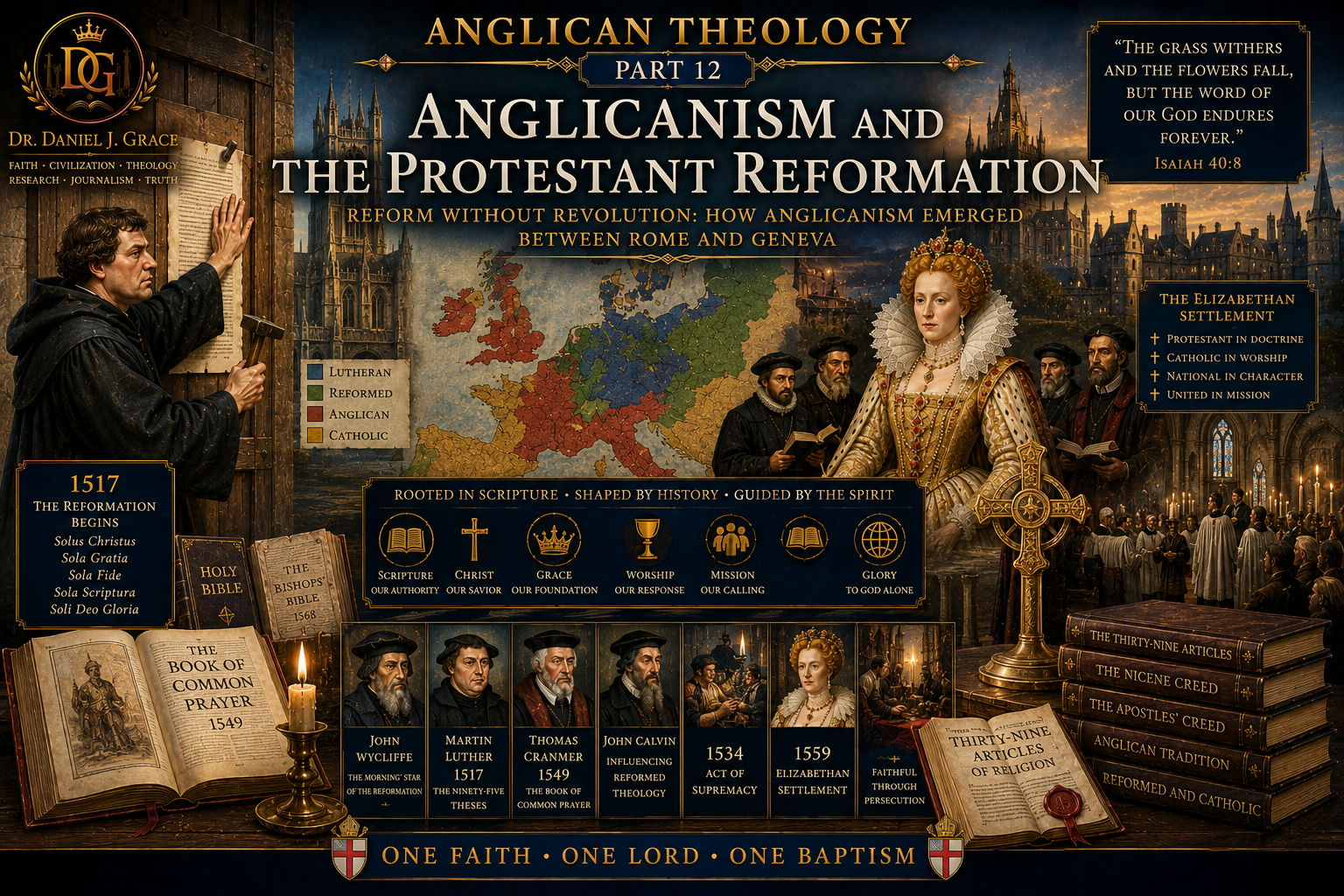
Anglicanism and the Protestant Reformation
Introduction
The Protestant Reformation stands as one of the most significant events in Christian history. Beginning in the sixteenth century, it transformed theology, worship, politics, education, and society throughout Europe and eventually across the world. While Anglicanism emerged during this period, it developed differently from many other Protestant traditions.
Unlike some reform movements that completely rejected earlier church structures, Anglicanism sought reform while preserving continuity with historic Christianity. It retained bishops, liturgy, creeds, and many ancient traditions while embracing key Protestant convictions regarding Scripture, grace, and faith.
This unique position gave birth to a church that has often described itself as both Reformed and Catholic.
Understanding Anglicanism requires understanding the Reformation itself.
This chapter explores the causes of the Protestant Reformation, England’s distinctive path, major reformers who influenced Anglican theology, and how Anglicanism developed its unique identity within the broader Reformation movement.
The Late Medieval Church
Before the Reformation, Rome united Western Christianity under its authority.
The mediaeval church provided the following:
Worship
Education
Social services
Spiritual guidance
However, by the fifteenth century, many Christians expressed concerns regarding the following:
Clerical corruption
Financial abuses
Poor education among clergy
Excessive church bureaucracy
Calls for reform emerged long before Martin Luther.
Many faithful Christians desired renewal rather than division.
Early Voices of Reform
Several important figures anticipated later Reformation developments.
John Wycliffe (England)
Wycliffe emphasised:
Biblical authority
Scripture in the common language
Church reform
He became known as the “Morning Star of the Reformation”.
Jan Hus (Bohemia)
Influenced by Wycliffe, Hus called for moral and theological reform.
He was eventually executed for heresy in 1415.
Both men influenced later reformers.
Martin Luther and the Beginning of the Reformation
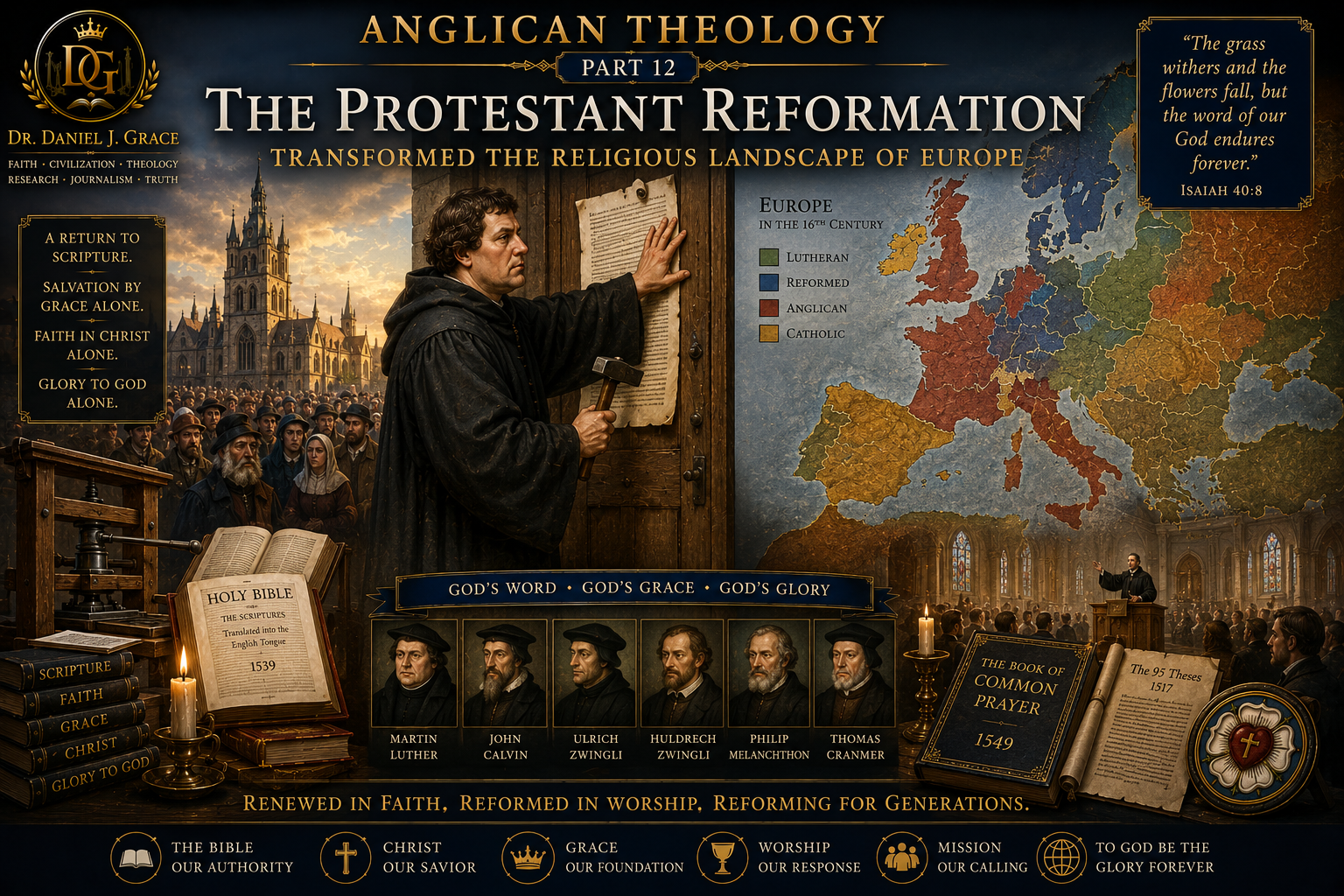
The Reformation officially began in 1517.
Martin Luther challenged the sale of indulgences and other church practices.
His concerns quickly expanded into broader theological issues.
Luther emphasised:
Salvation by grace
Justification through faith
Biblical authority
His writings spread rapidly through Europe.
The movement soon became impossible to contain.
Core Principles of the Reformation
Several principles became central to Protestant theology.
Sola Scriptura
Scripture as the supreme authority.
Sola Fide
Justification by faith alone.
Sola Gratia
Salvation by grace alone.
Solus Christus
Christ alone as mediator.
Soli Deo Gloria
Glory belongs to God alone.
These principles influenced Anglican theology, though often interpreted within its own distinctive framework.
The Reformation Reaches England
The English Reformation followed a different path than developments in Germany or Switzerland.
Political factors played a significant role.
King Henry VIII sought an annulment of his marriage to Catherine of Aragon.
When Rome refused, conflict intensified.
In 1534 the Act of Supremacy declared the English monarch the supreme head of the Church of England.
This event marked a decisive turning point.
Henry VIII and Religious Change
Henry VIII did not initially intend to create a Protestant church.
He remained conservative in many theological matters.
However, separation from Rome allowed for broader reforms.
During his reign:
Papal authority ended in England.
Monasteries were dissolved.
The English Bible became more accessible.
These developments prepared the way for future reformers.
Thomas Cranmer
No figure shaped Anglicanism more profoundly than Thomas Cranmer.
As Archbishop of Canterbury, Cranmer guided the theological development of the English Church.
His contributions include:
The Book of Common Prayer
Liturgical reform
Biblical worship
Protestant theology
Cranmer sought a church that was both scriptural and catholic.
His influence remains visible throughout Anglican worship today.
The Book of Common Prayer
The publication of the Book of Common Prayer transformed English Christianity.
For the first time:
Worship occurred in English.
Ordinary people could participate fully.
Scripture occupied a central role.
The Prayer Book reflected both ancient traditions and Reformation principles.
It remains one of Anglicanism’s greatest treasures.
Edward VI and Protestant Reform
Following Henry VIII’s death, his son Edward VI became king.
Under Edward’s reign, Protestant reforms accelerated.
Changes included:
Revised Prayer Books
Greater emphasis on Scripture
Reformed theology
Simplified worship
England moved significantly closer to continental Protestantism during this period.
Mary I and Catholic Restoration
When Mary I became queen, she sought to restore Roman Catholicism.
Many Protestant leaders were imprisoned or executed.
Among those martyred were:
Thomas Cranmer
Hugh Latimer
Nicholas Ridley
Their deaths profoundly influenced Anglican identity.
The memory of these martyrs strengthened Protestant convictions within England.
Elizabeth I and the Elizabethan Settlement
Queen Elizabeth I inherited a deeply divided nation.
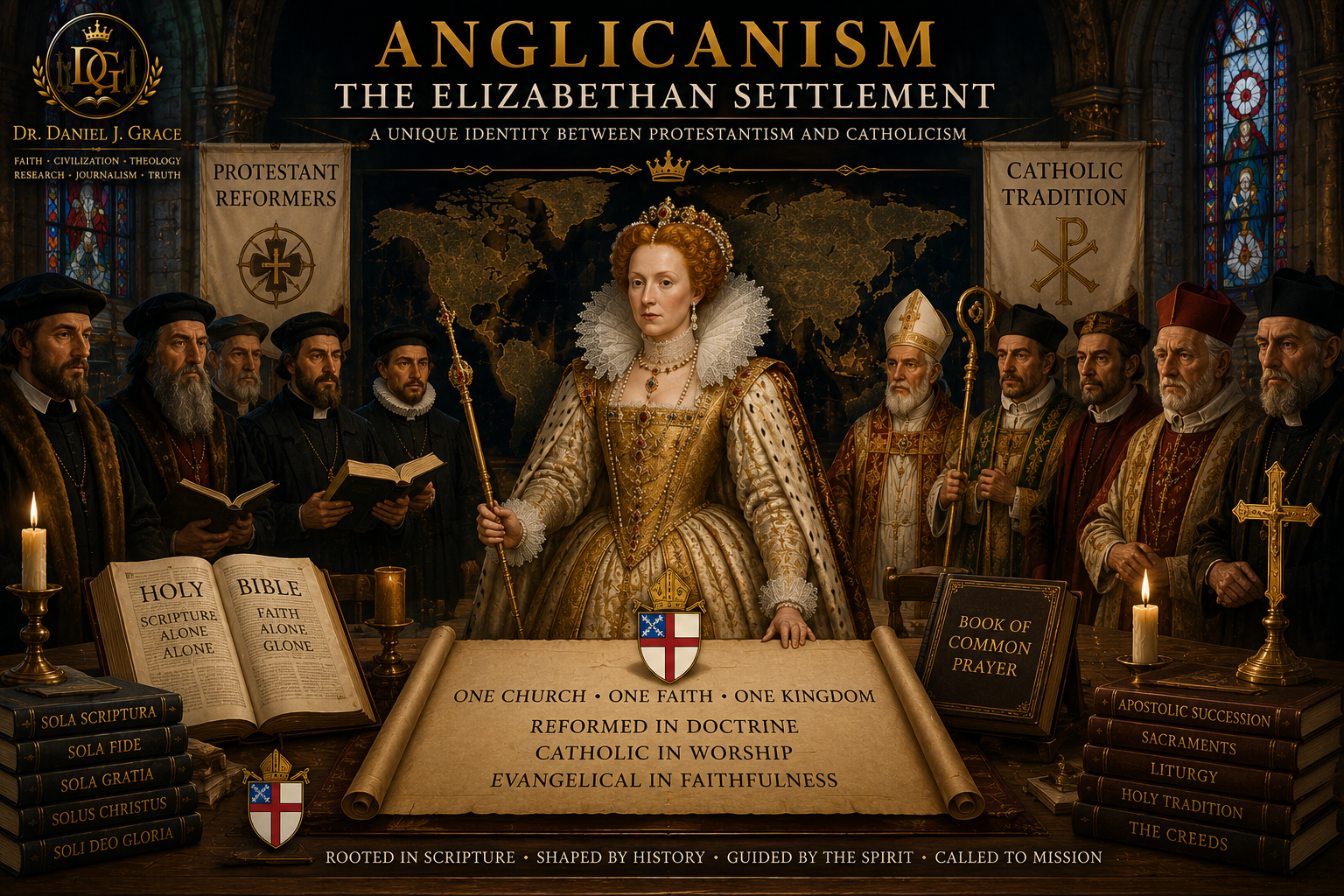
Her solution became known as the Elizabethan Settlement.
This approach sought stability and unity.
The Church of England would be the following:
Protestant in doctrine
Catholic in structure
National in character
This settlement laid the foundations for modern Anglicanism.
The Via Media
One of Anglicanism’s defining concepts is the Via Media (”Middle Way”).
This does not mean compromise for its own sake.
Rather, it reflects a desire to balance:
Reform and continuity
Scripture and tradition
Faith and reason
Personal devotion and corporate worship
The Via Media became a defining characteristic of Anglican theology.
The Thirty-Nine Articles
The Thirty-Nine Articles emerged during the Reformation period.
They clarified Anglican doctrine on issues including the following:
Scripture
Salvation
Sacraments
Church authority
The articles reflect Protestant theology while preserving historic Christian beliefs.
They remain important theological documents within Anglicanism.
Anglicanism and Continental Reformers
Anglicanism interacted with major Protestant thinkers.
Martin Luther
Influenced Anglican views on justification.
John Calvin
Influenced Anglican theology regarding Scripture and grace.
Philip Melanchthon
Contributed to theological dialogue.
However, Anglicanism never fully adopted any single reformer’s system.
Its identity remained distinct.
Reformed Yet Catholic
This phrase often summarises Anglican theology.
Anglicans embrace Reformation principles while maintaining continuity with ancient Christianity.
The church retained:
Bishops
Creeds
Liturgical worship
Historic ministry
At the same time it embraced the following:
Biblical authority
Salvation by grace
Reform of doctrine and worship
This combination distinguishes Anglicanism from many other Protestant traditions.
The Reformation’s Lasting Influence
The Reformation continues influencing Anglican life today.
Its impact appears in:
Worship
Theology
Biblical preaching
Church governance
Many Anglican debates still reflect questions first raised during the Reformation.
Understanding these historical roots helps explain contemporary Anglican identity.
Anglicanism and Christian Unity
One significant lesson from the Reformation is the importance of unity.
The divisions of the sixteenth century remain painful realities.
Modern Anglicans participate in ecumenical dialogue with the following:
Roman Catholics
Lutherans
Orthodox Christians
Methodists
The goal is greater understanding and cooperation while remaining faithful to the Gospel.
Lessons for the Modern Church
The Reformation reminds Christians of several important truths:
Scripture Matters
God’s Word must remain central.
Reform Is Necessary
The Church must continually seek faithfulness.
Courage Is Required
Many reformers suffered greatly for their convictions.
Unity Remains Important
Truth and love must work together.
These lessons remain relevant today.
Conclusion
The Protestant Reformation profoundly shaped Anglicanism.
Emerging from a unique English context, Anglicanism sought reform without abandoning its historic roots.
Through figures such as Thomas Cranmer, the English Church embraced biblical authority, worship renewal, and theological reform while preserving continuity with the ancient Church.
This balance between Reformed conviction and Catholic heritage remains a defining feature of Anglican identity.
The legacy of the Reformation continues influencing Anglican theology, worship, mission, and spirituality.
For Anglicans, the Reformation was not merely a historical event.
It was a call to renew the Church according to Scripture while remaining connected to the faith handed down through the centuries.
Dr Daniel J. Grace
Faith • Civilization • Theology
Research • Journalism • Truth
🌐 danieljamesgrace.com
© 2026 Dr Daniel J. Grace. All Rights Reserved.
No part of this article may be reproduced, distributed, transmitted, or published in any form or by any means without prior written permission from the author, except for brief quotations used in academic citation, review, or research purposes.
Leave a Reply